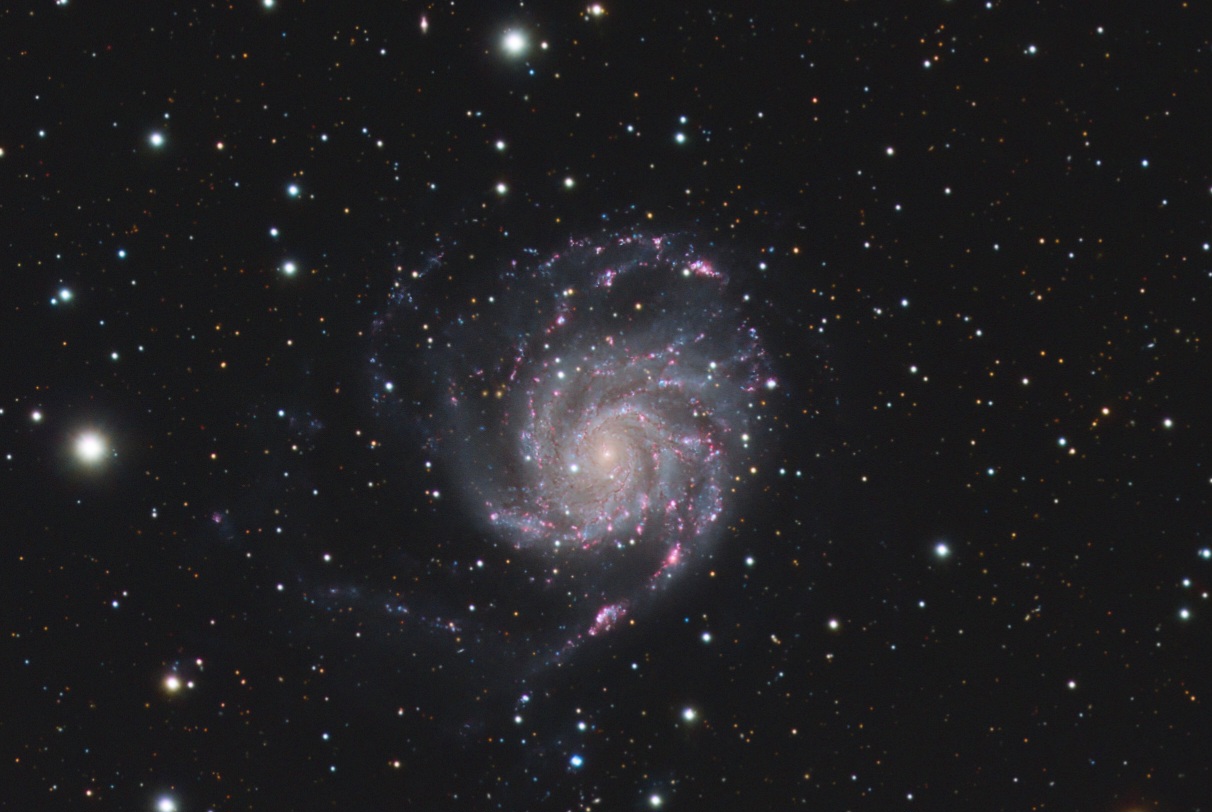
[RCC] M101 Redux

7 replies352 views
Kevin Knight avatar
After taking some feedback from my last attempt I decided to start fresh with a new data set

https://www.astrobin.com/20t4vd/

I think I over did the saturation a bit, but I liked the way it looked and some feedback from my first attempt said it lacked color. 

Anyway hit me with the good the bad and the ugly. 

TIA
Jay Hovnanian avatar
Hello Kevin,

To me, if there is a problem ("the bad") in this image, it would be that you might be expecting a level of resolution that is not going to be there at 350mm ... especially in a galaxy with such a diffuse appearance (even at greater image scales).

Otherwise, color is largely subjective.  Your core is bright, but has a nice "glow" to it.  I'm not sure you could have coaxed much more out of the data?

Congratulations,

Jay
Helpful Insightful Respectful Supportive
Dale Penkala avatar
Hi Kevin,
I would tend to agree with @Jay Hovnanian in that you may be expecting too much for a 350mm focal length image. I do tend to think that the saturation is a bit over done but again reiterating what Jay said thats kind of a personal thing. As far as color goes how did you color calibrate the image? If you can use SPCC in Pi it would be a very accurate color rendition.

Nice work!

Dale
Helpful Respectful
Cfeastside avatar
It seems pretty purplish to me so working on the color balance to reduce that would be what id work on.  I havent seen the original so not sure what your processing was, but using or redoing the star color and maybe followed by color balance adjustments in photoshop?  Colr is always challenging for me on these galaxies.  Using pixinsight has helped with that for me with their new spcc process.  Keep at it! 👍
Brian Puhl avatar
I would generally agree with all the above on target selection vs focal length, but it is galaxy season and there's not much to hit up unless you're staying up all night.    That being said I did exactly what you did with 350mm focal length.... Purely because the wide scope had nothing else to look at for awhile.   You can still get quite a bit of detail, but you will need lots of integration time.

The glaring issues mainly is color.   She's quite purple.  You definitely need to familiarize yourself with SPCC or PCC at a minimum.  Pix has settings built in for the IMX571 sensor.   You'd be surprised how well it looks.    

A little less on the denoise possibly, but you are pushing the limits of your scope.  More integration time with M101 really is necessary since there is alot of detail to capture in the arms. 

I have a Meade 70mm Quad, probably your biggest competitor in the range.   Here's what you could achieve with more integration time.  Just because you have a small scope, don't let it slow you down! 

Helpful Engaging Supportive
Kevin Knight avatar
Thanks all for the input.  I started fresh from the stacked master and incorporated as much as I could with the knowledge I have.  I tried to keep it simple this time. 

Also did the following:

Did crop the image in a wider format to account for my small focal length. 
Did use SPCC after reading up on it and how to use it. 

Did Not mess with the saturation levels at all, only RGB/K in curves
Did Not use StarXT (that's a technique for future me)

I understand my scope is not really suited for Galaxy hunting but from my backyard that is all that is really being offered up in the ASI APP as visable.  When we first got the scope a bit over a month ago, we could see Orion's Nebula for about an hour or so, and it looked wonderful, so I am excited for the season to change  

I am also thinking of selling the Redcat, and purchasing an ASKAR V (I have one on preorder ATM). That will give me up to 600MM FL with the tradeoff of more exposure time needed which I'm fine with living in AZ I have plenty of clear nights. 

I added a new revision that I think looks much better. 


I have a few questions to ask if possible: 

Q. Are the reds in purples in everyones image just a mater of more exposure time? or is there a technique to that as well? 

Q. I have been saving all of my raw files since installing a NAS last week.  I have been saving each target in its own folder with Darks, Bias, and Flats which I shoot at the start of each night.  How should I handle multi night images in PI? do I just combine the 2 masters files, or do I put all the subs and calibration files in the same folder and run as normal? 

Thanks again for all the help.
Dale Penkala avatar
Kevin Knight:
Thanks all for the input.  I started fresh from the stacked master and incorporated as much as I could with the knowledge I have.  I tried to keep it simple this time. 

Also did the following:

Did crop the image in a wider format to account for my small focal length. 
Did use SPCC after reading up on it and how to use it. 

Did Not mess with the saturation levels at all, only RGB/K in curves
Did Not use StarXT (that's a technique for future me)

I understand my scope is not really suited for Galaxy hunting but from my backyard that is all that is really being offered up in the ASI APP as visable.  When we first got the scope a bit over a month ago, we could see Orion's Nebula for about an hour or so, and it looked wonderful, so I am excited for the season to change  

I am also thinking of selling the Redcat, and purchasing an ASKAR V (I have one on preorder ATM). That will give me up to 600MM FL with the tradeoff of more exposure time needed which I'm fine with living in AZ I have plenty of clear nights. 

I added a new revision that I think looks much better. 

I have a few questions to ask if possible: 

Q. Are the reds in purples in everyones image just a mater of more exposure time? or is there a technique to that as well? 

Q. I have been saving all of my raw files since installing a NAS last week.  I have been saving each target in its own folder with Darks, Bias, and Flats which I shoot at the start of each night.  How should I handle multi night images in PI? do I just combine the 2 masters files, or do I put all the subs and calibration files in the same folder and run as normal? 

Thanks again for all the help.

Hello Kevin,
I think this looks much better, maybe a tad bit on the blue channel could be pulled back but certainly much better than your 1st attempt and I like the more fov to btw!

As for handling multiple night subs, in WBPP just load all your light frames in like your normally would. You shouldn’t need to do anything different in the way of darks, bias’s or even your flats unless you remove your camera from the imaging train, or change filters.

Not sure what your referring to in the way of reds, and purple, but if I’m understanding you correctly when you see the magenta/purplish colors in some cases this is done thru adding Ha to an image. Sometimes if the blue channel is on the strong side it can cross over into the red channel and the 2 combined kinda will give you that magenta look to the image.

I have been wanting to get the Redcat71 setup myself. While your setup may not be suited for “portrait” versions of galaxies (an exception might be M31 & M33) a larger grouping would make wonderful targets! Just a few suggestions Kevin, shoot M81/82 M31, Markarians Chain, the Leo Trio M65,66 & NGC 3628 would be a wonderful target with your setup.

Here are some similar images I have although most are in the 480mm range.

M31:  https://www.astrobin.com/pf1t0q/F/?nc=&nce=
M81/82: https://www.astrobin.com/s4fa40/C/?nc=&nce=

I also think that large open clusters would be beautiful as well. The double cluster in Perseus, The Coathanger, M44 the beehive etc…

Hope this helps!
Dale
Helpful Supportive
Brian Puhl avatar
Kevin Knight:
Thanks all for the input.  I started fresh from the stacked master and incorporated as much as I could with the knowledge I have.  I tried to keep it simple this time. 

Also did the following:

Did crop the image in a wider format to account for my small focal length. 
Did use SPCC after reading up on it and how to use it. 

Did Not mess with the saturation levels at all, only RGB/K in curves
Did Not use StarXT (that's a technique for future me)

I understand my scope is not really suited for Galaxy hunting but from my backyard that is all that is really being offered up in the ASI APP as visable.  When we first got the scope a bit over a month ago, we could see Orion's Nebula for about an hour or so, and it looked wonderful, so I am excited for the season to change  

I am also thinking of selling the Redcat, and purchasing an ASKAR V (I have one on preorder ATM). That will give me up to 600MM FL with the tradeoff of more exposure time needed which I'm fine with living in AZ I have plenty of clear nights. 

I added a new revision that I think looks much better. 


I have a few questions to ask if possible: 

Q. Are the reds in purples in everyones image just a mater of more exposure time? or is there a technique to that as well? 

Q. I have been saving all of my raw files since installing a NAS last week.  I have been saving each target in its own folder with Darks, Bias, and Flats which I shoot at the start of each night.  How should I handle multi night images in PI? do I just combine the 2 masters files, or do I put all the subs and calibration files in the same folder and run as normal? 

Thanks again for all the help.


I suppose I maybe should have clarified, since you're asking about the reds.   My image was shot in mono with Ha addition.   I was merely trying to show you the detail you can achieve at that focal length.    A lack of Red, or Ha data is a downside that you will always have with a color camera.  The Bayer matrix only allows you to grab one red pixel out of every 4, 2 pixels of green, and 1 for blue.  This is why (most) color cams are debayered as RGGB.  Mono efficiency will far surpass color any day.   This doesn't mean you can't still get the reds, but it's going to require a substantial amount of integration time and dithering to achieve it.  Also, that RGGB matrix is why (you've probably noticed) your images will appear very green until they are color calibrated.

I have two versions of M101 in my gallery, one with the 70mm and narrowband, the other is taken with a color cam and a longer focal length.  Feel free to check them out and you'll see a major difference.  

As for color manipulation, after you've color calibrated your data and stretched it, try not changing the RGB curves individually.  This messes with the color balance.   Instead try simply boosting the C (color) curve.    From there you can use SCNR mildly to tone down on the green overpowering the image.   This will again balance it out.   By that point you should see an image roughly resembling what most of us produce.   It will always lack red and blue, so this is why integration time is important.  From there you can use subtle curve changes to enhance your red and blue but chances are it will become noisy rather quickly.     

Lastly, apply a super STF stretch, then use histogram with live preview to adjust your black points so the background is neutral after any color curves.  

​​​​​This is pretty much the cliff notes version of how I handle OSC (color) data.   There is much more, like denoise, decon, etc but it's too much to explain right now.
Helpful Insightful Engaging
Related discussions
[RCC] Soul Nebula: Where is my OIII?
Hello everyone. I recently purchased my first dedicated astronomical camera (Playerone Ares-C) and am finally starting to get some data that can be considered as such. After a few short acquisition tests, I finally managed to acquire a substantial da...
First imaging attempt seeking feedback on data quality and processing results.
Nov 3, 2024
Heart Nebula feedback needed
Hi! Requesting constructive critique for this one, the Heart Nebula: https://www.astrobin.com/5l2nju/B/ This is the first real multiple-night project that I coordinated for best SNR during acquisition and my first real attempt at deconvolution with s...
Iterative improvement approach with new dataset after receiving feedback.
Oct 20, 2021
[RCC] The Seagull and Thor's Helmet Mosaic
Reference Image: https://app.astrobin.com/i/3s6l32 Looking for some feedback on this image. It is a 2 panel mosaic with 4 hrs per panel per filter. I started from a Forax palette and then improved the coloration a bit to my liking. Looking for feedba...
Mosaic imaging with multi-filter data; relevant for feedback on color balance.
Apr 2, 2025
[RCC] My First Imaging Attempt with GSO RC 8” Carbon
https://astrob.in/m3c60w/0/ This journey has been both challenging and rewarding, as I worked to perfect the optics and fine-tune the acquisition process, it started with the bane of RC telescopes: the dreaded collimation! The first major upgrade I m...
New equipment first attempt; seeking improvement feedback like your fresh start.
Jan 30, 2025
[RCC] sh2-223 / sh2-224 and the Jellyfish Nebula images
Hello everyone. I would like to know if any kind soul would be willing to give me their opinion on my last two images. They are processed in a HOO palette, and I aimed to give them that beautiful look resulting from the combination of the dark scarle...
Nebula imaging seeking opinions on processing and image quality feedback.
Jan 2, 2025