Light pollution filters: suggestions?

15 replies1.3k views
Michele Vonci avatar
Hi all, I recently started guiding and as a consquence of the prolonged exposure (300s) - this is my guess - all of my pictures have a very annoying red tinge due to light pollution that wasn't present in my previous unguided images (60-90s).  I thought that maybe I should go back to shorter exposurer…but then I would miss the benefits of having a guiding system smile smile …so perhaps I need a  light pollution filter! I use an unmodded dslr with a short focal newtonian…any suggestions about the light pollution filter?
Patrick Stevenson avatar
I recently had to give up my observatory east of Tucson, AZ where I had dark, desert skies.  We had to move into town for health reasons.  I now shoot from a small lighted parking lot just a few blocks from mid-town.  The light pollution is so bad that I can't even see stars dimmer than mag 5!  I now have a new Celestron CGX mount and an Orion EON 130mm Triplet Apo.  I would have loved this setup under dark skies!  I am using a modified Canon T3i camera but I will be switching to an ASI1600mm with a filter wheel soon.  Right now I use a clip-in Astronomic CLS-CCD filter that does very well filtering out man-made light.  I have no idea what would work with observing but it works well for photography.  This site has helped me a bunch https://astrobackyard.com  The site belongs to a guy that lives in downtown Toronto.  Good luck.
Helpful Engaging Supportive
Chris Sullivan avatar
I'd first make sure that the red tinge isn't amp glow - on my Nikon, the amp glow would always show up as a red cast. Light pollution would show up as bright pink, but then again, I image under Bortle 7-8 skies. For my color cameras, the Orion SkyGlow Astrophotography filter did a great job. There are other good options out there, like the Optolong L-Pro, Astronomik CLS, Astronomik CLS CCD, IDAS LPS P2, Baader Moon & Skyglow Neodymium, etc. Some are known for causing a bit of a bluer cast and false color than others and some are better at filtering out light pollution where others can be a bit weak. I'd take a close look at what spectra they block and read reviews. They're all very helpful - even under skies that aren't that light polluted. Jerry Lodriguss has some great examples of how they work on his site: http://www.astropix.com/html/i_astrop/cls_filter.html

If you have severe light pollution (Bortle 7 and higher), I'd recommend switching to mono if you can. I found it much easier to manage light pollution with a mono camera than a color camera. Good luck and clear skies!
Helpful Engaging Supportive
Michele Vonci avatar
Hi Patrick and Chris,
thanks for sharing your experience with me and for giving such good suggestions!

CS

Michele
Well written Respectful Supportive
Ken Rockelein avatar
I use a Nikon D5300, unmodified, and live under Bortle 7-8 skies as well, and have struggled with finding a good light pollution filter as well.  My telescope is an f-8 RC 8".   After trying, and returning, several different kinds I have finally settled on the Optolong L-pro.  So far, it's been a fantastic performer.  Some day I plan on switching to a mono camera, but that will cost me an arm and a leg, so in the meantime I'll practice and develop my skills with the Nikon and the Optolong.

Good luck in your search, and clear skies!!
Well written Helpful Respectful Concise Engaging Supportive
Tareq Abdulla avatar
I just ordered a light pollution filter, it will take long time to arrive, but hopefully once it arrives then i give it a try then i can review or confirm people about my impression, and i am planning to use that with my mono camera and filters.
bobzeq25 avatar
I use a different approach.  I work hard on gradient reduction, and don't use broadband light pollution filters.  They can make getting good color difficult, they work by ripping out parts of the color spectrum.  That only works well on emission nebulae, and metal vapor lights, gradient reduction uses spatial variability, works equally well on every target, every light pollution source.

Bortle 7.

Pretty much every experienced imager uses gradient reduction.  Some add a broadband LP filter (the two techniques can work together), some don't.  Some only add it on emission nebulae.

Re exposure.  What you want to do is to compare the read noise of the camera to the position of the obvious skyfog peak in the (linear) histogram.  Some units conversion is necessary.  Exposing to where the skyfog peak is more than 10X the read noise squared, gets you nothing but reduced dynamic range.  <smile>

Then you just shoot more subs.  Total imaging time is far more important than getting the subexposure time exactly "right".
Helpful Insightful
Frank Turina avatar
Michele Vonci:
I need a  light pollution filter! I use an unmodded dslr with a short focal newtonian…any suggestions about the light pollution filter?


I also use  an unmodified dslr. I recently bought an IDAS D2 LPS filter.  It is designed to filter newer LED light as well as LPS and HPS.  My town is replacing their older street lights with LED so the D2 seemed like a good choice.  It’s a little pricey but after using it a couple of nights it seems to be doing a good job.  I took 210 second exposures at ISO 1600 and the gradients weren’t too bad. Plus the color balance was easy to correct in post processing.  I live in a Bortle 7 zone and without the filter my subs are completely blown out at about 90 to 120 seconds. So I probably doubled my maximum exposure.  If you’re dealing with light pollution from LED sources, I’d consider the D2.
Helpful Concise
Daniel Tackley avatar
Hi Michele,
As you know, I'm Manchester based too and the city centre is directly south from my observing location. I started off using the IDAS LPS D1 filter which allowed me to do guided exposures of 180". Recently I have bought the STC Astro Duo-Narrowband filter which is effectively a combination of Ha and OIII narrowband filters that you use on a colour camera. I'm very happy with this and it has opened up many new ways of processing images - either in RBG or splitting out the Ha and OIII and processing separately before combining in all sorts of different ways to produce Ha alone, bicolour (Ha/OIII), HOO, etc.
Dan
Helpful
Michele Vonci avatar
Daniel Tackley:
As you know, I'm Manchester based too and the city centre is directly south from my observing location. I started off using the IDAS LPS D1 filter which allowed me to do guided exposures of 180"


Hi Daniel, I remebered that you once commented one of my iris nebula pictures with the suggetsion of some light pollution filters...I've deleted that pictures to make room for new pictures - that's  the downside of having a free astrobin account - and I've lost your comment too. I believe the filter you suggested was indeed the IDas  Lps D1! I have manchester to the north and stockport to the east...I know Stockport Council is changing sodium street lights for leds...perhaps it might be worth using the d2 which as far as I have read cuts better the led continous spectrum?
Stephan Linhart avatar
Hi Michele,
I can chime in on the Astronomie CLS CCD. I have constantly great results under very mediocre skies. They even work on very good skies!
I just uploaded some images made with this Filter.
Have a look here:
http://www.astrobin.com/users/Sonixx/?active=79905&public=&sub=gear

Best regards,

Stephan
glennb44 avatar
I tried the link but there re    No Images   ??
SJ Richard avatar
I'm waiting for my Optolong L pro filter to arrive. Anyone here is using this filter?
John Sim avatar
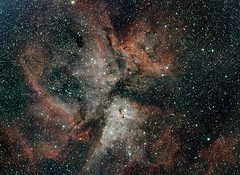
You can also check out the STC astro-multispectra filter. I use that with my QHY168C OSC camera and didn't appreciate how effective it was until I had a go at imaging Eta Carina which only rises to 15 degrees above my light polluted southern horizon. Looking through a very good pair of 15x70 binos I could see stars I reckon down to about mag 7 but there was no hint of any nebulosity and I was very surprised when the first frame downloaded and the nebula was very clear. In the end I got an image I was quite pleased with, given the circumstances. The LMC climbs to 6 degrees above my horizon but I need to find a tree filter before I can image that.
Eta Carina nebula by John Sim, on Flickr
Helpful Insightful Respectful Engaging
David Redwine avatar
Darcstar avatar
When I was imaging with an unmodified DSLR (Nikon D5100) I used a Baader UHC-S 2" filter that screwed into an extension and then straight into the OTA.
It cuts out a vast majority of both sodium and mercury vapour light signal. This is most likely the light pollution that you're experiencing.
They are inexpensive and I highly recommend them. The contrast difference when compared to without is amazing and the edges of your images will be much cleaner.
Good luck and clear skies.
Well written Helpful Supportive
Related discussions
Best modification for a Canon 60D?
Hello all, I am seeking some advice… perhaps this is well-travelled ground, but I am interested to see what experience those have on this board. After one year of imaging with my unmodded Canon 60D, I am ready to modify it. I like this camera, ...
DSLR modification may help reduce red tinge from light pollution issues.
Sep 1, 2020
L filter or light pollution filter?
Hi guys, I see a lot of guys out there imaging with a light pollution filter in place of the L filter. I live in an orange zone…should I consider doing that? woukd I have to expose longer with the light pollution filter compared to the L filter...
Addresses light pollution filter usage and exposure time considerations.
Jun 2, 2017
DSLR and narrow band imaging
Hi all, Looking for some help, I am very new to all of this (3 weeks in) and sometimes it is really difficult to see through all of the info available online. My setup is a skywatcher Mak 127 with a focal length of 1500mm, a skywatcher EQ5 pro goto m...
Narrow band imaging techniques can mitigate light pollution in long exposures.
May 22, 2020
AstroDon filter issue--suggestions please
Hello I am wondering if anyone has a suggestion that might help me My imaging set up is an RC reflector with an FLI proline 16803 camera and 50mm Astrodon filters (LRGB + 5nm narrow band) I have had a string of issues…everything from my mount h...
Filter selection and usage directly addresses author's light pollution filter question.
Mar 1, 2020