Does frame rate matter for lunar?

10 replies287 views
Stuart Taylor avatar
Forgive the noob question, but I am a noob with lunar!

I've only been doing lunar for a couple of weeks and I am aware that I need to keep exposures relatively short to 'freeze' atmospheric seeing as much as possible (so I am generally using 1-5ms), but since the moon doesn't rotate I can't see that frame rate would matter, would it? Obviously a lower frame rate has the disadvantage that it takes longer to collect enough frames, but presumably it doesn't affect the actual image?

I understand why high frame rate is desirable on planets, as they rotate quite fast. But not on the moon, I am guessing?

Thanks
Well written Respectful Engaging
andrea tasselli avatar
The Moon does actually move about somewhat, the movement is called libration but they are quite slow as they occur over one lunar month. For really high resolution lunar imagery there is another factor to keep in mind which is the variation of illumination with time, which might be critical depending where you are pointing at. But in general the length of time requirements are pretty lax for lunar imagery. That has NOTHING to do with the exposure lenght of single frame (or otherwise known as frame rate) which is heavily dependant on seeing and SNR. So this requirement is just the same for planets as it is for Luna.
Helpful Insightful Respectful
Stuart Taylor avatar
andrea tasselli:
exposure lenght of single frame (or otherwise known as frame rate)


The exposure length of a single frame is not the same as the frame rate.
For example, I am capturing moon images usually with an exposure time of 1 - 5 ms, but my frame rate is only about 7fps (as it's a large sensor).

I understand that the exposure length is important (keep it short), but my question is does the frame rate matter?
Well written Engaging
andrea tasselli avatar
In my time the two were pretty much one and the same but, yes, you're right they are NOT the same in general. To answer your question; it is the same as to say how long can I capture a given body before rotation gets in the way. The answer was in my previous replay to your question and in short it is: it depends, but in general you are allowed around 10 minutes as a rule of thumb. More or less depends on circumstances.
Stuart Taylor avatar
andrea tasselli:
In my time the two were pretty much one and the same but, yes, you're right they are NOT the same in general. To answer your question; it is the same as to say how long can I capture a given body before rotation gets in the way. The answer was in my previous replay to your question and in short it is: it depends, but in general you are allowed around 10 minutes as a rule of thumb. More or less depends on circumstances.

Thanks. This is helpful. I shall try and keep my videos down to < 10min then.
Well written
Dale Penkala avatar
Hello Stuart,

Here is a general idea what I shoot for the moon when image it. 
1st I do not take individual images, I uses the Ser video format.
2nd I’m using the 290mm camera from ZWO and at full frame size/resolution I almost always get 82-84 frames per second.
I personally use a sequence of video’s. My sequence is usually 3 - 45sec video’s then I process them in AutoStackert 3 load all the images I decide in Registax, stack and use the wavelets for sharpening the image. Once I’m happy with it I then will take the image in Gimp and tweak the contrast, brightness etc…
When I take the sequence I’ll generally shoot it so that its a tad on the dark side and do the brightness tweaks “post processing” in Gimp.

Just another note I use the Pro-Planet UV/IR cut 642nm filter which helps somewhat with cutting some of the turbulence in the atmosphere.

Dale
Helpful
Andy Wray avatar
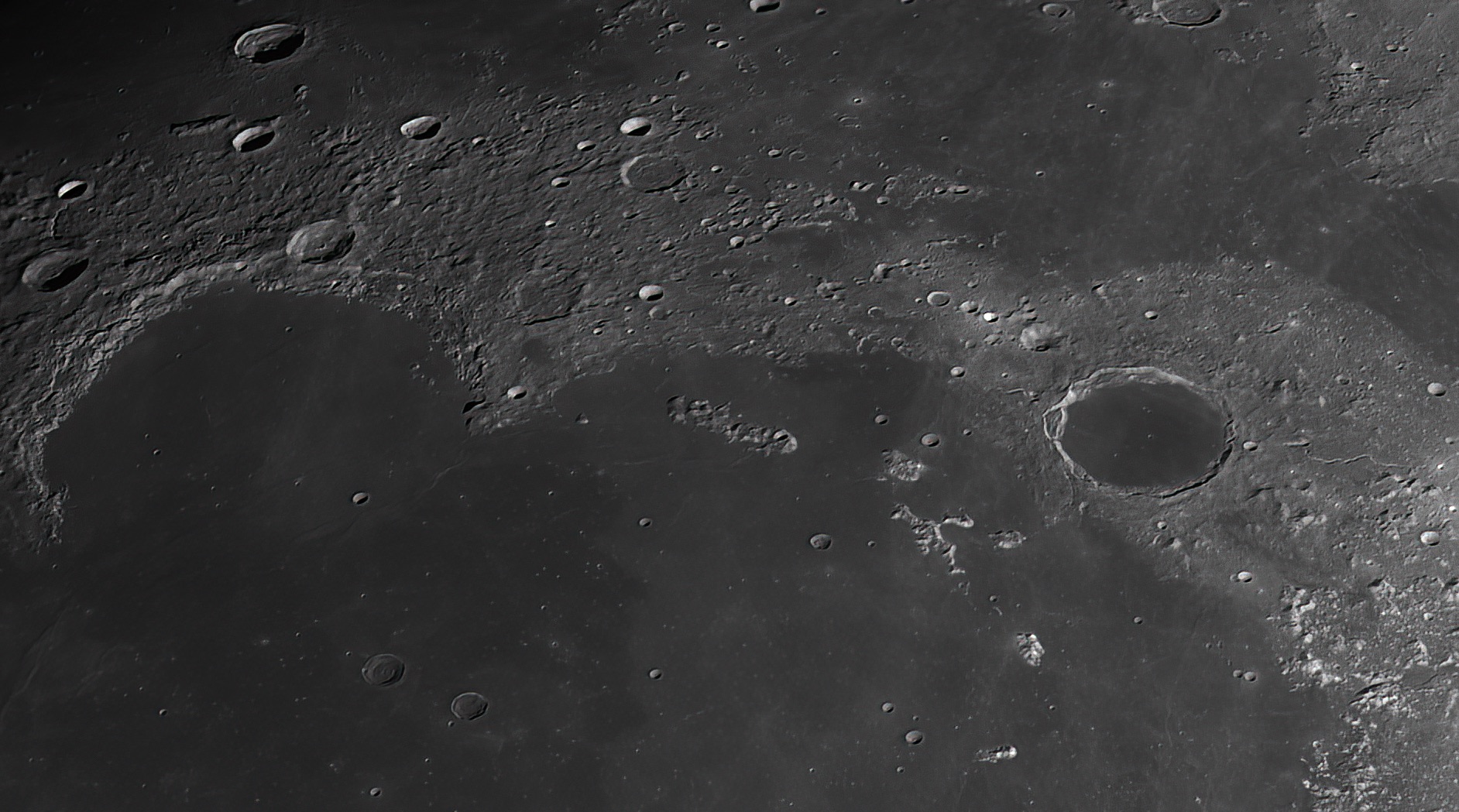
I'm not sure the moon needs videos.  It is so bright that you can capture a burst of well exposed still images (typically 1/640 secs) that can be stacked.  Here's one of my attempts:


Moon -- quick stitch of 30 shots on Sony NEX 5N through Skywatcher 200 PDS
Helpful
andrea tasselli avatar
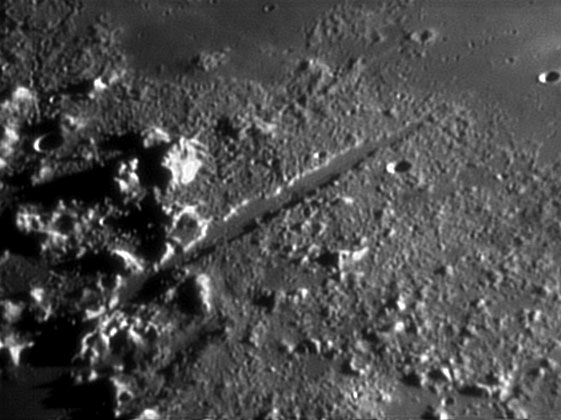
The moon despite being one of the darkest large planetary body out there does well at prime focus. High resolution imagery is another matter entirely so, yes, it needs video. Such as to get the rille running along Vallis Alpes:

Dale Penkala avatar
Andy Wray:
I'm not sure the moon needs videos.  It is so bright that you can capture a burst of well exposed still images (typically 1/640 secs) that can be stacked.  Here's one of my attempts:


Moon -- quick stitch of 30 shots on Sony NEX 5N through Skywatcher 200 PDS

Andy I didn’t say that you can’t do it in that manner, I stated that “most” use video to help eliminate atmospheric seeing.  While that shot is more of a portrait its isn’t high resolution as @andrea tasselli had mentioned. Video really is the best way to get high resolution images of the planets and lunar surfaces.

Dale
Stuart Taylor avatar
Dale Penkala:
Hello Stuart,

Here is a general idea what I shoot for the moon when image it. 
1st I do not take individual images, I uses the Ser video format.
2nd I’m using the 290mm camera from ZWO and at full frame size/resolution I almost always get 82-84 frames per second.
I personally use a sequence of video’s. My sequence is usually 3 - 45sec video’s then I process them in AutoStackert 3 load all the images I decide in Registax, stack and use the wavelets for sharpening the image. Once I’m happy with it I then will take the image in Gimp and tweak the contrast, brightness etc…
When I take the sequence I’ll generally shoot it so that its a tad on the dark side and do the brightness tweaks “post processing” in Gimp.

Just another note I use the Pro-Planet UV/IR pass 642nm filter which helps somewhat with cutting some of the turbulence in the atmosphere.

Dale


Thank you for this Dale. Those are some really super images! Well done!
Well written Respectful Supportive
Dale Penkala avatar
Stuart Taylor:
Dale Penkala:
Hello Stuart,

Here is a general idea what I shoot for the moon when image it. 
1st I do not take individual images, I uses the Ser video format.
2nd I’m using the 290mm camera from ZWO and at full frame size/resolution I almost always get 82-84 frames per second.
I personally use a sequence of video’s. My sequence is usually 3 - 45sec video’s then I process them in AutoStackert 3 load all the images I decide in Registax, stack and use the wavelets for sharpening the image. Once I’m happy with it I then will take the image in Gimp and tweak the contrast, brightness etc…
When I take the sequence I’ll generally shoot it so that its a tad on the dark side and do the brightness tweaks “post processing” in Gimp.

Just another note I use the Pro-Planet UV/IR pass 642nm filter which helps somewhat with cutting some of the turbulence in the atmosphere.

Dale


Thank you for this Dale. Those are some really super images! Well done!

No problem Stuart, and thanks.

Dale
Related discussions
Planetary and Lunar Tracking with HEQ5
Hi, Is it the same process to track solar system objects as it is with deep space (polar align, star align, object align, shoot)? Or—is there something else I need to know to track the planets and moon? Thanks!
Lunar imaging frame rate considerations relevant to moon tracking and capture.
May 7, 2020
Two Things I Don't Understand About the ASIAIR Plus
1. When I have ASIAIR in station mode, where do I set my Android connection to: My Wi-Fi or the ASIAIR, or does it not matter? It seems to work either way, but I;'m trying to see which will get me the strongest signal when I am indoors. 2. When I...
Discusses camera settings and frame rates relevant to lunar imaging techniques.
Nov 9, 2023