First narrowband attempt: seeking feedback on HOO Medusa Nebula image

5 replies158 views
David Friedlander-Holm avatar

Hi, I’m looking for some feedback on this HOO Medusa Nebula image I took. This was my first time trying out narrowband imaging and I wanted some feedback on both the imaging and processing techniques. If there are any tips or tricks I should know, I would love the input.

📷 Medusa NebulaMedusa Nebula

https://app.astrobin.com/i/o4ypz2/
Thanks for any feedback!

Well Written Engaging
andrea tasselli avatar
I'm sorry to say but it looks pretty weird, with those streaks and the two arcs top and bottom where it shouldn't be any (in OIII). Integration is very limited even for a 20" to bring out the PN and it shows in the noisy image, despite the shadows clipping. I guess the best way around is restarting from scratch and show an auto-stretched image before any further processing to see what is going on there and how best to progress. A run down of the processing steps would also be helpful in that regard.
Helpful Insightful
David Friedlander-Holm avatar

Thanks for the feedback!

I know the streaks are odd (I probably attest this to my broken off-axis guider that has been an ongoing pain).

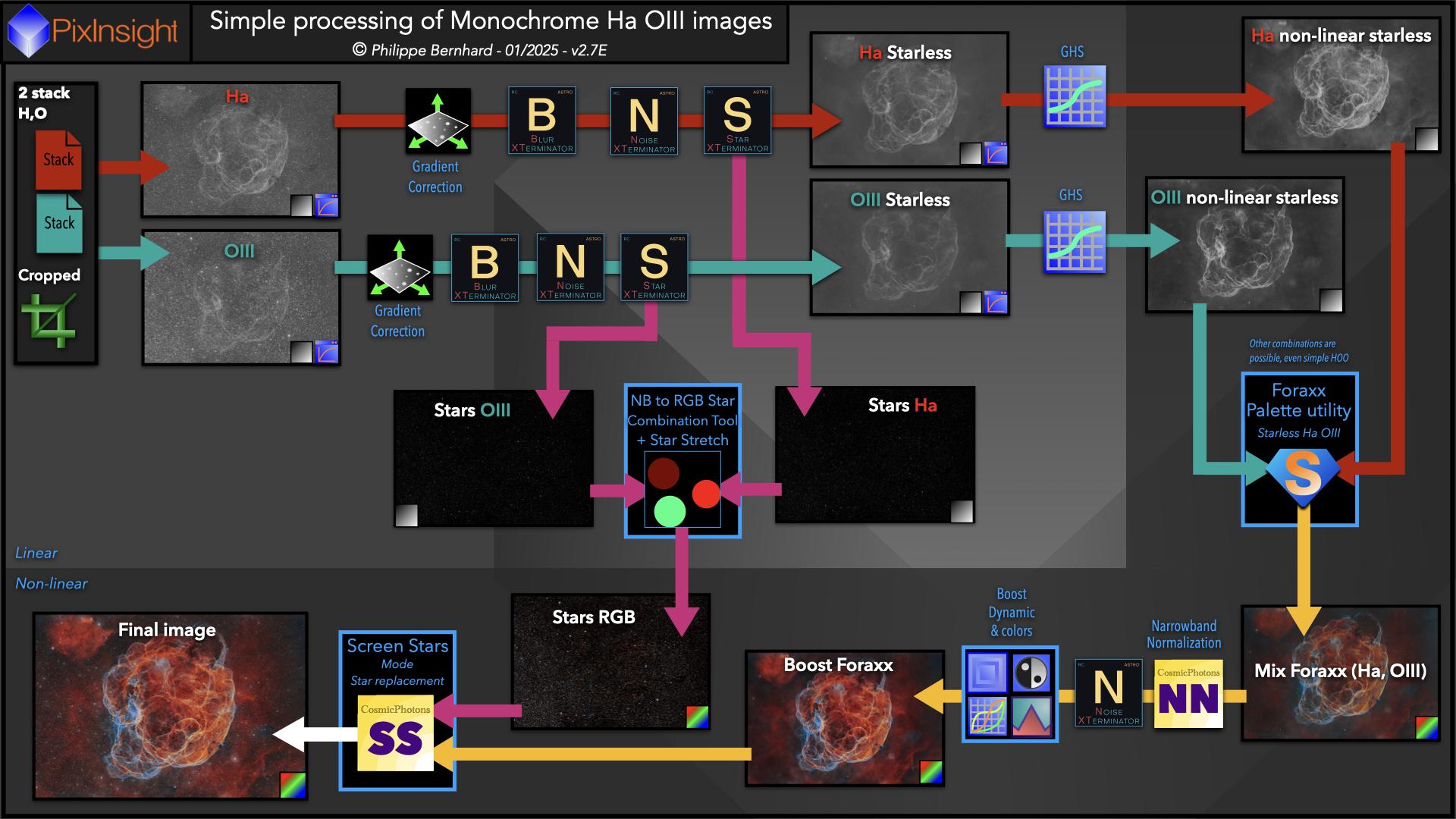
As for my process, I used this basic process from Philippe Bernhard https://astro-photographie.fr/wa_res/files/HOO1-Processing_of_Monochrome_Ha_OIII_images.png?t=

I’ll add some screenshots of the pre-stretched image when I have some more time later today but thank you again for the feedback!

Respectful
Tony Gondola avatar

More integration time. I would want to see that before discussing any processing issues.

SonnyE avatar

For a first attempt, good.

But too bright and garish for me.

Jure Menart avatar

I agree with others, to try to get more data. But TBH is quite a lot of signal for only 30 minutes of capture 😳 good work for first NB capture :)

For weird Oiii arcs, I would suggest you try to run MultiscaleGradientCorrection and put some effort to clean the BG. After that it will be easier for next steps.

The Oiii could also be because of bad flats. Can you show stretched (STF) master flat for Oiii?

Helpful Concise Supportive
Related discussions
RCC (Request for Constructive Critique) on M33
Hi All, I am seeking constructive feedback on my image of M33. Any advice would be greatly appreciated. Triangulum Galaxy M33 (2025) - AstroBin Thank you!
First narrowband attempt seeks feedback; author also requests constructive image critique.
Nov 1, 2025
Crescent Nebula raw data available for processing - 21 hours collected
Hello all, The time has come again to offer up some of my raw image data for anyone to process if you’re up for it, specifically my 2025 acquisition of the Crescent Nebula in Cygnus. I captured this in a relatively narrow FOV with my Celestron C6 sco...
Narrowband imaging raw data available; author seeking processing feedback.
Jan 7, 2026
Request for help checking Astrobin first discoveries
Please could I request your help and advice? There are 3 images and I would like to know if they were Astrobin firsts when they were posted. O III arc 7° long in HOO near SNR G206.9 + 2.3 https://app.astrobin.com/u/huntinghorn?collection=45383&i=...
Directly relevant—both discuss first narrowband imaging attempts and seeking feedback.
Feb 28, 2026
Processing techniques for LDN 1089: balancing faint dust and bright stars
I have recently published a post about the techniques that I used to process my image of LDN 1089 (https://app.astrobin.com/i/gfwv5v). Unlike my two previous posts, this is not a full step-by-step walkthrough, but it rather focuses on the challenges ...
Processing techniques for nebula imaging; discusses balancing faint and bright features.
Aug 11, 2025
DSLR Mod: Installing a Narrowband Filter Directly on the Sensor (Results Included)
Hello everyone! I wanted to share a super fun mod I did on my DSLR in case anyone is interested or has feedback — or if someone out there has tried something similar! I recently sent my main astro rig to a remote observatory, and honestly… I started ...
Narrowband filter modification; relevant to author's first narrowband imaging attempt.
Dec 1, 2025