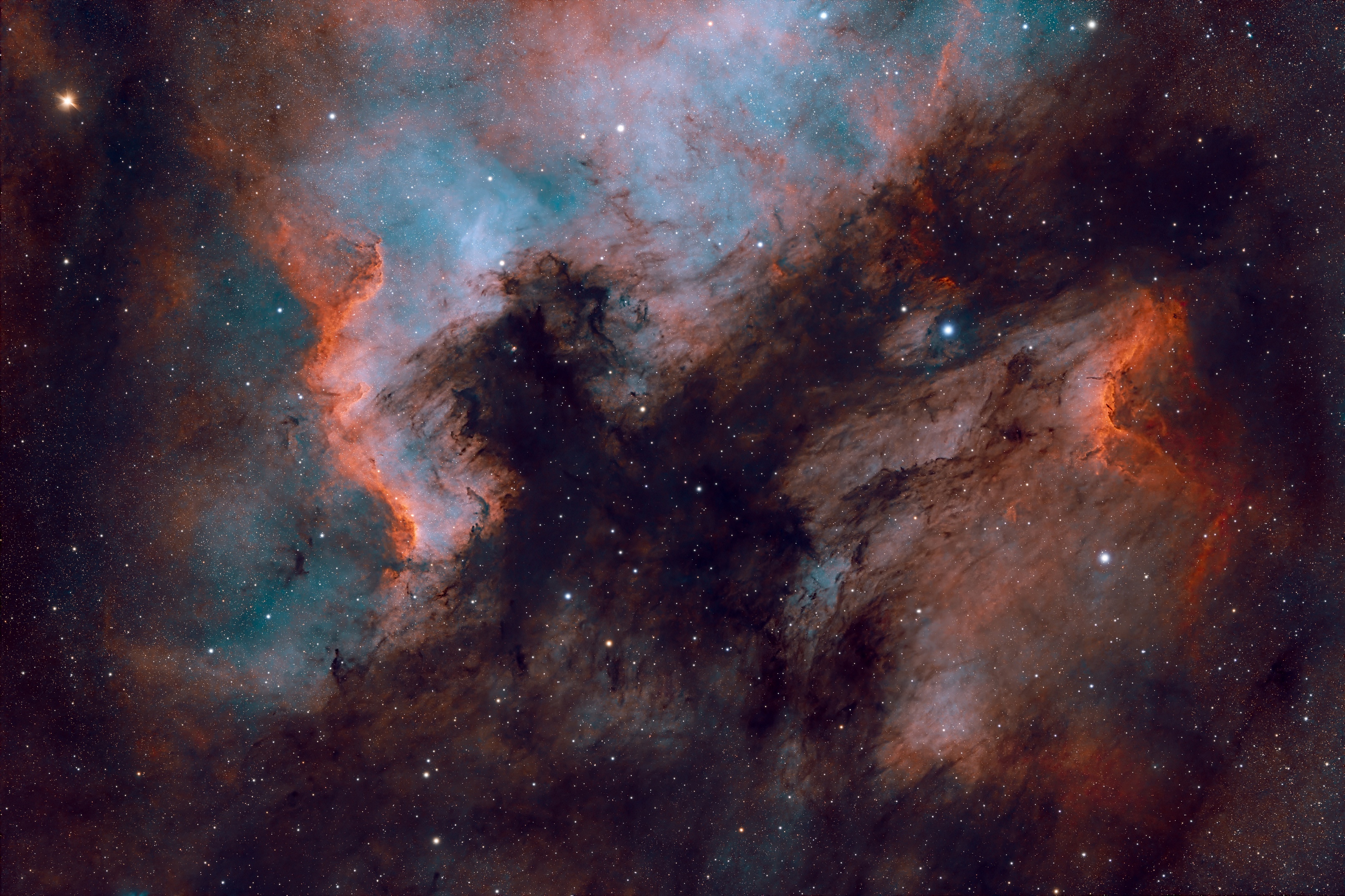
there are a few great shots on astrobin that pair the reducer with a full frame camera but all these are already processed. The only single unprocessed file i have seen of this combination had stars, that reached a good way into the image, that i would just not be happy with.
As i don’t know anything else about the above mentioned frame i would hope that some owners of this combination could share some information with me.
I think the more critical factor (with the Esprit 120) is the focuser, and with full frame camera - sensor tilt. If the 120 is like my Esprit 100, the draw tube of the OEM focuser is out about 2/3rd of its total extension to reach focus with the field flattener/flattener-focal reducer. It is not a bad focuser and the for the prevalent imaging setups/cameras at the time of its design is a good (ish) focuser. However, the new modern ASP-C and full frame sensor cameras are larger and significantly heavier that the sensors of the older 4/3 frame size like in the ASI294MC that I started with. Couple that with larger sensors that utilize almost entire image circle and tilt (and focuser droop) can become apparent.
When I switched from my ASI294MC to an AS2600MM, I suspected I might be seeing some sensor tilt, but as I watched more closely I could tell there was a slight shift as the telescope tracked - noticeable when Blinking large (long duration/lot of frames) images sets in Pixinsight. I chased this and did discover there was very slight 'play' in the draw tube. It wasn't enough to notice with the lighter/smaller sensor camera, but started to become noticeable with the heavier camera. When I exchanged the filter slide for an EFW, there wasn't much doubt anymore.
I replaced the OME focus tube/focuser with a Moonlite Express Nightcrawler. Much more robust (much heavier as well) and it eliminated the isue of draw tube droop and increased the focuser tube instrument weight capacity to approximately 26 lbs. However, when I went from a guide scope to an OAG-L, I found that the ZWO tilt plate which was OK in the non-OAG position on the Camera Body, exhibited some slight amount of 'flex' when mounted on the OAG-L as required. The N.I.N.A. 3rd party plugp-in, HocuFocus, has a really good/easy to understand tilt/backspace tool called Aberration Inspector. I'm not going to go further into that tool but you can find a great tutorial on it by Patriot Astro in YouTube (linked below). The portion on the Abarration Inspector begins at 26:40.
https://youtu.be/M1-izvBlO44?si=_j3_ZuN6fRobvPROThe tool works great, but it demonstrated the flex of the ZWO tilt plate when it has the entire rest of the imaging train hanging off of it(OAG-L, EFW 2"x7, ASI2600MM). Plus trying to adjust the tilt the ZWO's three adjustments screws to a four corner tilt data/illustration is, well, tedious.
There is an alternative to the 'flex' ing ZWO tilt plate and it moves all of that back to the Camera. That is the ASG Photon cage. It is a very robust and rigid tilt and back focus adjustment device that literally 'contains' the entire camera. It was designed to work with the output provided by the HF Aberration Inspector. There are a series of videos that introduce the device, its installation, and use with the N.I.N.A. HF Aberration Inspector. The first one is linked below. Besides being a very easy way to manage tilt and backspace, there is a pretty good discussion of both issues within the video. I did get a Photon Cage and wouldn't do without it now, but you don't need the device to learn a lot of useful things from the videos.
One of the other things you may need at some point are some custom adapters / spacers. Since ASG owner told be about Precision Parts, they've been my goto for anything specific to my setup that I needed. (also linked below).
https://youtu.be/RJr7OiD5Xeo?si=1tAPd6DxXAhlY18XPreciseParts Build-An-Adapter