New Gradient removal technique By Vicent Peris

PixInsight Addicts 5 replies361 views
Edoardo Luca Radice (Astroedo) avatar
Hi all,
 in the last few nights I have tested the new technique of gradient modeling and removal by Vicent Peris (https://www.pixinsight.com/tutorials/multiscale-gradient-correction/).
In my opinon works very well.
in my two latest images you can see the results.
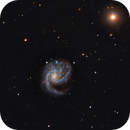
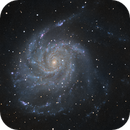


In M101 you can also see a comparison between before and after the correction.
Oleg Zaharciuc avatar
Nice, thanks!
Jerry Yesavage avatar
Hi, went back and read the technique, looks like you need to have a second image that overlaps the first… a bit too much for me without an operational second camera… but I have been thinking of adding one of the newer CMOS cameras atop my main telescope for wide angle… maybe this is an excuse.

I have the same gradients you have and maybe will post them when I put up M 53, which I am working on today while house-bound.
Edoardo Luca Radice (Astroedo) avatar
looks like you need to have a second image that overlaps the first…


That's right: you need a secon wide field image to use as a reference for the primary.

As a secondary camera I'm using a Canon 60D with a 180 mm telephoto lens by Leitz (an Elamerit-R 180  f/2.8  ).
I control the camera only with the intervallometer.
Alberto Ibañez avatar

Hi, went back and read the technique, looks like you need to have a second image that overlaps the first... a bit too much for me without an operational second camera...

 Just for your reference, I tried this technique with a reference taken from the web (aka not mine) and worked surprisingly well… I must do an in deep analisys, but seems that it is not mandatory to gather your own data to apply this technique.
Richard Francis avatar
Thanks for pointing to this tutorial. With an additional wide-field imager, or indeed an on-line image source, it looks very useful for LRGB images. However, I fear that for narrow-band it could be a bit more tricky. Self-captured wide-field images could be possible with 2 sets of narrow band filters with the same passbands, but on-line sources are more difficult as we need access to the individual channels to make sure that the channel combination is the same.

cheers,
Richard
Well Written Insightful Respectful Concise
Related discussions
M81-M82_True_HA - Pixinsight Continuum Substraction and Stars Restoration- A Processing Example based on Vicent Peris Method
You can check the original image and post here : https://www.astrobin.com/necfmm/ I share this because it may interest many of you in search of new processing idea or example after the recent IOTD of Vicent Peris (https://www.astrobin.com/b3f77y/) It...
Pixinsight processing techniques for deep-sky image enhancement and improvement.
Mar 8, 2022
Small Star Processing and/or Elimination
I have been imaging for the past 2 years and my processing techniques have slowing been getting better as you can be seen in my gallery progression (https://www.astrobin.com/users/Tackettbr/) . I use pixinsight predominantly with minimal photoshop. R...
Advanced star processing methods complementary to gradient correction techniques.
Sep 8, 2021
Using Deconvolution in Pixinsight
Hi Folks, My website, Cosgrove's Cosmos, has just published some new posts under its Tips & Techniques Section entitled: "Using Deconvolution In Pixinsight". https://cosgrovescosmos.com/tips-n-techniques/using-deconvolutioninpixinsi...
Pixinsight deconvolution techniques for image detail enhancement post-processing.
Mar 28, 2022
Star removal - Comparing pure Starnet vs Starnet+Photoshop "Content Aware fill"
i found out this little technique, thought i'd share. Removing stars with the otherwise great Starnet++ tool in PI often generates badly stamped out artifacts. Sure you can clonestamp it away, but that's a lot of manual work. I've just st...
Star removal methods relevant to overall image processing workflow.
Sep 15, 2021