Hi Nick
Off course.
I have the mount sitting on a wooden pier I built my self. It works wonderful. Image here:
https://photos.app.goo.gl/82GN9TioD2tbyzGz5The pier is made of epoxy laminated Douglas and measures 120x120 mm across and is 3.5 meters long, with a 2 meter deep concrete footing. Very solid. I haven't done any polar alignment for months and I see absolutely no sign of that being necessary. I use NINA three point PA. When I built the pier I ran into comments about wood not being good for a pier because it would warp. That assumption did not turn out to be a problem. At least not in my case and with the way I chose to laminate the pier. On top of that it's a joy to have a beautiful wooden pier in stead of one made of concrete.
At present I have two scopes, the TS 130 mm F7 Apo (0.8 reducer) and a TS 203 mm RC. Currently I use the APO most of the time as it's so easy to use and is fairly fast.
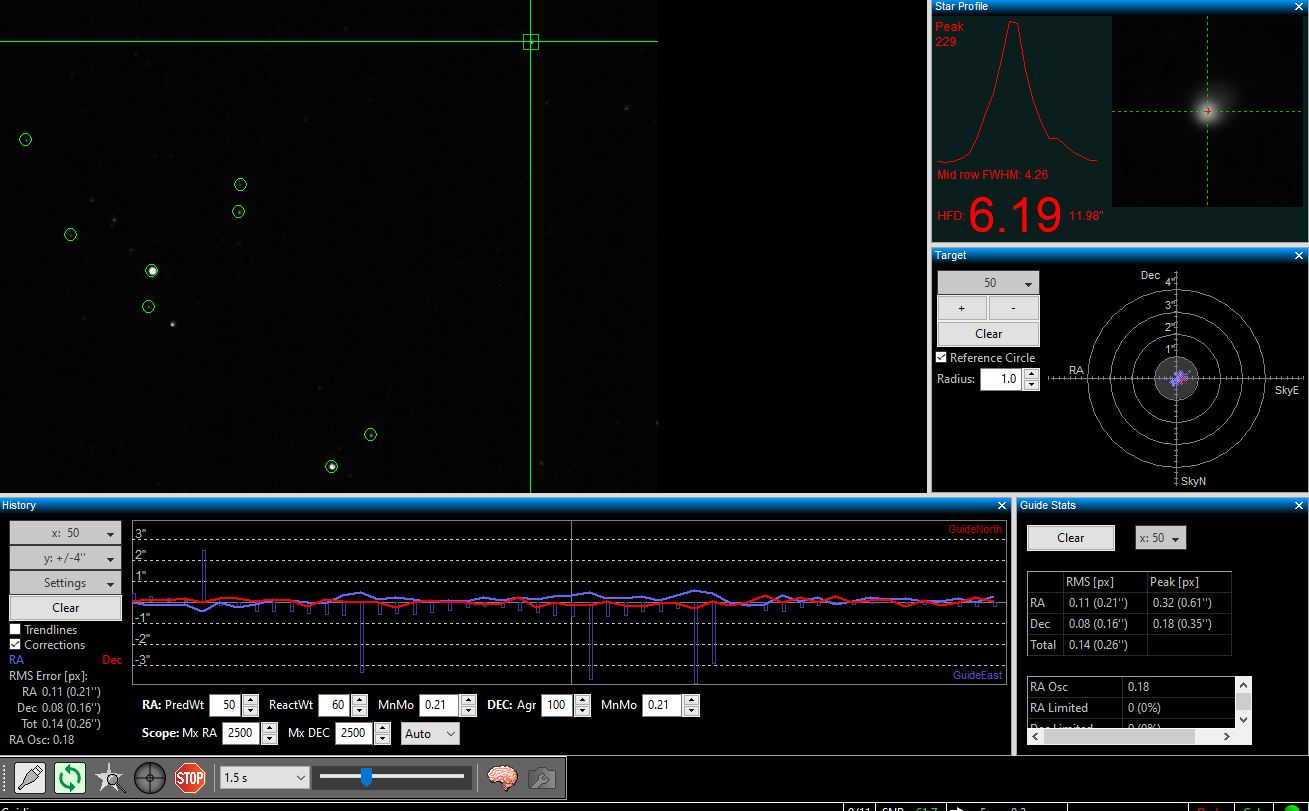
I use PHD2 for guiding, the cheap SW 80/400 mm achromat and also the ASI120MC as a guide cam. I have found that using a longer than recommended focal length guide scope improves guiding considerably. I once read an article saying that PHD2 has less trouble locking on to a slightly out of focus star that one being perfectly focused with sharp edges. Personally I think there is a lot of truth in that from what I have observed.
PHD2 settings are very basic. On RA I currently use predictive algo, but the normal hysteresis also works very fine. On DEC I use the default. Numbers are those reached by running the guide assistant. I reduced the Min move numbers about 10%. The guide assistant reports no backlash on Dec BTW.
What I think is very crucial to understand, and accept, is that there are many nights where it's seeing that limits your guiding and not your setup/equipment. I see a lot of people going to extremes doing all sorts of things to minimize cable drag, vibrations etc. but at the same time not being aware of what the atmosphere does to guiding. Also I see tripods standing directly on lawns etc. which has to go wrong. When I used I tripod I had it standing on what I regarded as a solid paved surface held down by a another added 10 kilo weight. Even then I knew that every night I had to do PA because of movements in the soil below due to changing temperatures, moisture etc. So I have to say that a pier is one of the best cheap investments I have ever done for my astrophotography.
I think that's it. Feel free to ask if there's anything I forgot.
Clear skies, Steen