Mysterious artifact I can't explain, curious as to what it might be

5 replies628 views
David Koslicki avatar
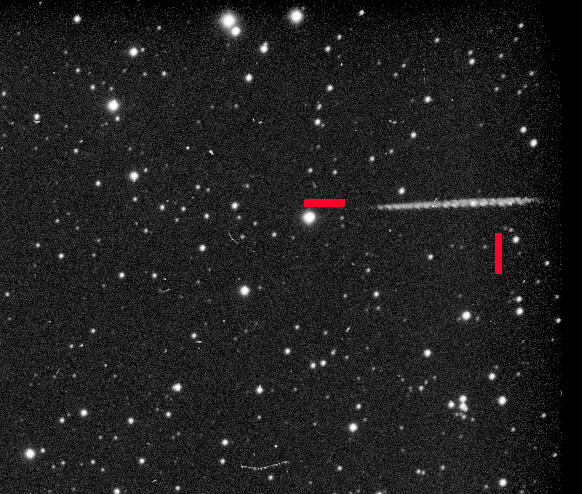
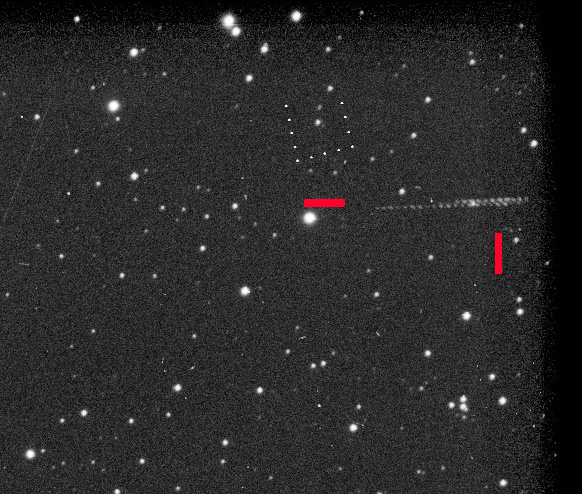
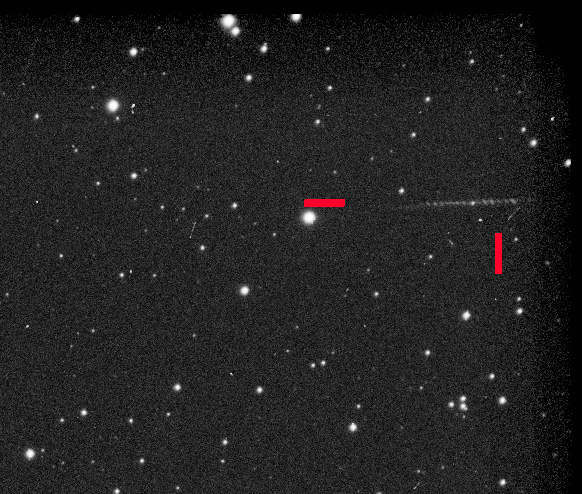
Recently, I've been imaging vdB 132 and the surrounding region and noticed what I first thought was a sensor issue, but the more I think about it, the less I can explain it. Namely, there is this odd repeating dot structure on the very edge of my sensor:
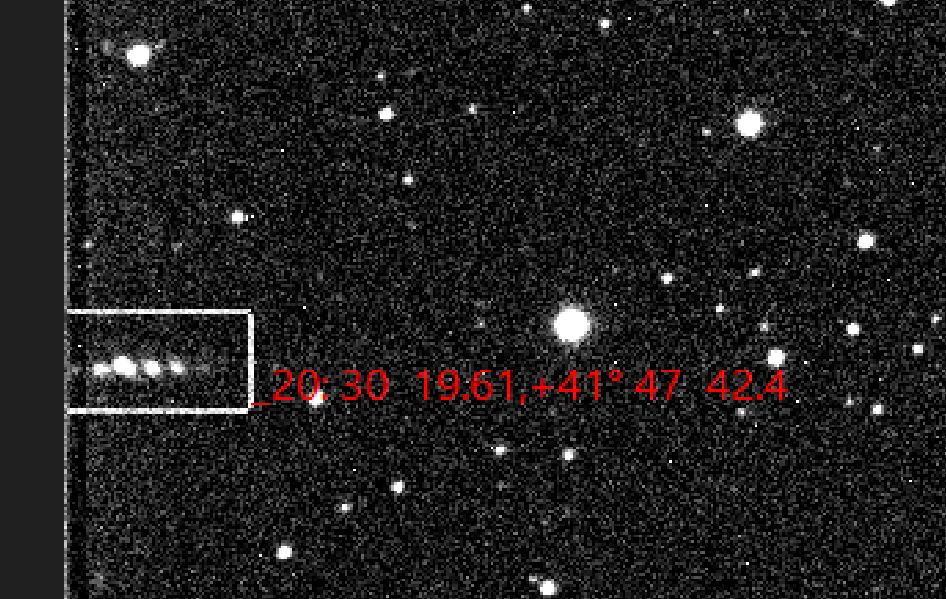
Sensor is rotated by 0.36 degrees, so basically north is up.

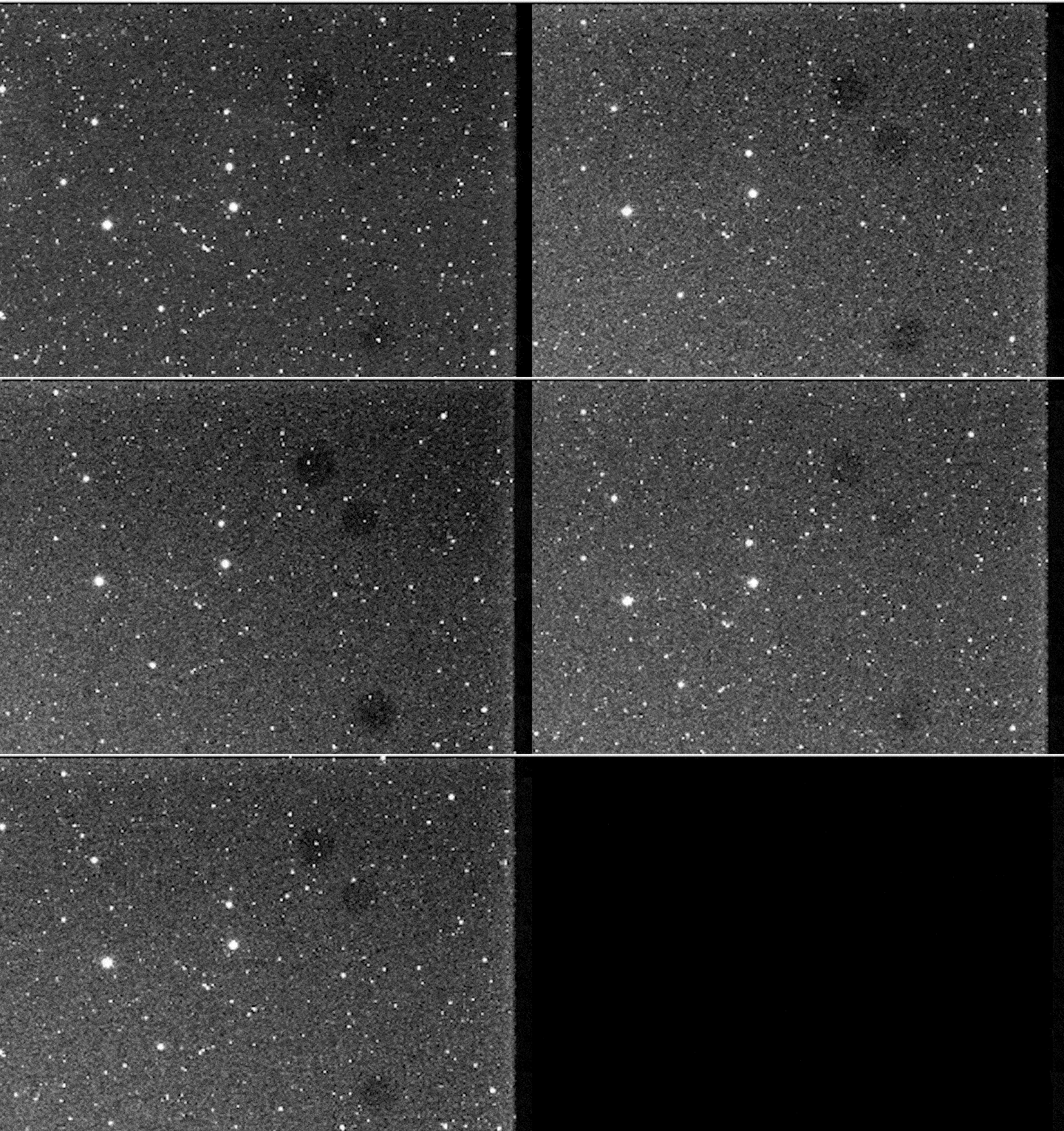
It isn't fixed in place, as it moves along with the dithering. The following GIF is of frames taken in time order, and the artifact is in the upper right (flipped vert & horiz to the above):
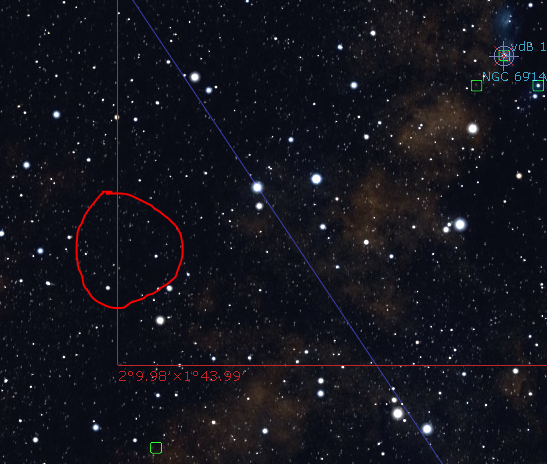
Looking at this region in Stellarium, I expected to see some bright star just out of frame, perhaps reflecting off of the filter, but there doesn't appear to be anything interesting nearby:
It also shows up most strongly with my RGB (Zwo) filters, and faintly in Ha (Baader). I could be convinced that it's some sort of reflection (as the repeated dot pattern overlaps with a single star as it moves out of the frame. But this wouldn't explain why only that single faint star is reflecting off something in my imaging train, in the exact same location in space, over two nights, and with different filters and brands.

Here are the stacked (maximum) and cropped images of Ha, R, G, B respectively:
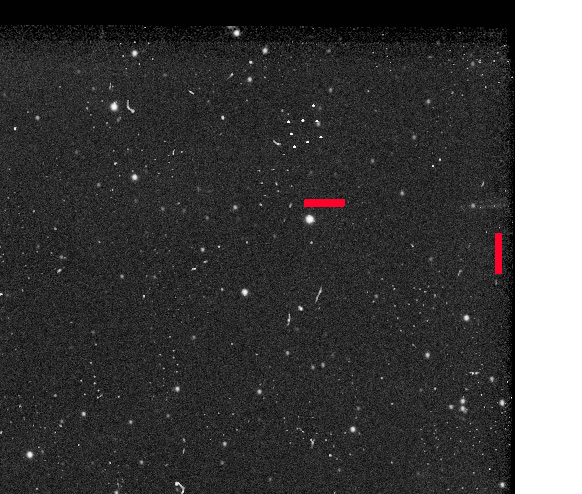


You can see that over the two nights I imaged, this artifact shifted slightly.

And in RGB to see the color is different from surrounding stars:
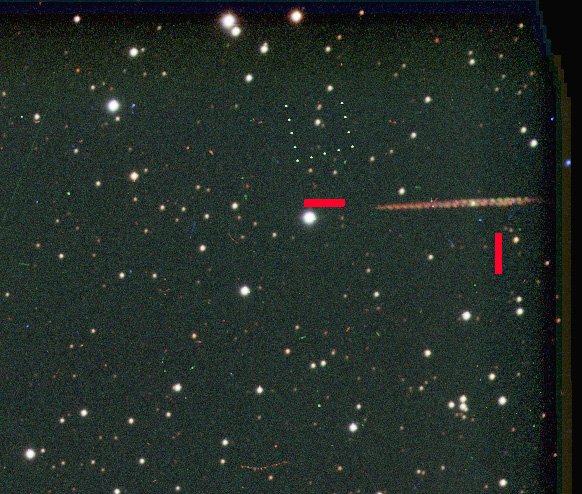


ASTAP doesn't recognize it as an asteroid or comet (which would've been weird as it doesn't move consistently in time). Looking at other frames I've taken of different regions of the sky, I have not seen this artifact before.

Anyone have any ideas?
Well Written Helpful Insightful Engaging
abreen avatar
The way the artifact moves in X at twice the rate of pointing X motion makes it seem like some reflection is involved. The same location in space over many exposures and two nights seems to rule out terrestrial sources.

The reflection element makes me think to look for a bright source outside the opposite side of the frame, and not necessarily just outside. Flares can come from well outside the frame, depending on the lens design.

Looking straight in that direction I find Vega, which is definitely bright enough to be suspect. It's 20 degrees off axis but I've seen flares in other lenses well outside their FOV. You could test the Vega theory with a lens hood long enough to keep light from 20 degrees off from reaching the objective lens.

The split into a line of several dots makes me think diffraction, but it doesn't look like the dot repeat distance scales with wavelength so I'm thinking it's most consistent with multiple internal reflections between two refractive transitions very close together. Perhaps the gap between two closely spaced elements in your refractor, as is common in doublets and triplets? It feels like the spacing is too narrow to be a plate of glass like a filter, and too wide to be in something like a coating.

If that's the cause, it should stay put if you rotate the OTA or the sensor and should show up in any image taken at that exact radius from Vega.
Helpful Insightful Engaging
David Koslicki avatar
Thanks @abreen ! Next time the clouds clear, I'll try rotating the OTA and sensor and see if this still happens. Back of the envelope calculation says that my ~6inch dew shield isn't nearly long enough to block out Vega, so that might very well be it! Still funny it's happening on the extreme edge of the sensor *shrug*
John Hayes avatar
I agree 100% with abreen!  These kinds of reflections can come from non-blackened lens elements or other components in the optical system and they are almost always due to a bright star just out side the field of view.

John
abreen avatar
@David Koslicki were you able to solve the mystery?
David Koslicki avatar
@abreen I'm fairly sure that it was indeed a reflection from Vega: it stuck around on rotation and moving the sensor around a bit, and calculating FOV, dew shield length, etc. suggests it could be reflecting off the primary objective. Looking at the edge of the primary from a similar angle does actually reveal a similar reflection pattern (from the inside edge of the lens, I assume). I wasn't able to get it to move further to the center of the sensor though *shrug*. But enough evidence for a reflection to satisfy my curiousity!
Related discussions
Phantom "Star pairs" ... bizzaire !
Hello All, I've noticed these bizarre false "star" pairs showing up in my recent M108 RGB Star image - I unscreened the stars right after the original RGB combination and did minor processing on them but didn't notice this other str...
Discusses similar false artifacts appearing in imaging data from sensor issues.
May 6, 2024
RGB filter reflections from bright stars
Hi - I just started processing some of my RGB data captured over the past few weeks using the ZWO RGB "optimized for ASI 1600" filters. As I researched, I now understand I may be dealing with expected performance with very low cost filters,...
Author experiencing unexplained artifacts; candidate discusses similar mysterious imaging phenomena.
Nov 26, 2020
Strategies for Flats Across Multiple Nights of Imaging
I'm usually trying to image targets across multiple nights and have noticed some slight issues with calibration frames. I find sometimes artifacts on the imaging train move around from night to night (gusts of wind blowing stuff around, etc). Oth...
Addresses calibration frame artifacts across multiple imaging sessions.
May 24, 2024
DeepSNR - Artifacts or Stars?
So I've tried to jump on the DeepSNR bandwagon but I keep getting weird results. I don't know if it's showing me the next level of dim stars in my image which were hidden by noise or if it's creating artifacts. I've tried using th...
Explores distinguishing between artifacts and real astronomical features in data.
Aug 4, 2024
Samyang 135 Star colors issue
Hi all, Got the Samyang 135 2 years ago, but unfortunately never get a good image.. the issue as you can see in the picture is strange star colors .. its look like the stars color have 2 different settings.. see left and right stars colors .. the lef...
Discusses mysterious imaging artifacts that could explain color anomalies.
Jan 13, 2021