ZWO ASI533MC Pro - UR/IR blocking filter needed?

14 replies892 views
Jan Klíma avatar
Hi guys!

I'm sorry for this newbie question, but I'm a little confused - is it necessary to use a UR / IR blocking filter with an OSC camera like ZWO ASI533MC Pro??

If I understand correctly, a dual narrowband filter like L-extreme will come in handy for shooting nebulae in places with high light pollution, but what about shooting galaxies at Bortle scale 4? No filter or is a UR / IR blocking filter needed?

Thank you so much!

Regards
Jan
Well Written Respectful Engaging
andrea tasselli avatar
It is very much needed.
Ron Clanton avatar
Yes, I have that camera and use the IR/UV filter as a default.  When I'm imaging emission nebulae, I use an Optolong L-eNhance filter… which is awesome!

Ron
Dale Penkala avatar
If you want to do a light pollution/broadband filter the Optolong L-Pro works great for your broadband targets. If you use this filter I do not believe you need to use the UV/IR cut filter. Same with the L-eHance and L-extreme filters.

Dale
Padraic Moran avatar
Interesting question and interesting answers, but given that the OP is in B4 skies with little LP, can anyone explain WHY the UV/IR is recommended? I have Bortle 2 skies (when not covered in cloud) and have just got a 533MCP so would be interested in the answer too.

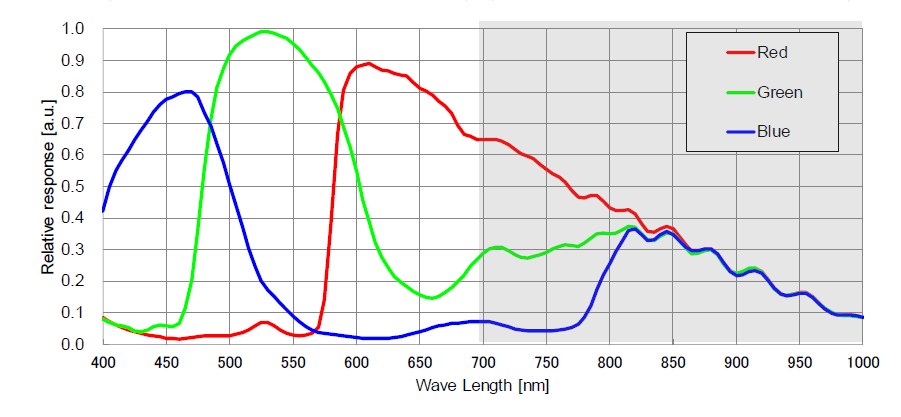
As an example, the Baader Planetarium specification for their UV/IR Cut filter states that the UV/IR cut filter band pass is 420nm-680nm. The IMX533MC sensor does seem to have some blue response below 420nm, and a significant red response (and some blue/green) above 680nm. Will this cause bloated stars in blue and red even without light pollution?

IMX533MC spectral response
Well Written Insightful Respectful Engaging
Ron Clanton avatar
I live in Bortle 5 skies and can tell the difference using/not using the IV/UR cut filter.  I'm certainly not an expert, but I figure the filter are relatively cheap and "do no harm"… so why not?  BTW… I don't use both filters at the same time.

Ron
Dale Penkala avatar
Padraic Moran:
Interesting question and interesting answers, but given that the OP is in B4 skies with little LP, can anyone explain WHY the UV/IR is recommended? I have Bortle 2 skies (when not covered in cloud) and have just got a 533MCP so would be interested in the answer too.

As an example, the Baader Planetarium specification for their UV/IR Cut filter states that the UV/IR cut filter band pass is 420nm-680nm. The IMX533MC sensor does seem to have some blue response below 420nm, and a significant red response (and some blue/green) above 680nm. Will this cause bloated stars in blue and red even without light pollution?

IMX533MC spectral response

I don’t have a lot of background in this area but the “Bloated Stars” is what the UV/IR cut filter was always recommended to me for. I’ve always tried to follow that rule so I’m just passing this on. Again I don’t have the technical background to answer this better, sorry!

Dale
andrea tasselli avatar
The reason for having a UV/IR cut filter in a colour sensor are twofold: one is to avoid IR "pollution" of the colour response of the G/B channels which would make impossible to properly colour calibrate any broadband image and secondly to avoid IR bloating of the images when used with refractors not corrected in the IR (a lot of of them aren't).
Helpful Concise
Dale Penkala avatar
andrea tasselli:
The reason for having a UV/IR cut filter in a colour sensor are twofold: one is to avoid IR "pollution" of the colour response of the G/B channels which would make impossible to properly colour calibrate any broadband image and secondly to avoid IR bloating of the images when used with refractors not corrected in the IR (a lot of of them aren't).

Lets clarify a couple things Andrea, not just for me but also @Jan Klíma  does this only apply to refractors or does this also apply to reflectors? How about SCT’s? My understanding is the UV/IR Cut filters are mainly for refractors, not so much for reflectors. Again this is only my understanding. 

Dale
Jan Klíma avatar
Ron Clanton:
Yes, I have that camera and use the IR/UV filter as a default.  When I'm imaging emission nebulae, I use an Optolong L-eNhance filter... which is awesome!

Ron

Thank you Ron! I will buy it then! Wonderful weekend!
andrea tasselli avatar
It applies to everything. I have UV/IR cut, in one form or another, on all my optics, reflective or refractive. Star bloat or IR halos are, however, a feature of only refractors (and not all of them either) and some very specialised catadioptric optics.
Jan Klíma avatar
andrea tasselli:
The reason for having a UV/IR cut filter in a colour sensor are twofold: one is to avoid IR "pollution" of the colour response of the G/B channels which would make impossible to properly colour calibrate any broadband image and secondly to avoid IR bloating of the images when used with refractors not corrected in the IR (a lot of of them aren't).

Thank you Andrea! Agree. I will buy it then! Wonderful weekend!
Clavius avatar
Hi …. If you don't want bloated stars , yes. It's very useful
Dale Penkala avatar
andrea tasselli:
It applies to everything. I have UV/IR cut, in one form or another, on all my optics, reflective or refractive. Star bloat or IR halos are, however, a feature of only refractors (and not all of tem either) and some very specialised catadioptric optics.

I have all my imaging configurations covered as well but was under the impression that it really apply’s to refractor’s. Glad thats cleared up!

Dale
Padraic Moran avatar
Thanks all for this info. Will install a UV/IR on the 533 at the next outing.
Well Written
Related discussions
What is the best/right gain and temperature for the Zwo 183mc pro?
Hi guys. As some of you know I image mostly with the Rasa 8 equipped with the Zwo 183mc pro camera. I have been imaging at different gains at times and same temperature. But I will like to stick to one gain for a specific filter and sky conditions. W...
Camera settings guide for ZWO OSC camera model similar to yours.
Sep 27, 2023
Noob in Deep Sky Dreaming of Galaxies
Hi fellow astrophotographers! I've been mainly doing planetary photography, however deep sky, and specifically galaxies interest me a lot. I tried looking into acquisition and processing - however it turned out to be way more confusing than I cou...
Beginner galaxy imaging with OSC camera in light-polluted areas.
Oct 23, 2023
New to Narrowband Imaging....
Howdy folks. I have lurked a little bit here and there on the forums, and generally have used Astrobin to post my own images at times to see my own personal growth with astrophotography. Recently, I picked up a mono camera I caught on sale for a real...
Narrowband filter usage and light pollution mitigation strategies.
Dec 24, 2023
Filter Upgrade Time - Antlia Quad Band?
Hi folks: I've been imaging with from my Bortle 7/8 backyard for a few years now, and I'm starting to wonder if it might be time to consider upgrading the filters I'm using. I use an Optolong L-eXtreme for Ha/OIII targets which I've b...
Filter selection for imaging at Bortle 4 light pollution levels.
Dec 9, 2023
Experimenting with dual band filters
Hello everyone, I've recently added to my Newton 20cm f/4 + ASI2600MC a filter wheel with two 5nm Antlia Dual Band filters, one Ha-OIII and one Hb-SII. Another slot of the FW has an old IDAS LPS-2 (light pollution suppression). The idea is to acq...
Dual band filter application with OSC camera systems.
Mar 2, 2024