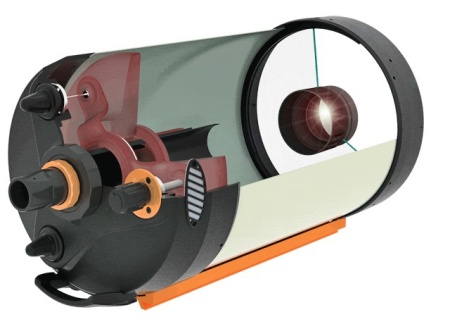
External focuser on an SCT; What about temperature change induced focal shift and back-focus?

John StoneSpaceyJohn Hayes
33 replies518 views
John Stone avatar
It seems like every serious astro-photographer is putting external focusers on the back of the EdgeHD telescopes and locking the mirrors.

I picked up a nice little EdgeHD 8" and a Primaluce Lab Esatto 2" LP focuser and gave it a try myself.

I first assembled the focuser and spacers and then using a ruler down the draw tube resting on the top of the threaded baffle nut sticking out of the telescope I measured 133.3mm - 55mm = 78.5mm  (plus the length of the threads that would screw into my OAG, plus 1/3 my filter thickness) by moving the focuser back and forth.  I noted the focuser step count for this distance.

This set perfect back focus, I then unlocked the main mirror, slewed the telescope to the zenith, and the perfectly focused it with a batinov mask being sure to finish with a counter-clockwise direction.

I locked the mirror and then ran an auto-focus in NINA with the Esatto and found there was variability of about 0.1mm in focus position using the Esatto when compared to the batinov mask.

All was good for the evening, had good guiding and good/sharp subs.

Then the next night rolled around...

After my first auto-focus run on the second night I noticed the Esatto had come to focus 0.75mm away from the perfect back focus point I measured yesterday.   That's out of the +/- 0.5mm spec Celestron publishes.  I then asked ChatGPT about it and it told me that the SCT is very sensitive to temperate changes.  A 10°F change will move the focus point 0.5mm and put your back-focus out of spec.

So my question becomes: 

What are all the experts doing about this problem? 

Do you have to reset the back-focus on the external focuser each night and then focus the main mirror, lock it, and pray the temperature doesn't drop more than 10°F?

How does this work in a remote observatory?  Is this something you get the techs to do for you every month (or change of seasons)?

I've never heard this discussed before and I'm curious what the solution is.

Thanks.

B.t.w,

I got this nice image of NGC 3726 with this setup after only 2 nights (3 ½ hours each RGB; 10 ½ hours total).   

It's WIP since it will need a lot more exposure in my B7 backyard, but I'm pretty happy with the scope's performance.

Note:  I did no star reduction in producing this image.   Just a BlurX 'correct-only' and NoiseX at default settings.

Well Written Helpful Engaging
David Jones avatar

I won’t claim to be an expert, but when I change my 11” Edge configuration from Hyperstar back to f/10 or f/7 I set my Esatto to it’s mid-point number of steps (which puts it at the prescribed BFD with spacers), and do what you detailed. I then rely on electronic focusing and with a total of 15mm travel I’ve not had issues - but would repeat the procedure if I stayed in that configuration for a while and found myself at the mechanical limit of the Esatto due to a bigger temperature shift. I’m just a backyard guy and haven’t stayed in one configuration across a longer seasonal shift in temps to know if the Esatto’s travel distance is sufficient. Even with motorizing the mirror focus (with a Rose focuser or similar) seems remote setup is going to need support to deal with the mirror locks - if needed. I’m thinking 7.5mm in each direction should cover a large temperature swing.

Well Written Helpful Respectful Supportive
John Stone avatar
David Jones:
if needed. I’m thinking 7.5mm in each direction should cover a large temperature swing


I'm sorry but I think you're missing the point I'm raising.    Did I misunderstand you?

1.) Your back focus can't vary by more than +/- 0.5mm and still be within Celestron's spec.
2.) It only takes a 10°F temperature change to cause the focus point to shift out of that spec if you use an external focuser

How are people who are using external focusers mitigating/dealing with this issue?

I did find Optec makes a movable secondary mirror focuser which would solve this problem but it is only available for the C11 and C14 ...  AND it introduces diffraction spikes because it needs wires run up to the secondary to move the focus motor.

That would suck, but I wonder if they could create a curved "wire router" similar to what people who are using Hyperstar are doing.

I was imagining another motor on the back of the telescope that could lock/unlock the mirrors remotely and then you could have a motor on the movable mirror and another on the external focuser and a third to lock/unlock the mirrors.   

That would be pretty cool.
Well Written Respectful Engaging
andrea tasselli avatar
Mirror spacing distance isn't very critical and/or sensitive in most metrics for an all-spherical SCT, if I recall right. There might be a slight increase in spherochromatism but it isn't wild for the 5 degrees temperature change mentioned and not something you'd see at those pixel scales (the de-space variation is 0.047mm for a C8). I can run the calcs if needs be.
Well Written Helpful Respectful Concise
David Jones avatar

John Stone · Mar 25, 2026 at 08:45 AM

I'm sorry but I think you're missing the point I'm raising.    Did I misunderstand you?

It’s not you, it’s me. I haven’t sweated that tolerance but I don’t have the data nor have I compared the results across the images of the night if that is a wise choice or not. I need to do that and reassess. I’ve been looking into the Optec and the IF ONAG as much better solution - just a budget constraint for now. I think I can tolerate the spikes but would attempt the curved spider veins On that and to back up Andrea’s statement Gaston’s write up https://www.innovationsforesight.com/support/celestron-edgehd-back-focus-tolerance/ shows the mirror spacing tolerance (large) but getting that requires either the Optec or, if memory serves, someone (maybe John Hayes) had worked up a solution for moving the primary on a C14 with support so that mirror flop could be avoided it worked well - I think the assemblies vary but principles could apply.

I ran a non-Edge C8 for a while and managed with a motor focuser and was either fortunate or oblivious to any flop significance.

An electrical mechanism for mirror locks might prove interesting if successful but would shift the need a focus motor for the primary and eliminate the Esatto.

Dave

Paul Larkin avatar

Hi, John.

I have an identical setup to you (EdgeHD 8” and Esatto 2” LP focuser) and have wondered exactly the same thing.

To be sure I am on the same page as you, the issue is that because the focuser moves the camera rather than the mirror, any auto-focusing moves the camera away from it’s ideal backfocus position, once set. Yes?

The only way to focus without moving the camera away from ideal backfocus is by focusing with the mirror.

I have wondered exactly the same thing as you. I have calculated that over a given night, the focus can change by up to 1mm or so. So far I have chosen to live with it but also have not had enough cloud free nights over the past year or so to do any serious testing/comparing. I wonder how significant 1mm really is, but given people use such things as .2mm spacers, maybe it does matter.

I had the ZWO focuser on the mirror but changed to the Esatto because I was having problems with autofocus (probably no fault of the ZWO in the end, other than dealing with backlash). But I so much like the Esatto that I’ve stuck with it (none of the same ZWO backlash isues) - so smooth, quiet and precise, it’s a joy to hear it do its thing. If one uses the reducer, I assume there is no back focus issue, because the reducer is behind the Esatto focuser (so the distance from reducer to camera remains fixed), although I am not sure if the extra space from the back of the OTA to the reducer matters.

Dylan O’Donnell has a C14 and it looks like he has installed the focuser the same way as you and I. I didn’t get around to asking how he dealt with the backfocus issue. https://www.youtube.com/watch?v=BuuO4ZOc9HY

Hopefully someone who’s been doing this for some time knows more.

Cheers.

Paul

Well Written Helpful Respectful Engaging
GalacticRAVE avatar

John,

You raise an important point regarding external focusers. basically what you have to do is make a guesstimate of the average temperature of the night and the temperature spread, and start on the short end getting longer over the night (as the tube contracts). usually from previous focussing runs you should have a pretty good idea how much the focuser moves per degree over the night. for my EDGE 11 and the Esatto2LP I get some 6000 steps per 1C, which corresponds to a bit less than 0.2mm (and is consistent of what you would expect for the thermal contraction of aluminum times the SCT amplification of 25). and I get typically a spread of 5C over a typical night. I have the back focus set with the focuser in the middle, so at ~210 000 steps.

So shortly before I start my run I put the focuser to 195 000 and do a focus by hand with the focus knob on the main mirror - does not need to be super exact, basically try to get HFR for a typical night. Then lock the mirror. and run the focussing routine. After that I run autofocus once per hour, and over the night the focuser moves from 195000ish to somewhere around 225000 or so.

the ESatto moves very smoothly, so you can even do a first order correction over the night, is shift after every exposure the focuser by 6000*Delta T (take a fraction of a second).

Hope that makes sense.

So nothing for a remote setup and problematic in desert climates, where Delta T over the night can be considerably larger than 5 C.

Summary: it works, but not the ideal solution. In hindsight, starting anew I probably would go for the shifting secondary (pay once, cry once)

Matthias

Helpful
Vitali avatar

My EdgeHD11 is in a remote observatory. The primary mirror is locked and I use external focuser. The primary mirror is moved manually (by me or observatory stuff) to the “winter“ position in autumn or “summer” position in spring. These positions put the ideal backfocus at the average night temperature of winter/summer.

I’m OK with that.

Well Written Helpful Respectful Concise
Tony Gondola avatar

I wonder if this is all chasing a red herring. Yes, there is a perfect back focus position and Celestron tells you what it is but do they tell you what the temperature of the measurement is?

As the entire optical responds to temperature changes I would expect is that the focus position, even when it changes is still the best position for that temp. Have you not found that to be true in practice? I can’t see changing changing the back focus (somehow) during a run. If that needs to happen then I would consider the design unsuitable for astrophotography.

Well Written Concise Engaging
andrea tasselli avatar
As I anticipated in my previous message the amount of optical aberration introduced by the 5 degC cooling contraction is insignificant (at least for the 8", might a bit more for the larger ones). In fact it would take a LOT more to be appreciable. A LOT more.
John Hayes avatar

The “perfect” BWD isn’t given by Celestron for your telescope. What they provide is the design spec. Small manufacturing variations mean that the best spacing varies a little between telescopes. The correct position is the spacing that minimizes field aberrations and the tolerance on the spacing is determined mainly by the size of the sensor. The small variation due to thermal variations won’t make any noticeable difference-even with a fairly large sensors. I gotta run but I can spend more time in another day or two going over this if you have more questions..

John

Well Written Helpful Respectful Engaging Supportive
Spacey avatar

The backfocus is not critical and you can live with being off on an edge 8 and suffer no more than minor necessary cropping of the sides if you see any optical distortions with a crop sensor.

I regularly use an edge 8 with the internal focuser. Precision mounting of the celestron focus motor is very important but you can get, as I do, very good and repeatable focus particularly if you are using filter offsets and a luminance filter for your focusing.

Helpful
John Stone avatar

Spacey,

Thanks for you post but you and I have differing opinions on this.

Celestron’s optical designers specified a back focus and tolerance that meets their published performance specs. Whether or not that back focus distance is exactly 133.35mm ±0.5mm for my particular telescope is immaterial for this discussion.

I’d like to always run my equipment within these published guidelines and the main point of this topic is how are people doing this with the ever popular external focuser on the back of the SCT in the face of temperature induced focal plane movement?

It seems like people have been adding external focusers on these telescopes for decades so I’m surprised this isn’t a front-and-center issue that’s been solved somehow.


So far it seems that most people are ignoring or minimizing this issue when using external focusers except for GalacticRAVE who works around it by starting the night with his back focus on the -0.5mm inward side and lets the dropping temperature move the focus plane through Celestron’s 1mm of tolerance to end the night at +0.5mm on the outward side which gives him an 8°C temperature window (measured on his scope) in which the telescope is operating within spec. This does require him to reset the mirror on the nights when the cumulative temperature change exceeds this range.

I’d like to move this telescope to a dark sky site like StarFront or SoFar2.com but this temperature induced shift is throwing a wrench into the works for me since I’m not there to reset the mirror.

I think the right solution is to either;

A.) Create a motorized mirror lock/unlock system and then add code to your image acquisition software that monitors the external focuser’s drawtube extension and performs a “reset” with the movable mirror when the back focus goes out of tolerance (you decide how much that is for yourself).

Or

B.) Go buy an Optec SMSF focuser and fix your back focus with extensions tubes. The problem with the Optec for me is twofold;

1.) You have give up your diffraction spike free telescope (I hate diffraction spikes; religion I know)

2.) They aren’t made for the 8” or 9.25” model so that’s not even an option for me

Option A is what I’ve been doing but it’s a manual process. I have to go outside each night when starting up (and sometimes in the middle of the night if the temperature changes a lot), point the scope to the zenith, unlock the mirror, reset the drawtube to the proper back focus, focus with the movable mirror, re-lock the mirror, and continue my imaging run with the precise external focuser.

I’ve noticed a significant improvement in the repeatability HFRs across focus runs and generally more consistently and smaller HFRs throughout the night using the Esatto so it really does make a difference to me.

Well Written Helpful
John Stone avatar

b.t.w. it looks like this new forum experience has deleting my image I put in my first post.

Spacey avatar

I appreciate the effort you are putting into this and I’m interested in the results you ultimately get to see whether I would go down the same road.

The back focus is specified but I don’t see it as absolute. What I mean is we have to focus the instrument and in this case it means the main mirror must be moved and that alone means you cannot maintain a set length back focus.

If you focus the instrument and then reset the backfocus distance to the published spec, you’ve then unfocused the instrument. You cannot maintain backfocus length and focus at the same time.

It practical terms if the camera sensor is within a few mm away from the optimal point the only distortions you will see will be near the edges of the frame and you’ll be cropping those out of necessity on this scope imaging across multiple nights. You may try to experiment with spacers and save yourself time. You could purposely alter the backfocus by 1-2 mm and compar your stacked results with a setting closer to ideal. I think you will not see any difference.

Well Written Helpful Insightful Respectful Engaging
John Stone avatar

Spacy,

Now I’m really confused. Back focus is the distance from the lens group in the baffle tube to the focal plane. It must be maintained at the specified distance or the that lens group doesn’t work as designed.

There is only one spacing between the mirrors that causes the system to come to focus at the focal plane the proper back focus from the lens group.

If you could set the mirrors to this distance and fix them permanently so they never moved the scope would always be in focus. (disregarding other optical elements like filters).

The problem is that the distance between the mirrors changes as the metal tube holding them expands/contracts with temperature changes. The shape of the mirrors change with changing temperature. Maybe other things move around that I’m not aware of, but these changes cause the focal point to move so what you do is adjust the mirror spacing to compensate to maintain the focus point the proper back distance behind the lens group.

Helpful Engaging Supportive
Spacey avatar

I’m interested in seeing an HFR trend with what you are doing if you can post in the future.

I see stable HFR across a meridian flip on my setup provided conditions are good. On good nights it stays between 2.5 and 3 all night.

The temperture induced changes affect this instrument in a non linear fashion. I don’t see a gradual rise in HFR like I do with my refractors. It stays stable for long periods and then changes dramatically all of a sudden as the tension in the optical tube gets to its breaking point and causes a focus change.

Helpful Respectful Concise Engaging Supportive
Spacey avatar

John Stone · Mar 27, 2026, 02:13 AM

Spacy,

Now I’m really confused. Back focus is the distance from the lens group in the baffle tube to the focal plane. It must be maintained at the specified distance or the that lens group doesn’t work as designed.

There is only one spacing between the mirrors that causes the system to come to focus at the focal plane the proper back focus from the lens group.

If you could set the mirrors to this distance and fix them permanently so they never moved the scope would always be in focus. (disregarding other optical elements like filters).

The problem is that the distance between the mirrors changes as the metal tube holding them expands/contracts with temperature changes. The shape of the mirrors change with changing temperature. Maybe other things move around that I’m not aware of, but these changes cause the focal point to move so what you do is adjust the mirror spacing to compensate to maintain the focus point the proper back distance behind the lens group.

I think you are holding to the idea that the back focus distance is absolute. It is nominal for the instrument by design. Consider that Celestron gives you no way of setting a backfocus distance independent of whatever distance is required to focus the scope onto your target. We get a focus knob as our only adjustable setting.

Well Written Helpful Insightful Respectful Concise Engaging Supportive Perfect post
John Hayes avatar

The mirror spacing can be adjusted to bring the system into focus at a wide range of positions behind the telescope. However, the BWD is a basic design parameter that sets the mirror spacing to minimize field aberrations. (Let’s not use the term “distortions” to describe field aberrations since optical distortion is a specific 3rd order aberration.) When you have the sensor positioned correctly, the system will come into focus when the mirrors are properly spaced. If you put a focuser on the back of the telescope (which isn’t the best way to focus the telescope), you have to lock the mirrors into a fixed position and that should be done at the spacing that minimizes field aberrations. When you use the focuser, it should only change focus by a small amount to track thermal changes, but keep in mind that the focus position changes as the square of the optical magnification of the secondary mirror times the change in space that is induced by thermal changes. Celestron SCTs have an optical magnification of 5x so the focal plane position changes by 25x the amount that the mirror spacing changes. That makes these telescopes very sensitive to thermal variations but in spite of that, the variation in field aberrations with temperature change is minor and it’s not something that you will likely be able to easily see.

As John Stone mentioned, the best way to focus these scopes is to use the Optec SMFS with the mirrors and the camera sensor locked in position. @Niall MacNeill wrote about setting the proper BWD on his C14 Edge in great detail under one of his images (I can’t recall which one). He demonstrated that for a C14 Edge with a 16803 sensor (36 mm x 36 mm), the tolerance on the BWD was around ± 50 microns (as I recall). The tolerance goes down rapidly as the sensor size gets smaller. I’m not sure what it would be for a C8 Edge so you’ll have to experiment to see what it is on your system. (I’ve got the results from a ray tracing calculation somewhere for a C14 Edge but it won’t apply to a C8 so I’m not going to look for it. I posted a lot about this subject years ago on CN but it’s probably been archived.)

John

Well Written Helpful Insightful Respectful Engaging
GalacticRAVE avatar

@John Stone you could leave the mirror locks open. If you make sure the last focusing motion is counterclockwise, ie push the mirror against gravity, the position is fairly stable. Then have the external focuser and put another focuser on the mirror knob. Most refocusing you do via the external focuser, which should also cope with residual mirror flop (major slews or meridian flip). The set up at the beginning of the night over the seasons and/or if you have substantial temperature changes move the external focuser to the nominal position, do a focusing with the mirror (can be quick and dirty), and than move back to the external. space may be a practical issue, in particular with a C8. The celestron and the zwo eaf certainly get in the way, in particular without the reducer. Pegasus zero may be an option as it is positioned on the side.

Sedat Bilgebay avatar

After spending some time using an external focuser on my C8 Edge HD, I switched back to primary mirror focusing and I’m quite happy with the results. As John Hayes pointed out, the best option would be the Optec system, but it can be expensive or difficult to implement for users who are not technically inclined.

When you lock the mirror and use an external focuser attached to the busines end, each frame after a focus adjustment ends up with a slightly different focal length. For example, with a C8 Edge, one frame might be at 2125 mm and the next at 2132 mm, and so on. The plate scale changes with every focus adjustment, and aberrations begin to creep in as you move away from the designed spacing between the two mirrors. When registering these images, they also need to be interpolated.

With sufficient backlash compensation and a Starlight microfocuser, I’m achieving very consistent focus and a stable plate scale, so I’m quite happy with the results.

Below is a photo of my current setup in my remote observatory where you can see the focuser setup.

📷 C8 Edge Focuser.JPGC8 Edge Focuser.JPG

Well Written Helpful Engaging
Scott Badger avatar

FWIW

https://www.innovationsforesight.com/support/celestron-edgehd-back-focus-tolerance/

Also, I spoke with a technician at Celestron a few weeks ago, and he said (contrary to the manual) that the mirror locks should always be engaged, even when focusing, with or without an electronic focuser. The locks should be snug, but not hard tight and he stressed that they should be evenly tight.

Cheers,
Scott

Well Written Helpful Respectful Concise Engaging Supportive
Tony Gondola avatar

John, nowhere in this thread have I seen any anything showing the effect of the issue on actual images or even spot diagrams. I would want to be really sure I wase’t tilting at windmills before I would be too concerned. I think this line in your OP sums it up:

“I've never heard this discussed before”

The reason might be that it’s an insignificant effect. I don’t know that it is but I would want to be sure it was before trying to fix it.

Helpful Concise
Sedat Bilgebay avatar

This topic has been discussed many times on Cloudy Nights. The stars start getting bigger for sure. However, BXT can fix these nowadays. Back then, it was quite an important issue.

John Hayes avatar

Scott Badger · Mar 27, 2026 at 11:11 AM

FWIW

https://www.innovationsforesight.com/support/celestron-edgehd-back-focus-tolerance/

Also, I spoke with a technician at Celestron a few weeks ago, and he said (contrary to the manual) that the mirror locks should always be engaged, even when focusing, with or without an electronic focuser. The locks should be snug, but not hard tight and he stressed that they should be evenly tight.

Cheers,
Scott

That is absolutely terrible advice! There are two mirror locks at 120 degrees on either side of the focusing screw. If you partially lock those two mirror locks, the off center focusing screw will induce a tilt in the primary mirror as you focus. I’m sorry but that technician at Celestron didn’t know what he was talking about! Do not operate you telescope this way.

Celestron Edge HD cutaway

John

Helpful Concise