3" Focuser Support for Orion 8" Reflector

15 replies260 views
texasastrophotography avatar
Hi folks,

So I've been recently looking to finally upgrade my camera train. I've been looking at the 6200mm / Zeus-M cameras, but learned that going to such a size would require a 3" focuser to ensure I don't have vignetting issues… Which is making me run into questions that I can't seem to find clear answers to online about.

I've got this 8" f/4.9 (1000mm) orion telescope from a while back, which currently is installed with a 2" Feathertouch. My concerns are as follows:

1. I don't know if this is actually something valid to think about, but would the secondary mirror become an issue for a 3" focuser? In other words, do I need to think about this - and if so, how can I make sure my secondary mirror can handle a 3" focuser? My secondary mirror is ABOUT 50mm x 80mm (rough estimate, wasn't exactly in a position to get precise numbers at the moment)

2. I noticed that the 3" Feathertouch adapters don't have anything available for newtonians? This is making me wonder if a 3" focuser / train on a (non-custom) newtonian is even something I should consider or not. Or are there adapters and/or recommended focusers I should look into instead of Feathertouch that would be compatible AND reliable?

Does anyone know how I can figure these out, if the answer's not already known by someone else? I'd really love to upgrade to one of these cameras, but at the moment it sounds like I might have to go with non-full frame imaging unless I were to go to a different type of telescope and basically do a whole new setup… Hoping to get some answers first though smile
Engaging
andrea tasselli avatar
I think you got the carriage in front of the horse(s), in a manner of speaking. You should ask yourself what is the coma corrector that would yield an unvignetted 44mm circle at the desired focal ratio. From THAT you would establish whether the secondary and/or the focuser need replacing (most likely the focuser, less likely the secondary). As for the secondary, you would need the focus extraction above the tube (once the CC is in place) and the tube diameter as fixing parameters, if the focal length is known. As a minimum I expect you'd need a 2.5" focuser but that depends also on the CC you are going to use.
Helpful Insightful Concise
texasastrophotography avatar
andrea tasselli:
I think you got the carriage in front of the horse(s), in a manner of speaking. You should ask yourself what is the coma corrector that would yield an unvignetted 44mm circle at the desired focal ratio. From THAT you would establish whether the secondary and/or the focuser need replacing (most likely the focuser, less likely the secondary). As for the secondary, you would need the focus extraction above the tube (once the CC is in place) as a fixing parameter. As a minimum I expect you'd need a 2.5" focuser but that depends also on the CC you are going to use.

Thanks Andrea,

At this moment, I have the Sky-Watcher Quattro Coma Corrector (S20204). According to the Starizona page, this provides a 30mm imaging circle.

For 3" coma correctors, I was looking at as a potential option was the SharpStar 3" 0.85x, although I'm not 100% sure it'd be compatible with a 1000mm aperture or not. Was mainly looking at it since the f-stop range falls into what I'm looking for. It does mention that it has a "44mm fully illuminated imaging circle".

As for the 3" recommendation, this was something provided to me from the Player One support when asking about the Zeus-M, so that's why I was researching that size.

That being said, if I find a coma corrector that's 2" that would be able to provide a 44mm imaging circle, it sounds like the next thing would be to check the focus extraction? It seems the distance from the plane to diagonal is roughly 6.8". The focuser has a 2.5" draw tube, so it seems like that distance is roughly 6.8" - 9.3" (roughly 170mm-240mm). I'm not sure if that'd be the necessary range for such a setup or not. I was attempting to use the calculator found here: https://www.bbastrodesigns.com/NewtDesigner.html#diagonal - but wasn't 100% sure I understood what to fill out in some of the fields (or rather what the results meant) 
Helpful Engaging
andrea tasselli avatar
In these things is best to carry out the actual measurements and the tube outer diameter should be rather easy to measure (dress-maker tape meter or a piece of string). The present focus extraction can also be quickly established remembering that the SW quattro CC moves the focal plane out by 20mm and measuring the current position of the focuser flange above the tube and add the spacing with the current setup and remove the aforementioned 20 mm.  Once you got hard data I can be in a position to calculate the various bits and bobs. 50 mm of minor diagonal is however very small and it is just a wisper from vignetting the aperture, never mind the imaging circle.
texasastrophotography avatar
andrea tasselli:
In these things is best to carry out the actual measurements and the tube outer diameter should be rather easy to measure (dress-maker tape meter or a piece of string). The present focus extraction can also be quickly established remembering that the SW quattro CC moves the focal plane out by 20mm and measuring the current position of the focuser flange above the tube and add the spacing with the current setup and remove the aforementioned 20 mm.  Once you got hard data I can be in a position to calculate the various bits and bobs. 50 mm of minor diagonal is however very small and it is just a wisper from vignetting the aperture, never mind the imaging circle.

Thanks - I'll look into taking a look at this. I'm going to actually start with trying to dig up a 2" (or 2.5") coma corrector that would work for my current scope, since if one doesn't really exist for this, no point in checking for this specific case. However, I agree on the 50mm comment as I was imagining that would indicate I need to be 'fairly close' to keep the imaging circle at 44mm, but then that'd result in other issues. 

More and more sounds like I'd either need a different scope for this kind of camera/setup, or just get something else like the 2600mm or Poseidon-M (which I'm leaning towards the latter). 

If you don't hear back from me in the next couple of days, It'll be safe to assume I just went with the other camera instead for this scope, most likely because I was unable to find a coma corrector for this particular hardware/setup... But also if I get an 'exact' measurement of my secondary mirror and find it's even less than the estimated 50mm, I'll just assume 'nope' lol. 

Just doing this research before making this kind of purchase has helped me learn quite a lot in a little amount of time about the hardware and what to look for, and your responses have also helped me understand a few more things - so I really do appreciate it!
andrea tasselli avatar
Sure, take your time and if in need just call out.
Tony Gondola avatar
What really matters here is what is the nature of the field illumination that the optics provide before it even hits the coma corrector. If you have the following information:

I.D of the tube
Length of tube ahead of the secondary
Diameter of the secondary
Distance from the secondary to the focal plane without the corrector

If you can measure all that just plug it into:

https://stellafane.org/tm/newt-web/newt-web.html

and your answer will be under the performance tab. It will give you diameters for 100% and 75% illumination. It won't matter how large the focuser is if the field illumination you need isn't there to begin with.
Werner Stumpferl avatar
I´m using a fullframe camera with a 2" focuser. My CC was a Maxfield 0.95 which I have replaced now with a Baader MPCC. Much less vignetting as the Maxfield and there is no need for me to change anything at my telescope.
8" Newton f/4, QHY600M + ASG PhotonCage, Indigo Filterwheel and OAG, Baader MPCC, Baader Steeltrack 2" focuser, secondary mirror is 72mm
texasastrophotography avatar
Werner Stumpferl:
I´m using a fullframe camera with a 2" focuser. My CC was a Maxfield 0.95 which I have replaced now with a Baader MPCC. Much less vignetting as the Maxfield and there is no need for me to change anything at my telescope.
8" Newton f/4, QHY600M + ASG PhotonCage, Indigo Filterwheel and OAG, Baader MPCC, Baader Steeltrack 2" focuser, secondary mirror is 72mm

Oh nice, surprised this one didn't come by my searches.

However, I did find the secondary mirror on mine to be at 58mm (so I slightly under estimated it) and at prime focus, I measured the imaging circle roughly somewhere between 30mm and 32mm (Orion's not around anymore for me to confirm that with them, unfortunately), so with that, I decided I'll probably target a full frame in the future when eventually getting a newer scope. By then, maybe the next best thing will have been made too. 

I did have some interest in the Quattro 300P, but Skywatcher informed me the image circle is only at 28mm... Seems newts are tough when it comes to full frame compatibility with minimum vignetting lol. I'd be curious what kind of imaging circle you have on that newt though - I may have to keep it on my watch list if it's on the larger side!
Helpful Engaging
Tony Gondola avatar
I did have some interest in the Quattro 300P, but Skywatcher informed me the image circle is only at 28mm... Seems newts are tough when it comes to full frame compatibility with minimum vignetting lol. I'd be curious what kind of imaging circle you have on that newt though - I may have to keep it on my watch list if it's on the larger side!


It's not a problem f you don't mind a larger obstruction. What makes it challenging is that the focal plane needs to be placed so far outside the tube to accommodate typical imaging trains.
texasastrophotography avatar
Tony Gondola:
I did have some interest in the Quattro 300P, but Skywatcher informed me the image circle is only at 28mm... Seems newts are tough when it comes to full frame compatibility with minimum vignetting lol. I'd be curious what kind of imaging circle you have on that newt though - I may have to keep it on my watch list if it's on the larger side!


It's not a problem f you don't mind a larger obstruction. What makes it challenging is that the focal plane needs to be placed so far outside the tube to accommodate typical imaging trains.

Oh, that's something I didn't think about either... Distance to gain that focus. I'll have to keep that in mind too if I want to continue with a new newt and full frame 
Stephen Jones avatar
You might like to have a gander at YingtianZZZ gallery.  He is using an 8" SW Quattro and FF camera.  https://app.astrobin.com/u/YingtianZHANG#gallery
andrea tasselli avatar
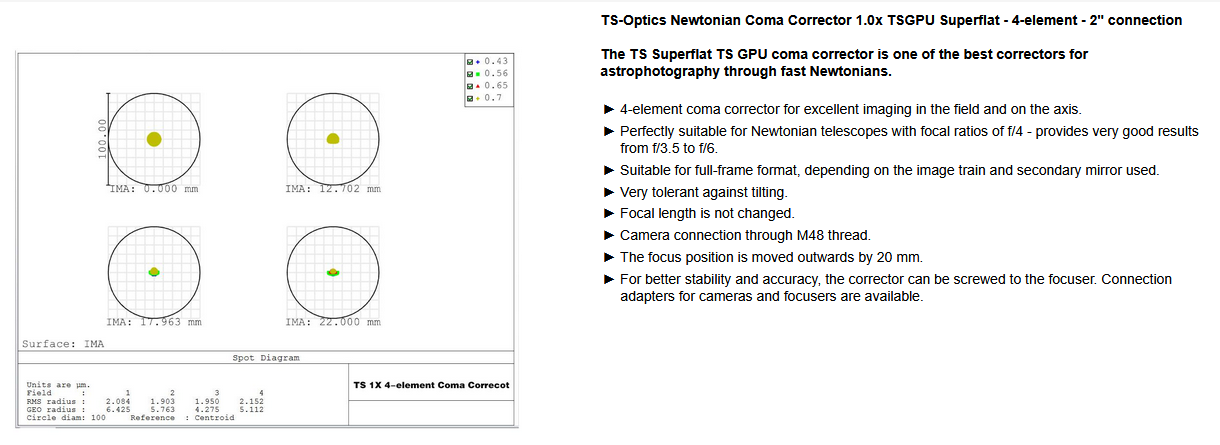
As per the below excerpt from the TS website shows the SW/TS-GPU CC *can* cover the FF format, depending on the image train e.g., the size of the secondary and its position w.r.t. the focal plane (surface, in reality).
texasastrophotography avatar
Hmmm, okay you all got me reconsidering again, haha. I'm going to have to dig even more into this then!

It's interesting to see Yingtian used the same coma corrector as me for the image of M104. I know flats can clear out a lot of vignetting, but would be curious in how much there was in the 'flats' taken for that image. Regardless, this is all pretty promising information you all have provided me and has me getting my hopes up smile

I sent out a contact form to TS in regard to the above coma corrector to see if they can help me determine what kind of vignetting, if any, I'd experience with my current hardware, and to let them tell me if they need more details or not. The little "suitable for full-frame format" snippet is pretty exciting to see. I can report back once I'm gathered more information with that (for anyone else in the future looking for this same kind of information).
Stephen Jones avatar
When you get time why not send Yingtian a private message with you questions.
texasastrophotography avatar

Alright, it’s been 6 months… And it’s been quite a journey with my entire upgrade, but I went all out and I thought I’d share here. Whether this is what someone in the future who finds this is looking for as an answer or not, I still wanted to make sure I didn’t just leave this thread on a permanent dead-end.

Through my journey, I found that the imaging circle to my telescope was likely even smaller than I “calculated” before. This was further supported by me remembering that even my 1600mm had some vignetting in the corners that I didn’t really think to be related to the imaging circle.

That being said, I talked a lot with Player One Astronomy about their Poseidon-M vs. Zeus-M models, with in mind that I will likely go with a 300P or similar for my upgrade. Their support staff is AMAZING. They worked with me through out my entire journey and we came to a conclusion to get the Poseidon-M (they legitimately helped me determine this was the best choice - didn’t try to just up sell me for money like some other companies might try to do!)

Of course, why it took 6 months? Well, I can’t say my entire upgrade was flawless. While I’ve always looked to Skywatcher as being a great brand, this last experience I had with them was enough for me to likely never go with them for future products again.

1.) I bought a 300P from Highpoint Scientific. Unfortunately, the clips I got that hold down the mirrors were misaligned and the screws to hold them down were bent at around 30 degrees (not exaggerating) - I found this out when trying to remove them so that I could install a custom mirror mask I made. I had to go between HPS and Skywatcher a bit through email until I finally was able to get a swapped RMA from Skywatcher (thanks to HPS reaching out directly to them) for the setup. Emailing Skywatcher has been a poor experience here - if you leave them detailed messages with a lot of information, don’t expect more than maybe 2 sentences in a response. Unfortunately the entire experience left a horrible taste in my mouth.

2.) The Poseidon-M I got worked, but after creating my dark library, I noticed some… weird dark shadows in my images. I shared these with Player One, and they sent the FITS files to their engineers and confirmed I had a defect in my camera. They were fully cooperative with me to swapping out my Poseidon-M with a brand new one under the warranty, and even provided me sample images of the dark frames with the same exposure + temperatures that I target - I got to choose which of 4 cameras I liked the dark frames the most and they sent me that one. I did not expect such awesome support!

That out of the way, the rest of my upgrade has (so far, knock on wood) been a great experience, even if there were times of me pulling my hair out. So here’s where I finally landed:

  • Skywatcher 300P Quattro Newtonian

  • Still the Skywatcher Coma Corrector

  • iOptron CEM120

  • iOptron Tri-Pier 360 for CEM120 Mount (Yeah I don’t have my own pier, too scared to trust myself to make one)

  • Sky-Watcher 355 mm Universal D-Plate (so that I could attach the scope directly to the CEM120, as the default dovetail that comes with the 300P protrudes and won’t fit on it)

  • Chroma 50mm filters (LRGB + Narrowband)

  • FHD-OAG MAX

  • Phoenix Wheel 7x50mm

  • Xena-M Guide Camera (as my 224mc could not obtain focus with the FHD-OAG)

  • Various other lil things to make my life better

Weather has been terrible for a while and because of the few issues I ran into (2 hardware, others just my personal lessons learned), I am finally taking my first photos with the whole new setup with what so far appears to be success (we’ll see once I get to the actual integration and stacking phases of course lol).

Related discussions
Strange circles in my image
Posted is a screen grab from Pixinsight. This image is very curious to me because I'm not sure whats going on here. So some info 51 images stacked in Siril, with no flats, darks, biases or dark flats. I wanted to see the raw image with no calibra...
Both posts discuss technical challenges encountered while attempting to improve their astrophotography imaging results.
Apr 2, 2025
Optimized Newtonian - Is it worth it?
There are a lot of ways I can think of that the current crop of Newtonian Astrographs can be improved. Lets restrict the conversation to apertures between 6 and 10 inches. 1.) Lowering the focal plane relative to the side of the tube (eliminate the f...
Both posts discuss technical challenges related to focusing and mounting camera equipment on Newtonian telescopes.
Jul 28, 2025
Custom M54 tilt adapter to suit QHY CFW3M-SR & OAG-M system, fits within 55mm BF - Design Files Included!
Hello all. I have a QHY 294M-Pro, CFW3M-SR, and OAG-M fitted to my Vixen R200SS newt. I have been battling tilt with my 294M ever since I bought it, and have been stumped by the lack of suitable tilt adjusters available on the market (especially in M...
Both posts discuss challenges with selecting and configuring specialized camera equipment and accessories for astrophotography telescopes.
Jan 1, 2025
Newt Astigmatism: tilt or secondary mirror?
Hello, I'm struggling to get good star shapes across images from my ONTC 10" F4, specifically around the corners. I tried everything and can't seem to locate/confirm the source of my problems. Some information about the setup: General Se...
Both posts describe troubleshooting optical or mechanical issues with wide-field astrophotography setups that are causing image quality problems.
May 24, 2024