Daniel Petzen avatar
Hi

I've been looking for my future telescope for quite some time and have looped back to the 14" GSO carbon truss RC after a long conversation with a very experienced astronomer.

My main concerns with the GSO RC telescopes were collimation and cleaning of the exposed mirrors. I've been told that the latest versions aren't that difficult to collimate and don't need it very often, especially if used in an observatory. It was also suggested that cleaning the mirrors can be done as rarely as once a year and is not a major problem.

I've also read a few horror stories where the GSO truss has been causing serious errors in getting good collimation, with a lot of people proclaiming it's a quality issue. This was also disputed by the astronomer I spoke to.

This is not just my "next" telescope for me, it's "the" telescope. This is what I'll be using for a long, long time.

The primary use will probably be, at least in the beginning, imaging galaxies, planetary nebulae, quasars and other small objects at native focal length, but I'm likely to get a reducer and do wide field object as well in the future.

I have an observatory (astro-shed really!), am in the process of building a pier and will have it on an EQ8-Rh.

It would be great to hear your view about what I've discussed and anything else that would be good to know before deciding.

Thank you!

Cheers,
Dan
Respectful Engaging
Christopher Gomez avatar


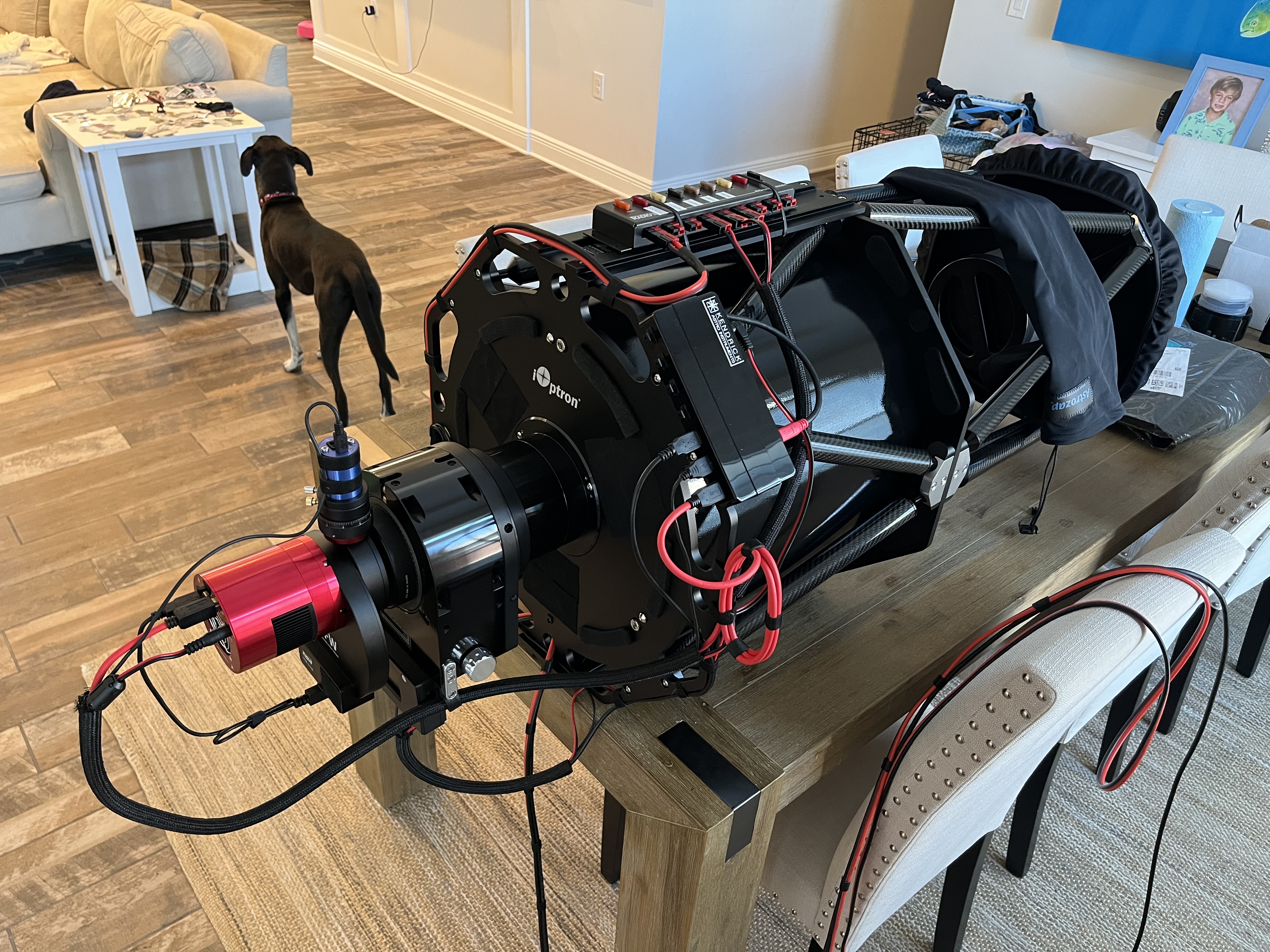
Hi Dan, I’ve been working in getting my ioptron RC14 all rigged up. Just waiting on my pier to be constructed. I am using the 3” flattener designed for it that doesn’t change the focal length. I have use the same setup for the RC 10 truss version and it worked out really nicely… see my astrobin photos. I don’t find these scopes difficult to collimate as long as you collimate the 3 components in order; focused then secondary and lastly the primary. I am hoping that my pier will be ready by April and then I should be up and shooting away
Helpful
Daniel Petzen avatar
It must be really hard to have that sitting on the dining table and just waiting for the pier!
I had a look at your images and if that is what you can do with 10", then I can't wait to see the images with the 14" :-)
Btw, are you using a laser collimator, and if so, which one?
Well Written Respectful Engaging Supportive
Christopher Gomez avatar
Its killing me! I've had it sitting there since Dec. I use the RC8 for a long time, then moved up to the 10'' and used that for about 2 years. Now I'm at the 14" and can't wait to start imaging. I use the Howie Glatter https://agenaastro.com/howie-glatter-2-635nm-high-brightness-red-laser-collimator.html wich comes with the dot attachment but I also use the concentric circle attachment to get the primary mirror collimation pretty close https://agenaastro.com/howie-glatter-holographic-attachment-concentric-circle-pattern.html .
I do my final adjustment to the primary with a star defocus test under the starts. You will also need a cheshire collimator to do the secondary https://www.highpointscientific.com/apertura-2-collimation-cap?utm_source=google&utm_medium=cse&utm_term=APT-CC2&utm_source=google&utm_medium=cpc&utm_campaign=20618277309&utm_content=&utm_term=&gad_source=1&gclid=Cj0KCQjws-S-BhD2ARIsALssG0aeFJIE3LNQEEvLvKhr5ZfrTfpGpA-KtTtXjja_L6Bjr3YFovwUca0aAkbNEALw_wcB

With this you'll be all set to collimate any RC no matter how misaligned the optics are!
Helpful Engaging Supportive
Pedro Goles avatar
I have used a 13' GSO RC, but after some years of saving, finally could buy an expensive CDK 14. 
The GSO was a good machine but not the best one. It's cheap, with high contrast regardless its central obstruction. I took many good pictures with it. BUT it have issues with the main mirror basis ("pintched" optics) and a raw border that produce rare reflection on stars. Once with a expert in optics we dismantle it, clean the mirror and paint the border with a permanent black pen,  and the images get really better. Collimation was a nightmare because there was some misalign of the optics elements with the baffle tube…
Also, it have a quartz mirror, with more temperature expansion that other good ones (read it as refocusing with each frame)

At last: a good starter scope for deep sky objects, but not a really good one. You shall consider improve your images taken with it using software in a pre-stacking time.

Good luck,
Pedro Goles
Helpful Engaging
[deleted]
@Christopher Gomez That's a good lookin' rig. Noticed you had the fans taped over and gaps on the rear plate plugged with foam. Wondering what the story is there.

Are the holes only covered for dust control while not in use, or do you plan to keep them covered while imaging, too?
Well Written Engaging
Christopher Gomez avatar
With my truss RC10 I didn't use them, with my setup being permanent in my roll off obcservatory, I find that I can just roll to roof off 1-2 hrs before sunset and I have plenty of time for temperature to equilibrate. While cleaning my scope I found dust and dead bugs that get in there and so I chose to just cover them up. The foam and tape are somewhat breathable as well
Yuexiao Shen avatar
Christopher Gomez:


Hi Dan, I’ve been working in getting my ioptron RC14 all rigged up. Just waiting on my pier to be constructed. I am using the 3” flattener designed for it that doesn’t change the focal length. I have use the same setup for the RC 10 truss version and it worked out really nicely… see my astrobin photos. I don’t find these scopes difficult to collimate as long as you collimate the 3 components in order; focused then secondary and lastly the primary. I am hoping that my pier will be ready by April and then I should be up and shooting away

Chris

Look forward to your test results

Yuexiao
Jose Salcedo avatar

Hi Christopher - I am buying a 14” GSO LW scope now and plan to fit it with a NiteCrawler 3.5” WR35 focuser that I already have in a refractor. What OTA flange-adapter did you use? Thanks

Well Written Respectful
Christopher Gomez avatar

Hi Jose, you would need the RC 117mm flange for it.

Helpful
Jose Salcedo avatar

Great! What I thought but wanted to confirm. Thank you and best regards.

Well Written Respectful
Gerald avatar

Hi Daniel,

I am using the GSO 14” RC for a year now.

The mirrors are excellent and the truss tube is stable enough to give me 10min unguided exposures.

A few days ago I just installed the 0,8x full frame reducer/corrector. The stars did not really get smaller (this was my hope), the flat fields are trickier, the +20% FOV is not really necessary, but the f/6.5 ratio gain is of course a winner.

You can check my gallery with a test image after I installed the reducer.

In addition here are some galleries which you might want to check.

Installtion of new mount and scope: https://photos.app.goo.gl/XbGPhFq2kTs5wLrV7

Collimation with Howie Glatter Laser and TSKOLLI-G2 https://photos.app.goo.gl/wJMNB2Aj6Q8isyye9
Upgrading the mirror cell: https://photos.app.goo.gl/95kFsom5Z52sNyQDA

But you should be aware of the mechanical issues with this beast.

  • The main mirror cell and the collimation screws are not the best in it’s class. The standard cell might squeeze the mirror and the collimation screws are too rough to perform the fine twists which are necessary. I am using SkyWave for the last step in the collimation procedure, which is a big help.

  • I upgraded to the TS carbon mirror cell after 6 months. The mirror is now much more relaxed and holds the collimation. This is a big price jump and also needs some handcraft skills.

  • I never used the original focuser. Detached immediately and stored as-is in the box, replaced by a Pegasus Prodigy. A friend is using the Esatto focuser on his GSO 16” successfully.

  • The baffle tubes are too short, too wide. You need to 3d print an extension in order to avoid stray light entering it. Otherwise this would ruin your flats. You can google them, they are available for purchase or to download the STL model.

  • The secondary mirror cannot really be moved in XY axis, so you need to align and tilt all other variables to find a compromise.

  • You might need to invest a bunch of money into proper collimation tools (and software licenses) for an RC, if you don’t have them already.

    Best,
    Gerald

Well Written Helpful Respectful Engaging
Daniel Petzen avatar

I really appreciate all the responses, and I’m glad the discussion has answered a few other questions as well.

If I go for a GSO RC, then it’ll be a 14”. Partly because of the physical space in my observatory, but also because I think the extremely heavy mirror in the 16” is starting to cause some problems.

It has unfortunately become and academic question for me, as I can’t afford a new telescope at this time. I’m still very keen to try the 14” or perhaps the 12” when I have the finances for it.

Well Written Respectful