Should I bin 2X2 or higher when shooting?

6 replies218 views
Johnathan Allison avatar
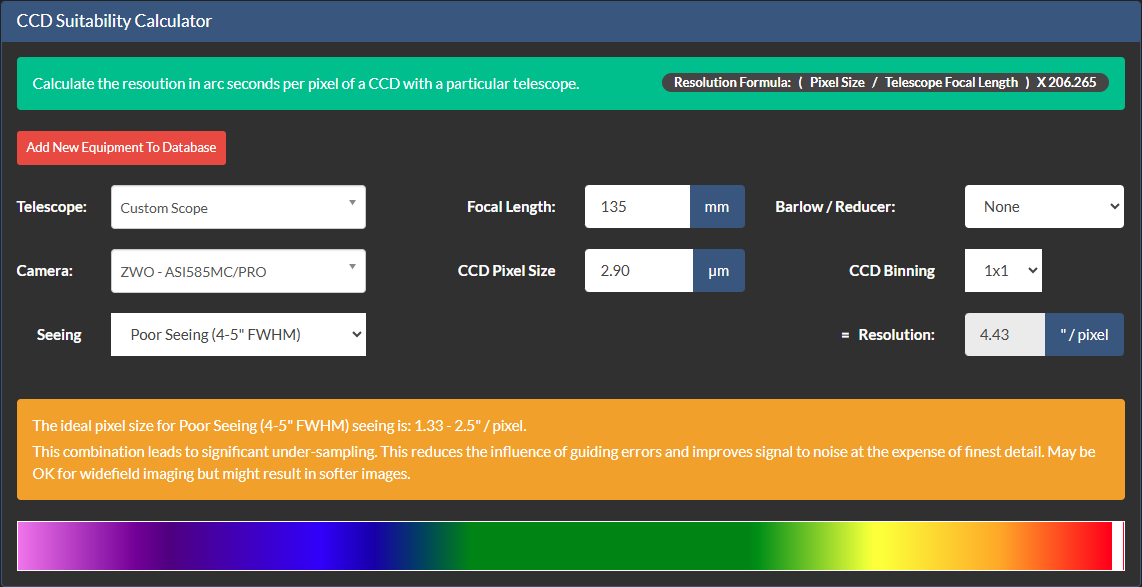
I am shooting with a ZWO-ASI585 MC PRO coupled with the Rokinon/Samyang 135mm F2 Lens. I am Undersampled right now with a res of 4.43"/pixel.  I am new and have gotten pretty comfortable with my setup and what to start exploring ways pull more detail out of my imaging. 

I am currently researching Binning/Drizzling and how I might utilize these either in the field or back on my PC. I was wondering what would  prove more beneficial. I don't get a lot of clear nights so I want to make the most out of my sessions and have anxiety of trying new things and possibly losing a whole night of imaging. A better understanding of what is happening would help with that anxiety. I will throw a screenshot of the astronomy.tools page below. 

If anyone has words of wisdom about this, it would be greatly appreciated.
Engaging
andrea tasselli avatar
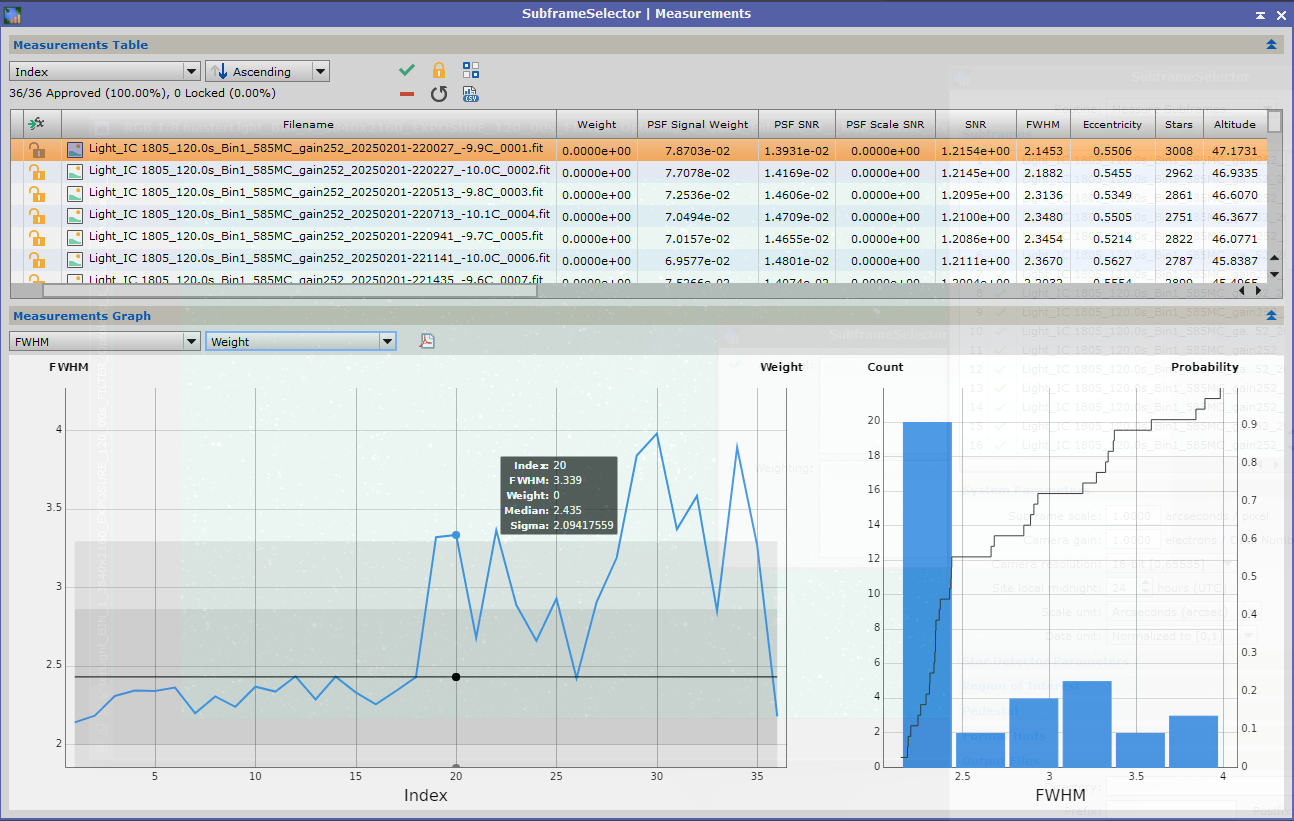
What's you average FWHM?
andrea tasselli avatar
Incidentally, you'd want to drizzle not to bin 2x2 (which is the opposite).
Johnathan Allison avatar
andrea tasselli:
What's you average FWHM?

2.669 Is my median
andrea tasselli avatar
2.669 what? Pixels, I'd presume. If so you are already optimally sampled as you are.
Johnathan Allison avatar
andrea tasselli:
2.669 what? Pixels, I'd presume. If so you are already optimally sampled as you are.

I have no idea what I am looking at lol. also I picked a different set of sub from a different target. the 2.669 was from a different target. 

andrea tasselli avatar
At your image scale it can only be pixels. So it is around 2.5 pixels give or take 10% (maybe 20%). At the best of times, if you dither agressively, got good SNR on each single frame and got a very large number of them you can try drizzling 2x then apply deconvolution and then downsample to the original scale with pretty much no major effect on final SNR. Otherwise just leave as it is. Personally, I never found drizzling 2x to be of any benefit unless your median FWHM is less than two pixels, with the other caveats withstanding. Applying "smart" deconvolution (i.e., BXT) can lead to some serious issue unless all the concerening ceveats are complied with. Users be warned.
Helpful Insightful Concise
Related discussions
ASI294mm Pro Bin 1x1 or Bin 2x2
Hello fellow astronomy enthusiasts! I've been using my ASI294mm Pro in combination with my William Optics GT71 for a couple of months now. So far I've been using the bin 2x2 mode, which results in pretty substantial undersampling. Now it'...
Directly addresses binning modes and undersampling trade-offs with different cameras.
Feb 22, 2023
Samyang 135 with Optolong L-enhance
Hi all! is anyone using the Samyang 135mm together with the Optolong L-enhance (clip-in) at low f-ratios, e.g. 2.8? I’m seeing things like not all filters work with fast systems, and am wondering whether the L-enhance is a good match for the rokinon ...
Uses same Rokinon/Samyang 135mm lens; discusses imaging parameters.
Feb 12, 2023
Saturated Pixels?
Hello, First time posting for guidance here, thanks in advance. I tried imaging a wide field with my 85mm Sigma Art lens and my ASI294MC Pro. In the image below, there is a section with what appear to be saturated pixels? Blue and red pixels. While t...
Relevant - discusses binning with ASI camera; relates to exposure optimization.
Oct 9, 2023
Dedicated astrophotography camera paired with the Samyang/Rokinon 135mm lens?
Hello fellow astrophotographers! So i was looking into upgrading from a DSLR to a dedicated astrophotography camera, and i was worried about pixel size, oversampling, undersampling etc. I’m looking into a color camera and I plan to pair it with a Sam...
Discusses binning and undersampling with Samyang 135mm and ZWO camera.
Jun 28, 2023
Band shift vs more integration time
What would you choose? I have shot an image I’m quite happy with at f/2 and my 7nm Optolong Ha filter. However, I am aware I might have gotten some band shift. I was shooting other things and I didn’t pay attention to the f-stop at the time. Since th...
Discusses integration time optimization, relevant to maximizing detail from limited clear nights.
Nov 24, 2025