Here I share a review I did of the IDAS DTD, with a small comparison to the Idas GNB for wide angle astro.
Idas DTD
The IDAS DTD (Dual Band Type D) is a filter that, although primarily designed to capture emission nebulae with color cameras under light-polluted skies, has proven to be surprisingly effective in landscape astrophotography for capturing the Milky Way as well.
Unlike other more restrictive dual-band filters (such as the Idas NBZ-II, the Optolong L-eXtreme, or others), the DTD allows a certain amount of starlight and galactic background light outside its central bands (Ha and OIII), resulting in a more colorful image where not only the typical bluish-green areas of oxygen or the reddish areas of hydrogen alpha are highlighted, but also golden and yellowish tones emerge in the central regions of the galaxy. This warm hue—unusual for a dual-band filter—makes it especially attractive for those seeking single-shot compositions without the need to mix with additional RGB exposures. In short, it is not a "pure dual band" in the strictest sense, and that works in favor of the landscape photographer, as it allows capturing not only emission but also the color and texture of the stellar environment, maintaining a very natural chromatic profile within its category. As is usual with Idas filters, the DTD performs very well with fast wide-angle optics (f/1.4 to f/2.8), which is essential in night landscape photography. Unlike other filters designed for telescopes, the DTD does not significantly shift the passbands or introduce strange halos, making it a perfectly valid option for use with quality photographic lenses and, if desired, also with longer focal length lenses.
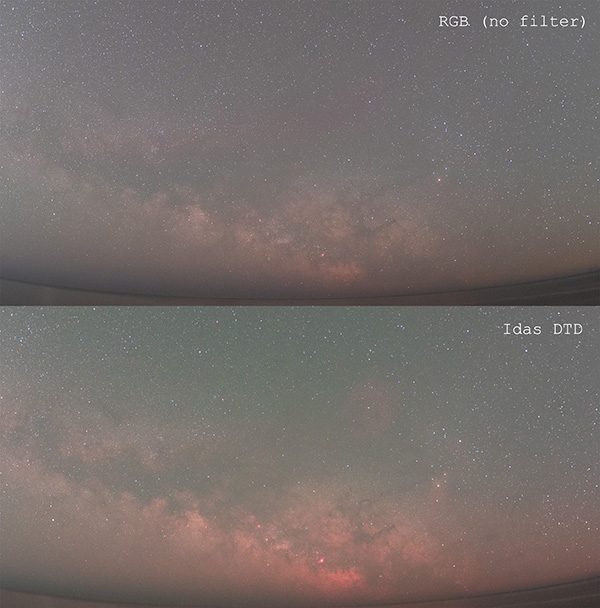
Comparison between an RGB (11mm, f2.8, 30 seconds, iso 1200) shot and a DTD shot (11mm, f2.8, 120 seconds, iso 2000), with WB correction.
Idas DTD vs Idas GNB
Both the IDAS DTD and the GNB are designed to enhance astrophotography with color cameras in light-polluted environments, but their approaches are very different, and this is especially reflected in the type of final image obtained, both in detail and in chromatic richness.
The IDAS GNB is a multi-band filter designed to moderately suppress light pollution. It is primarily focused on the Ha and OIII lines, although it allows some information from other bands to pass through. As for the DTD, it captures much more information and does not completely eliminate the areas between bands, allowing additional nuances to seep through. The result is equally contrasted images (not as much as those obtained with the GNB), but rich in colors, where warm tones (yellows, golds) appear in the central region of the Milky Way, in addition to the classic blues and greens of the nebulae, and the reds of the Hydrogen alpha. This combination provides a very attractive and powerful aesthetic, even without the need to combine with RGB shots.
In Milky Way photography, this translates into a clear difference:
- With the GNB, a bicolor image is obtained, in which the areas with H-alpha stand out. That can be very useful for, for example, photographing the winter track, where there isn't much color variation when shooting with wide-angle lenses, but not for the summer track, as it has a lot of other colors.
- With the DTD, a more expressive and colorful image is achieved, with approximately 1.5 more stops of light, and it often does not require complex post-processing or combination with RGB shots. Therefore, it is a more suitable filter for capturing the summer Milky Way if we don't want to combine filtered photos with RGB photos.
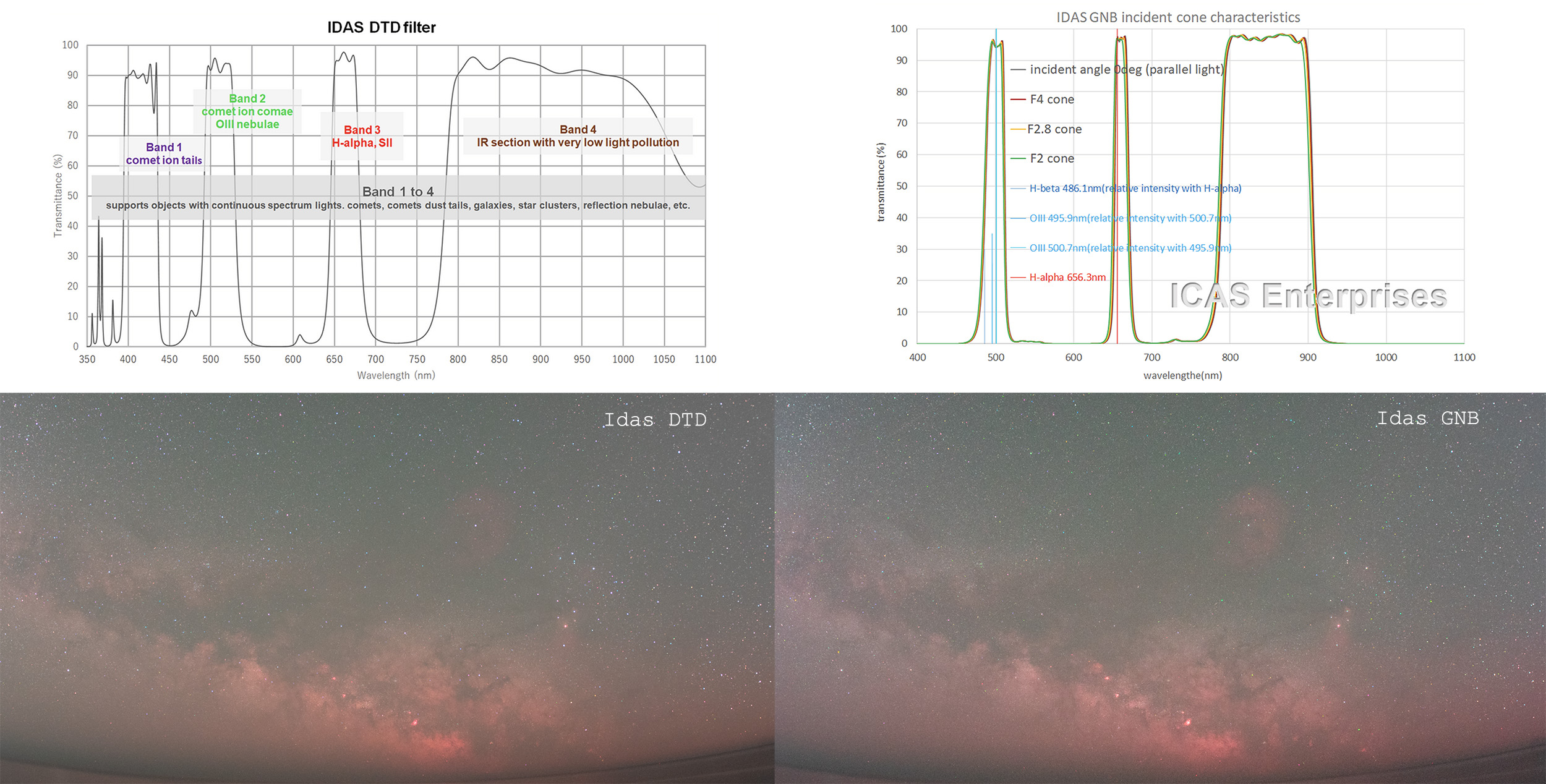
Comparison between the capture graphs of the Idas GNB and the Idas DTD, and between the capture of information from the Milky Way between the two filters. Parameters of the Milky Way photographs: 11mm, f2.8, 120 seconds, iso 2000 for the DTD photo, and 11mm, f2.8, 120 seconds, iso 2000 (+ one and a half stop exposure compensation to match the DTD shot) for the GNB photo. Both ewith WB correction.
Conclusions
The IDAS DTD filter stands out as a versatile and effective option for landscape astrophotography, especially in capturing the Milky Way under light-polluted skies. Unlike other more restrictive filters, it allows for greater starlight entry and a richer, more natural color reproduction. Its design makes it ideal for single shots without the need to combine with RGB images. Compared to the IDAS GNB, it offers a warmer and more expressive aesthetic, ideal for the summer Milky Way.
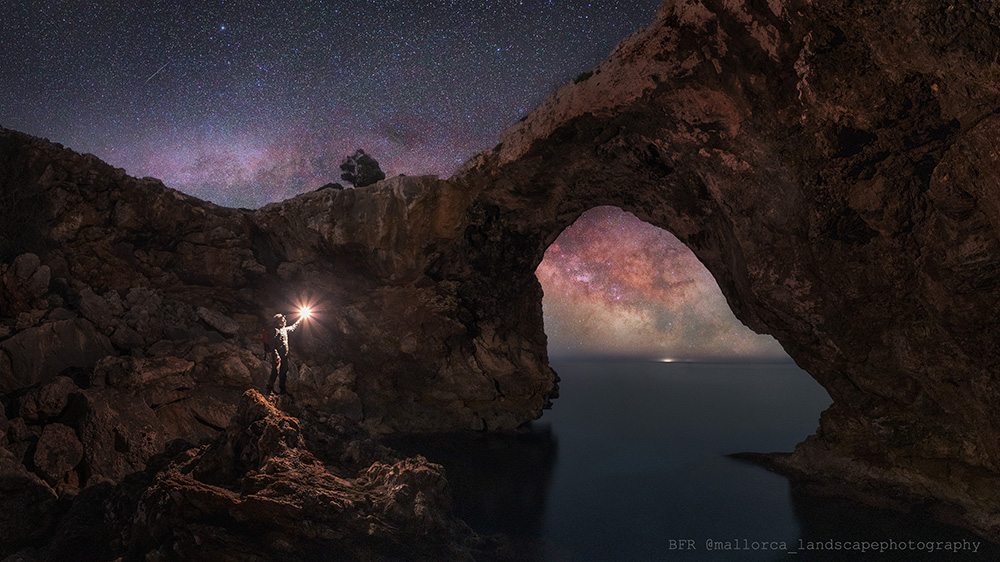
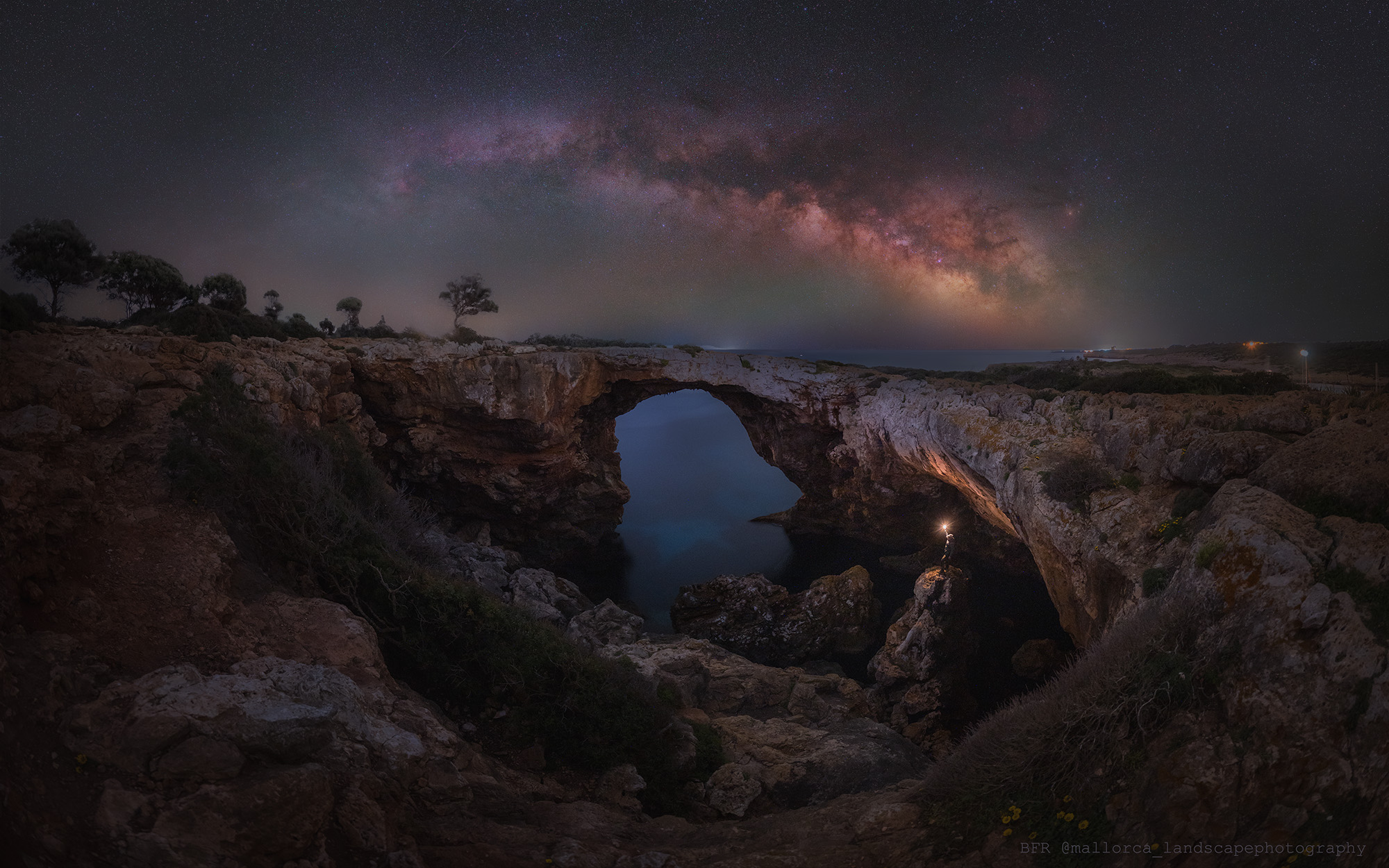
Panoramas taken at 11mm, f2.8, 120 seconds, iso 2000, with the DTD filter


