It’s not aliens.

9 replies498 views
Sean Mc avatar
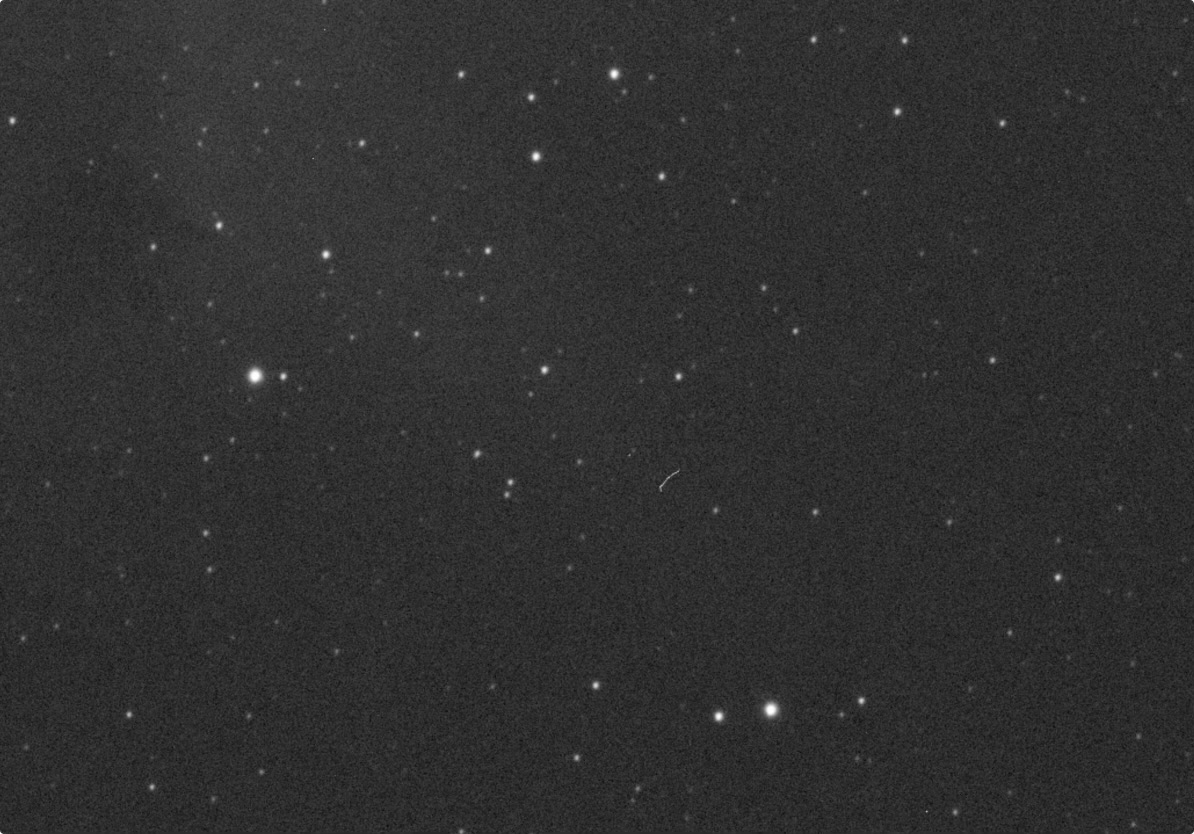
But what is it?  I get something like this, sometimes more squiggled almost every night. Not in the same place either. 
Brian Puhl avatar
Those are cosmic rays hitting your sensor.
Sean Mc avatar
I had one that made a loop like a cursive lowercase L before. Cosmic rays can do that?
D. Jung avatar
There are different particles with different mass and energy connected to what we refer to as "cosmic rays". Those have different atenuation properties and thus different stopping ranges in the sensor.
So, depending on what particle hits your sensor you might see different effects.
A high energetic muon will probably just pass through in a straight line and trigger a single pixel, while electrons can bounce off multiple times and create curly paths.
Helpful Insightful Respectful
Sean Mc avatar
Well that’s interesting. Maybe I’ll save some of the more interesting ones and create a collage.
Shannon Foye avatar
I don't remember the reference but straight lines are supposedly cosmic ray strikes and curves lines are from ground-based radiation. Ground based radiation streaks was stated to be more commonly experienced when the imaging setup is on concrete.
Oskari Nikkinen avatar
I was testing dark current of my RisingCam IMX571 camera a couple years back and left the camera running for a total of 27 hours with an hour per exposure also to see if there are "hits" on the sensor.

The image is downsized a little bit and saved as a lower quality JPEG to fit the 5mb limit here, but loads of streaks can still be seen in the image. The image was stacked using maximum value combination so that they are easier to see, and was also just stretched to make them visible (less than 2 electrons per hour at -10c). In the raw data i measure these streaks ranging from a few dozen to a couple hundred electrons. And i also occasionally see these in my subs, as well as the reject high image that Siril saves if the option was ticked.

Camera was in my 6th floor apartment at the time, so plenty of concrete all around. As far as i know there is no way to tell if some of these are cosmic rays, but it is possible. Most likely they are from local sources of background radiation, but still an interesting test.
Helpful Insightful Respectful Engaging
D. Jung avatar
If you have too much time at your hand and some dry ice
https://www.youtube.com/watch?v=BeohJbfgp_M
TiffsAndAstro avatar
D. Jung:
There are different particles with different mass and energy connected to what we refer to as "cosmic rays". Those have different atenuation properties and thus different stopping ranges in the sensor.
So, depending on what particle hits your sensor you might see different effects.
A high energetic muon will probably just pass through in a straight line and trigger a single pixel, while electrons can bounce off multiple times and create curly paths.

are there strong enough magnetic fields inside a camera to cause an electron to curve it's path tightly enough to hit multiple pixels?
Engaging
D. Jung avatar
TiffsAndAstro:
D. Jung:
There are different particles with different mass and energy connected to what we refer to as "cosmic rays". Those have different atenuation properties and thus different stopping ranges in the sensor.
So, depending on what particle hits your sensor you might see different effects.
A high energetic muon will probably just pass through in a straight line and trigger a single pixel, while electrons can bounce off multiple times and create curly paths.

are there strong enough magnetic fields inside a camera to cause an electron to curve it's path tightly enough to hit multiple pixels?

The main effect here is probably scattering. Exact path are difficultl to predict, and usually you would use Monte Carlo simulations to do that. I didn't read the full paper but you can see an example here
https://www.researchgate.net/publication/26306197_Experimental_observation_of_the_improvement_in_MTF_from_backthinning_a_CMOS_direct_electron_detector 

You would need magnetic fields of several 100mT to ~1T, even for low energy electrons to create this type of deflection over such short distance. 
If you feel like it you can use Lorentz equation to calculate it (if you do that for the relativistic case, it becomes a nice coupled differential equation to solve on a rainy Sunday).
Concise
Related discussions
Mysterious star trailing solved: a cautionary tale of fan vibration with a fan cooled (especially ZWO) camera.
Suddenly after no problems with star shapes, the next night out they were just terrible! Below I show a gif comparing two 2 hr stacks, one with the good stars, and the next with elongated stars. In this example the distortion was vertical. But later ...
Addresses mysterious recurring artifacts in astrophotography images similar to author's experience.
Nov 18, 2025
Secondary mirror coating issue or possible light leak problem?
I was considering sending my secondary for my ago idk 14.5" over to terry at ostahowski optics for a recoat because if I look closely enough, I have what looks like an oil spot or something that slightly dulled a small part of my secondary coating th...
Discusses optical issues causing image artifacts that could explain nightly occurrences.
Nov 3, 2025