Weird "star" on only 1 5-min Ha acquisition

15 replies825 views
Jure Menart avatar
Dear forum,

I did first light on my new refractor (Takahashi FSQ-106edx4, camera ZWO asi294mm, Baader Ha 7nm filter). I have a lot of issues still (late nights, a lot of other things) with focuser and also auto-guiding, so no final image yet But first few images were 5-minute subs with hydrogen alpha on Pelican Nebula.

I am quite happy with them (not other filters and full project yet, quite defocused etc etc ). But I am wondering if forum would know what is happening on 2nd sub. There is additional star that is not there on 1st, 3rd or any other out of 18 frames I did in that hour and half:
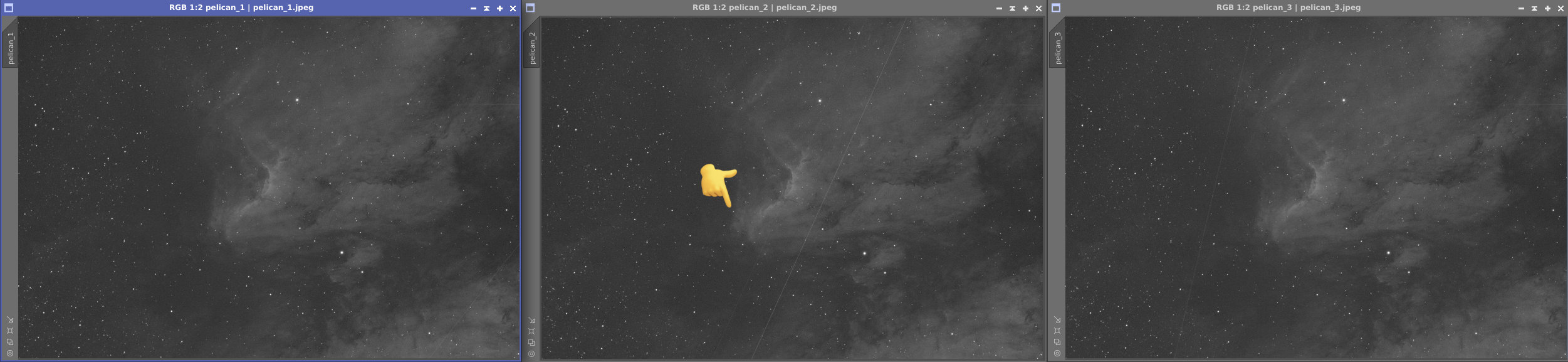

I hope it is visible, it stuck out quite obviously when I did blink in PixInsight. One can see normal satellite trails but this star is there only for 1 5-minute sub. Any idea what could it be?

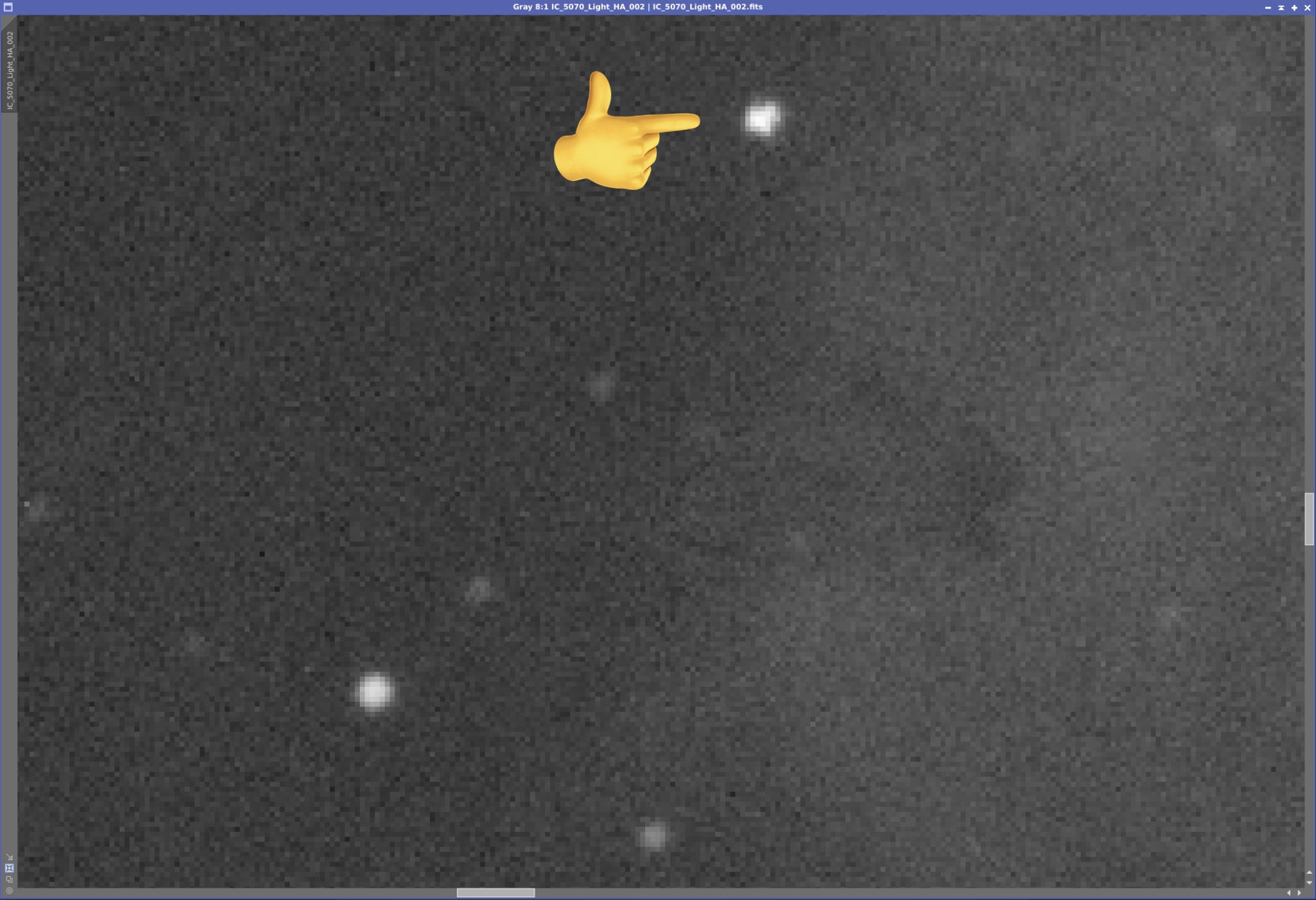
Zoomed in picture shows the star is a little bit deformed (in the frame with other lower bright star for comparison):
Sean Mc avatar
I’ll throw out a guess…. Aliens. 

or… maybe a geo sat that just happened to flare at that time?  I’m guessing it flared for shorter than 5 minutes, which gave it that funny shape.
Scott Badger avatar
Could be a meteor moving straight towards you. So, no visible trail, just a bright spot that appears for a couple seconds and then fades.

Cheers,
Scott
Well Written Insightful Respectful Concise
Oscar H. avatar
a random splatter of hot/cold pixels maybe
Jure Menart avatar
Sean Mc:
I’ll throw out a guess…. Aliens. 

or… maybe a geo sat that just happened to flare at that time?  I’m guessing it flared for shorter than 5 minutes, which gave it that funny shape.

Hi Sean,

I was thinking the same - it could be geo satellite, it's still weird to flash only once - but for me it's most plausible explanation at this moment
Jure Menart avatar
Scott Badger:
Could be a meteor moving straight towards you. So, no visible trail, just a bright spot that appears for a couple seconds and then fades.

Cheers,
Scott

Hi Scott,

Maybe. But that would be reeeeeally weird a? But it's one of the possibilities of course
Jure Menart avatar
a random splatter of hot/cold pixels maybe

Hi messierman,

Maybe. But would be really weird to have so many temporary hot/cold pixels grouped together I think...
Scott Badger avatar
Jure Menart:
Hi Scott,

Maybe. But that would be reeeeeally weird a? But it's one of the possibilities of course

I've seen meteors in that way 3 or 4 times. The last time was just last week. I looked up and and saw what appeared to be a planet, but brighter than Venus, a little redder than Mars, and where there shouldn't be a planet (near Polaris). It didn't move and was visible for a few seconds then quickly faded away.

Cheers,
Scott
Well Written
TiffsAndAstro avatar
No idea but it looks square compared to your other stars
Jure Menart avatar
TiffsAndAstro:
No idea but it looks square compared to your other stars

Yeah it indeed does interesting and puzzling
Jure Menart avatar
Scott Badger:
I've seen meteors in that way 3 or 4 times. The last time was just last week. I looked up and and saw what appeared to be a planet, but brighter than Venus, a little redder than Mars, and where there shouldn't be a planet (near Polaris). It didn't move and was visible for a few seconds then quickly faded away.

Cheers,
Scott

Hi Scott,

Yeah it seems this is the most logical explanation. Funny though to have such a direct path Thanks for your comments!
John Hayes avatar
For some reason, CMOS sensors are not as susceptible to cosmic rays as CCD sensors; however, it's still possible to catch one every once in a while.  Depending on the angle of incidence a cosmic ray can produce all kinds of interesting patterns.  I don't know exactly what this is but I wouldn't rule out the possibility that it's due to a high energy particle.  I used to see stuff like this all the time with my 16803 based cameras.

John
Well Written Insightful Respectful Concise
Josh Walawender avatar
I think John is on the right track with a cosmic ray, that was my first thought.  Is the image you showed raw, or was it processed in any way?  A cosmic ray would typically have sharp edges, but processing steps such as shifting or rotating the image in preparation for stacking can re-bin the pixels and smooth the edges.

A geosynchronous satellite would trail over time (of order 15 arcseconds per second), so the flare would have to be very short lived to produce a point source.

-Josh
Well Written Helpful Insightful Concise Engaging
Sean Mc avatar
Aren’t geo sats supposed to be stationary?

cosmic ray sounds plausible too.
Jure Menart avatar
Josh Walawender:
I think John is on the right track with a cosmic ray, that was my first thought.  Is the image you showed raw, or was it processed in any way?  A cosmic ray would typically have sharp edges, but processing steps such as shifting or rotating the image in preparation for stacking can re-bin the pixels and smooth the edges.

A geosynchronous satellite would trail over time (of order 15 arcseconds per second), so the flare would have to be very short lived to produce a point source.

-Josh

The images I showed aren't heavily processed - I stretched them and convert them to JPEG just for me easier to add pointing finger.
deleted avatar
I posted a new topic about this but was redirected here as I too have a weird "flash" of light in only one sub of the lagoon.  This sub is only 90" by the way.
Related discussions
How to use Blink efficiently
Hi, I am using the Blink process to select my good frames. But I think I do not understand how it is meant to be used. Here is what I am doing:Open all relevant subs in Blink - this gives me a long list, all items are checkmarkedGo through them with ...
Blink helps identify quality frames from multiple subs for better final results.
Jan 5, 2026
Blue Reflections of Bright Stars
[Note: this topic was previously posted to Cloudy Nights]I recently imaged regions containing exceptionally bright stars (e.g. Alnitak) and noticed some unusual reflections. The reflections appear strongest in the blue channel but are also apparent i...
Similar optical artifacts with Ha filter and bright stars; troubleshooting approach applicable.
Jan 30, 2023