I am the owner of an old F7.0 WO 110 mm 'apo' triplet. It is a great scope for visual - and I am fond of it -- but when taken down to F 5.5 using a FLAT III6A 0.8X reducer/ flattener it doesn't yield an entirely flat field for astrophotography. Not bad but no cigar. There is still some recalcitrant coma around the field edges - that I can't remove by varying flattener spacing to the sensor - and also some slight astigmatism. When you pixel peep it is clear that these diffraction differences create 'rainbow' effects that are evident in the colours of larger stars nearer the edge of the field.
Rather than just replace the WO scope I have been interested to see how far software only solutions can improve things to a level that I am happy with.
It will be no news to anyone that BlurXt AI version4 does an excellent job of sorting star shape -- as well as providing some interesting options for tweaking star and halo size which can help with colour.
What I did find however was that while applying the Blur Xt correction to the luminance the shape is improved but the irritating colour aberrations still remain.
Here is a fix - using PixInsight and Blur Xt - that worked very well for me (could well be well known to experts already but I thought to post it up in case useful)
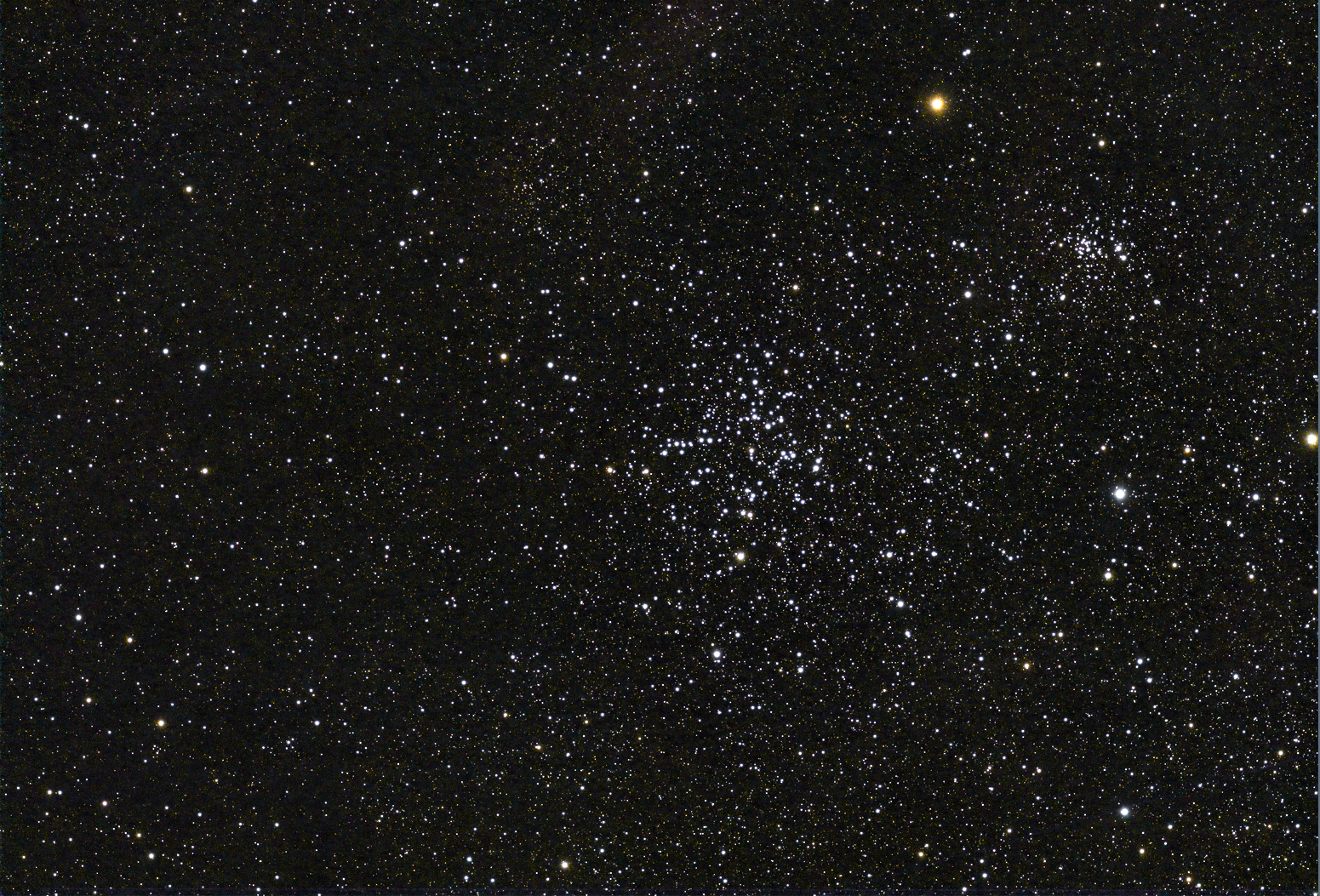
My particular example here was from 133 x 20s exposures using an ASI 294MC camera observing a field of sky around M38. 1.55 arc sec/ pixel dithered.
Processing steps were ..
1) 2X drizzle integration
2) ABE background removal
3) SPCC colour correction
4) Channel extraction into R, G and B followed by BlurXt correction only of the three channels
5) Then use 'star alignment' to register the Blue and Red channels to the green (I used max distortion 0.7 and always for PSF fits)
6) Then equally combine the three re-aligned channels into a single RGB image again using Pixmath
7) Then optionally apply star reduction, noise reduction et etc
The star alignment seemed to do a good job of aligning the three corrected colour channels and at least - in my set up and for this starry subject - the improvement was really quite dramatic, Picture below is of a highly blown up part of the field showing a distorted star very close to the edge of the field. The first image is as uncorrected, the second after applying BlurXt correction to the luminance and the final picture after carrying out processing as above.

The final wider field looked good enough - for me anyway - to be happy with the current setup and not hanker after more expense and kit (yet) :-). Tim

Rather than just replace the WO scope I have been interested to see how far software only solutions can improve things to a level that I am happy with.
It will be no news to anyone that BlurXt AI version4 does an excellent job of sorting star shape -- as well as providing some interesting options for tweaking star and halo size which can help with colour.
What I did find however was that while applying the Blur Xt correction to the luminance the shape is improved but the irritating colour aberrations still remain.
Here is a fix - using PixInsight and Blur Xt - that worked very well for me (could well be well known to experts already but I thought to post it up in case useful)
My particular example here was from 133 x 20s exposures using an ASI 294MC camera observing a field of sky around M38. 1.55 arc sec/ pixel dithered.
Processing steps were ..
1) 2X drizzle integration
2) ABE background removal
3) SPCC colour correction
4) Channel extraction into R, G and B followed by BlurXt correction only of the three channels
5) Then use 'star alignment' to register the Blue and Red channels to the green (I used max distortion 0.7 and always for PSF fits)
6) Then equally combine the three re-aligned channels into a single RGB image again using Pixmath
7) Then optionally apply star reduction, noise reduction et etc
The star alignment seemed to do a good job of aligning the three corrected colour channels and at least - in my set up and for this starry subject - the improvement was really quite dramatic, Picture below is of a highly blown up part of the field showing a distorted star very close to the edge of the field. The first image is as uncorrected, the second after applying BlurXt correction to the luminance and the final picture after carrying out processing as above.
The final wider field looked good enough - for me anyway - to be happy with the current setup and not hanker after more expense and kit (yet) :-). Tim