Collimating an Edge 8" for the First Time

13 replies933 views
Jerry Gerber avatar
Hi!

I am going to replace the factory screws with Bob's knobs this evening and collimate the Edge HD 8" scope for the first time.  I plan on doing it with the ASIAIR Plus in focus mode, where I will see an image of the out-of-focus star every 1/2" and check the out-of-focus star in both directions (too far and too close).  Then I will collimate.

My question is this:  Rather than use an 10mm or smaller eyepiece,( I'll be  using my ASI2600 camera.  Will this  produce a magnification good enough for collimation?

I much prefer to do it electronically through a tablet so I don't have to continually bend down to look through the eyepiece and then move to the corrector plate to make the adjustments.  

Thanks for any advice from those that have done collimation this way with a SCT.

Jerry
Engaging
Blue avatar
I used to do something similar when I was imaging with a C925 (Not an Edge)

The C925 had some residual coma so I used to do it in focus at high gain and an exposure time which would allow me to see the coma (Actually quite short, longer exposures tended to blur the coma away due to seeing) When the coma of the stars around the edges was all pointed directly away from the centre of the field I called it good enough and checking with ASTAP agreed.

I believe Metaguide has a built in function to help do this on a centred star as well if you configure it to use the main imaging camera not a guide cam, examining the residual coma so you can dial it out.
Helpful Insightful Respectful Engaging
Jeff Horn avatar
When I collimate my edge8, I use a zwo 294 and put the Asi Air in "video" mode.  I adjust the gain / exp settings to get a decent image of the donut.  I make slight adjustments and can see the result in real time.  I just take care to "center" the donut manually with the arrows between each adjustment.
Helpful
Rodolphe Goldsztejn avatar
I did the same a year ago: replace legacy knobs with Bob's knobs on my C8 EdgeHD. Had to collimate as expected; did it on a faint start, with a planetary CMOS cam (QHY 5L II), the one I use for guiding, and a 2x - 3x Barlow for the final steps.
A trick you may find useful: don't take too short exposures, turbulence is "killing" the process and you'll never know when you reach the sweet spot. Rather use an exposure time like 1/4 s or ½ s - just long enough to average out the turbulence –> the image becomes then perfectly readable on screen. Collimation is fun ;)
Helpful Insightful Respectful Engaging Supportive
Jerry Gerber avatar
Yesterday I decided to install Bob's knobs.  I followed the instructions exactly as directed.  After installation, I found them cumbersome and difficult to turn in tiny amounts.  I could not achieve good collimation with the knobs and decided to  remove them. I did so very carefully, one at a time, making sure that the other knobs were tight and aiming the scope slightly downward to avoid the secondary mirror falling off.

I replaced the knobs with the original Celestron screws and then proceeded to achieve good collimation in less than 10 minutes, and this was my very first time collimating a scope.  I found that the original screws are much easier to turn in very small increments.

My question is this:  I think Bob's knobs were a little  longer than the original screws, and a tiny bit thicker as well.  One was difficult to turn to remove. 

Might I have damaged the secondary mirror or stripped the threads of my new telescope by trying to install these?  And how would I know if there were any damage?

I won't hob nob with Bob's knobs any more!!
Well Written Helpful Engaging
Rodolphe Goldsztejn avatar
Did you purchase the "right" model of Bob's knobs - if I recall it well, there are several sizes available, and one thing for sure is that those for a classical C8 are not the same length as those for the EdgeHD (I had both).
In my experience, the knobs fit perfectly, turn easily, and allow for an easy adjustment in the dark.
Helpful
Jeff Horn avatar
Just my 2cents :   I avoided the Bob's knobs, just too many alternating views on how they held collimation.  I did however replace my phillips head collimation screws with allen head screws of same depth and made the process much easier.  Never felt that the phillips head screws were very accurate and always felt to be slipping or stripping when I turned.
Helpful Concise
Jerry Gerber avatar
Hi all,

Is there anyone in the San Francisco Bay Area that could teach me how to collimate my Edge 8?  I really botched it up and could use some help.  I am happy to pay or barter with someone.  There are no telescope repair places anywhere near me so I really have to learn how to collimate this myself but I am really struggling with it and am eager to get back to imaging.  If so, please contact me at jerry@jerrygerber.com, or at 415 242 4003.

Thanks!
Jerry
Well Written Respectful
Rodolphe Goldsztejn avatar
Living in Switzerland, that would be a long stretch and a costly support ;)

You may want to have a look at these instructions to get you started:
http://www.bobsknobs.com/resources/Literature/Instructions_English_a_Cass.pdf
http://www.bobsknobs.com/faq/faq.html#How_do_I_perform_coarse_collima --> particularly the section "How do I perform coarse collimation after installing Bob's Knobs?" which is useful whether you have Bob's knobs or not, and the following section about star collimation "How do I collimate using a star?".

More detailed instructions, especially if you aim for high resolution photography, can also be found here: http://www.astrophoto.fr/collim.html.

Star collimation is quite easy to perform with a planetary cam.
Accessories such as Bob's knobs are really helpful in this respect - no risk of scratching the corrector plate with a screw driver.

Hope it helps.
Well Written Helpful
Michel Makhlouta avatar
Hi Jerry,
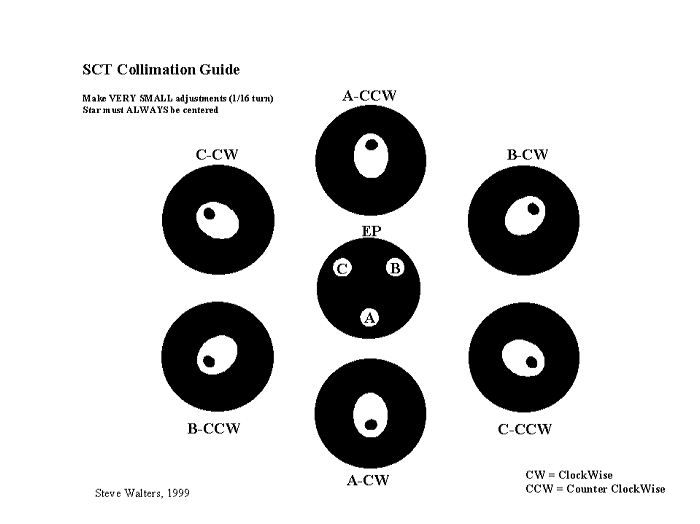
Make sure to do it at the native FL, without the reducer installed. After replacing the knobs, my collimation was way off, like the center is stretched outside of the donut. It takes some fiddling to get it to normaly donut shape again. The below is what I use, but upside down if I remember correctly (just align C, B and A with the knobs on your EHD):
Jerry Gerber avatar
Thank you Rodolphe and Michel!


If I am using the ASIAIR and a tablet to collimate, does the above chart still apply, or is everything inverse?
Well Written Respectful
Rodolphe Goldsztejn avatar
Michel may know better than me - I tend not to note those things as I collimate only every once in a while, more intuitively.
Blue avatar
One thing to be aware of with these (Unless Celestron have changed the design) is that the mirror sits on a post and the screws pull it back against and tilt it around the post. The three screws need to be snug to ensure the mirror does not move around (Not tight, just snug) and when you tighten one you have to loosen one or both of the others. That is opposed to a typical Newtonian or similar primary mirror where the cell floats in the center and the three screws around the edges act more or less independently of each other.

If you really tighten the screws up it might even distort the mirror, I can't recall how the mirror is mounted on it's cell.
Helpful Insightful Respectful
Michel Makhlouta avatar
Jerry Gerber:
Thank you Rodolphe and Michel!


If I am using the ASIAIR and a tablet to collimate, does the above chart still apply, or is everything inverse?

I retired my EHD a while back, just look at it from the front and align the A/B/C. If I remember correctly, when having this image on my phone, I used my phone upside down

So A was up, B and C down
Related discussions
Advice for troubleshooting edge 8 with hyperstar v4
IMG_3065.jpeg hello, I purchased an edge hd 8 and hyperstar v4 recently and set it up tonight for a trial run. I’m having a focus issue and was hoping for some advice on diagnosing and fixing the issue. On a previous night I used the star method to c...
Discusses Edge HD 8 setup and focus issues relevant to your scope.
Nov 22, 2024
RC8 Collimation using Innovations Foresight SkyWave
Hi, I will soon resume AP using my GSO RC8, that hasn't been used for 2 years and travelled a bit by car in between. Last time I checked it wasn't collimated anymore. I doubt it will be when I'll get it out of retirement (never works that...
Covers collimation procedures for similar aperture reflector telescope.
Aug 26, 2024