Homemade RGB filters

8 replies275 views
matt113d avatar
I recently bought a ZWO asi178mm camera with a view to eventually purchasing some RGB filters to produce colour images but also give me freedom to select my own bands for imaging. Not long after it arrived I decided I wanted colour images now. Without the money to buy them straight away, I was curious how well homemade filters would perform.

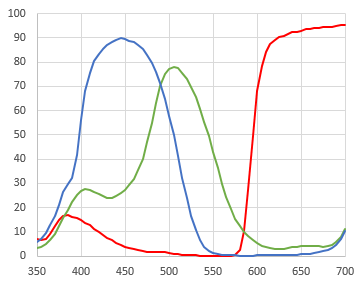
I coloured in some glass microscope cover slips with red, blue and green Staedtler permanent markers and characterised each of their spectral transmissions using a spectrometer I have access to at work. The results speak for themselves. I haven't had chance to take any images yet to test their practical effectiveness but I will provide an update when I have.

I will provide a graph below. The green is not as good as I'd hoped so I will be testing some other inks but I wanted to use a brand that people could easily access to try this for themselves. Please let me know if you have tried this or seen someone else try this. I have searched but I haven't found any post online detailing an attempt to produce homemade RGB filters.
Helpful Insightful Respectful Engaging
Lilith Gaither avatar
Awesome experiment, Matt! I can't wait to see how it goes!
Well written Respectful Supportive
astropical avatar
Hi Matt,
With permanent markers – amazing!
Green is near 100% in the ASI178MC specs :-)
Anyway, how would you rate the performance of your ASI178MM (in monochrome) as compared with a crop sensor DSLR when aiming at DSOs?
Cheers
Robert
Wei-Hao Wang avatar
Hi,

It’s great that you are doing this experiment. Do show us the results.

Just by looking at the curves, I would suggest to pay attention to two things. First is the transmission above 700nm. The leakage of very-near-infrared light may have some (or huge) impact to the image quality or color saturation or color balance. The second one is that the overlaps among the three curves are much larger than that for typical astronomical RGB filters, and perhaps even somewhat larger than the RGB Bayer filters in DSLRs. This may substantially lower the color saturation. It can be fixed in post-processing though.

Cheers,
Wei-Hao
Well written Helpful Insightful Respectful Engaging Supportive
matt113d avatar
Thanks for the responses.

The overlap/colour balance issue doesn't bother me too much. As you say, it can be corrected in post-processing. Really the point here is to produce colour images with a mono-sensor as cheaply as possible. I'm going to characterise some other green inks as clearly it's the weak link. As I stated before, it is important to me to use pens that could easily be identified and sourced by other people.

The NIR issue is definitely more pressing. I am currently looking for a cheap material with which to coat the glass that will produce the short-pass filter required. Though, again, the colour balance will be tricky to fix with the NIR in the mix, but not impossible. I could be wrong but I would imagine that the image quality loss would only really be a factor in refracting telescopes (because of chromatic aberration)? So reflectors would be okay. It might be possible to remove the NIR SP filter from an old camera but this is not really in the spirit of DIY in my opinion.

The main practical issue as I see it is coating the glass uniformly and without introducing scattering. Flat corrections will remove non-uniformity in the coating but scattering is a real issue. I think this merits the greatest challenge.
Helpful Insightful Respectful Engaging
altazastro avatar
Hi Matt,With permanent markers -- amazing!
Green is near 100% in the ASI178MC specs :-)
Anyway, how would you rate the performance of your ASI178MM (in monochrome) as compared with a crop sensor DSLR when aiming at DSOs?
Cheers
Robert


I can answer to this one: when compared with an unmodified Canon EOS1300D, which has a 37% peak Q.E., it is literally another league: much more sensitive.
To give an idea, the Rosette Nebula imaged with a 100 mm refractor and the DSLR for 75 minutes gives more or less the same results of 45 minutes with the 178MM paired to a Tamron 135 F2.8 (which as approximately a 48 mm aperture).
Also the monochrome sensor facilitates processing in my opinion, and the absence of a Bayer mask in front of it improves resolution.
Since I bought the 178MM, I'm using the DSLR almost only when its much larger sensor is needed for width of field reasons.
Helpful Engaging
astropical avatar
Thanks very much for your view, altazastro,
I just saw your images. Amazing - with a 90mm MAK, ASI178MM and on an AZ-GTi!!!
I think the key is to choose a monochrome camera for sensitivity. The ASI174MM seems to be a good choice for lunar work as well.
So many images uploaded, when do you sleep?
Cheers
Robert
Respectful Supportive
Wei-Hao Wang avatar
I could be wrong but I would imagine that the image quality loss would only really be a factor in refracting telescopes (because of chromatic aberration)? So reflectors would be okay. It might be possible to remove the NIR SP filter from an old camera but this is not really in the spirit of DIY in my opinion.

Most reflective scopes for astrophotography still contains refractive elements, either as field flattener, reducer, or coma corrector.

You may want to take a look at this image of mine:
http://www.astrobin.com/189410/0/?image_list_page=3&nc=
You can click it to see the larger version.  The purple star is caused by a very small near-IR leakage in the filter.  It's so small that most of the stars look just normal.  However, on this star it becomes apparent because that star is super bright in the infrared, even brighter than Vega.  The scope is a reflector, with refractive corrector lenses.  Either the coating or the chromatic aberration correction in the refractive elements are not so optimized for the near-IR.  So when there is infrared light coming in, the image quality becomes very poor.  This is a combination of a small IR leakage and a very bright IR star.  Now imagine if the IR leakage is larger and this happens on every regular stars.
Helpful Insightful
HR_Maurer avatar
Hi Matt,
i know from experience, permanent marker strokes usually are several µm thick. Depending on your painting technique, this could introduce some distortion like anisotropic stay light and more. Did you already look at airy discs produced with these filters?

CS Horst
Insightful Respectful Concise Engaging
Related discussions
Considerations when purchasing a camera
Hi everyone, I am considering the purchase of a dedicated Astro camera, currently using an unmodified Canon 5D Mark III on a 120 Skywatcher ED Apo. I would like to be able to photograph all objects but I think my priority would be DSOs, galaxies and ...
Relevant - discusses ZWO camera selection and RGB filters for DSO/nebula imaging.
Sep 7, 2018
[RCC] Wizard Nebula - OIII Filter Halo Reduction
Pretty new to astrophotography and have been going through my first NB sessions. I'm processing all in PixInsight, and for the most part things have been going pretty well following some well-carved workflows I've found online. In this image ...
Discusses filter usage with ZWO camera for narrowband astrophotography processing.
Oct 27, 2020
RGB filter reflections from bright stars
Hi - I just started processing some of my RGB data captured over the past few weeks using the ZWO RGB "optimized for ASI 1600" filters. As I researched, I now understand I may be dealing with expected performance with very low cost filters,...
Directly addresses RGB filter performance with ZWO ASI camera system.
Nov 26, 2020
Any need for an IR/UV cut filter with a ZWO ASI 2600MM-Pro mono camera, which doesn't have a IR/UV cut window?
I have ordered a ZWO ASI 2600MM-pro mono camera (for luminance mainly initially anyway) which doesn't have an IR/UV cut off window. Do I need an IR/UV cut filter for it as currently I do not have any CA using my ZWO ASI 2600MC-Pro colour camera (...
Covers IR/UV filtering considerations for ZWO mono cameras like author's model.
May 26, 2021