Autoguiding with Planets

Michael TimmSaffaswedeObservatório Astrográfico do BoqueirãoMichael JulianoTony Carro
28 replies1.2k views
Michael Juliano avatar
Good morning,

In order to improve the quality of my planetary shots, I was going to try autoguiding with PHD.  Has anyone tried this with planetary shots?  Does it even work?  I was concerned because my planetary scope has a fairly large focal length (1540), and I often use a 2x barlow, and I wonder how much good guiding will do at that level of magnification.

Any thoughts or experience?
Well written Engaging
Michael Timm avatar
I do not think that this will make sense. During planetary imaging a single frame has low integration times (like 8 ms or something). Autoguiding will not improve images taken with an integration time that low. Most guiding setups send corrections in intervals of 1-6 seconds to your mount.
Well written Helpful Insightful Concise
Michael Juliano avatar
I guess that's my question, at that Focal length, can PHD work fast enough, and will my 50mm guide scope have the resolution to keep the planet centered in the frame?

The more I think about it the more I am doubting that it will work. smile
Michael Timm avatar
I dont think that this will work. The seeing is far more problematic than the small deviation from the tracking within that 8 ms. And you cant use an autoguider to avoid seeing-problems. Man, that would be great :-)
Michael Juliano avatar
And you cant use an autoguider to avoid seeing-problems. Man, that would be great :-)


What we need is an adaptive mirror and a laser like the VLT... When do you suppose those will be on the amateur market?  Oh well, it was nice to kick the idea around...
Michael Timm avatar
I would love to own this really great solution, but i assume that the pricing is somewhat too high for my astro budget :-)
Steve Walkenshaw avatar
Normally when I have taken planetary shots with my 1250mm and barlows, I made a movie then processed it using Pipp, AS!3 and or Registax6.  My understanding is that due to the waves in the atmosphere, this method gives you the best chance of capturing several clear shots, and then those are stacked.  I think I read about it called "lucky imaging"  I had some nice shots for my equipment
glennb44 avatar
Adaptive Optics isnt that expensive for amateur astronomers.
https://optcorp.com/products/starlight-xpress-active-optics-with-usb-qsi-compatable

With my ZWo camera I use Firecapture and simply select Auto align and the planet just sits still (apart from translation distortions of seeing).  Thats what you are really wanting.  I am using 3000mm focal length Meade12inACF and 2x barlow, on a well polar aligned Titan mount. The postprocessing is faciltitated then. Some guiding corrections are then applied during liveview capture.

Cheers
GlennB
Concise
Michael Timm avatar
Didn't know that. Amazing. This thing is on my wishlist now :-)

[Edit]: After doing some research and reading reviews, this thing remains on my wishlist, but at the bottom of it. I have to check if it really fits both my approach and my setup.
Greg Powell avatar
Glad you asked, I am just now starting to dabble with planetary imaging and the thought of guiding to keep the subject from drifting has been on my mind. So it seems to just "chase" the subject via the mount controller to keep up with any drift is the way to go then. Thank you all. smile
Adel Kildeev avatar
My five cents: I would suggest to invest into polar allignment (the cheapest way  - to use Polar Scope Align App for Iphone or similar, helps a lot). With good polar allignment you do not really need even PIPPsmile
JOHN COX avatar
Yes. You can get it polar aligned close enough with a polar scope  or other methods for planetary. A little known secret is that a small amount of drift can be beneficial with planetary, assuming you're using high frame rate camera. Let's say  for example, you have dust spots on the sensor. If the planet was perfectly centered, that dust spot would  be concentrated on that same spot on every frame. But as it slowly moves, you get a better random mix of pixels. You also get a better random mix of hot and cold pixels. Otherwise the hot pixels (image noise) are also concentrated in the same spot or region of the image on every frame. A very small amount of drift is not a bad thing at all. It does'nt have to be perfect with planetary.
Helpful Insightful Engaging
Saffaswede avatar
Everyone keeps on telling me this, “Guiding is not necessary for planetary.” Okay, well what if I would like to do it regardless? Even with good polar alignment there IS drift. I don’t want to make small manual adjustments every so often. I want to concentrate on learning FireCapture, in the moment, with a real subject in front of me. Understanding how all the many, many settings affect the shot. That means hours on a target. … and hours of making irritating small adjustments. So with that in mind, for those of you who have ACTUALLY guided for planetary, could you please share how you did it and what the results were.
Well written Engaging
Saffaswede avatar
During my FireCapture education, I learned that FireCapture itself has planetary guiding functionality. … and it works GREAT! Here is the link to the tutorial. https://www.youtube.com/watch?v=hoNJq_YmEtk
Tommy Blomqvist avatar
This would only make sense on very dim planets and asteroids (or comets).

And in that case you may lock on to the target with your guiding software if it is bright enough for your guide sensor.
Sean van Drogen avatar
Saffaswede avatar
Tony Gondola avatar
Michael Juliano:
Good morning,

In order to improve the quality of my planetary shots, I was going to try autoguiding with PHD.  Has anyone tried this with planetary shots?  Does it even work?  I was concerned because my planetary scope has a fairly large focal length (1540), and I often use a 2x barlow, and I wonder how much good guiding will do at that level of magnification.

Any thoughts or experience?

If the object is drifting out of the field then the simplest thing to do is get a better polar alignment. You don't say anything about your setup but I assume that if your scope has a native FL of 1540mm then it's on some kind of equatorial mount that can be polar aligned. SharpCap has a tool that will help you get an alignment in just a few min. If you're not using it, you should. It's a simple process and there no reason not to use it. 3080mm really isn't that long for planetary and imaging runs are short and as has been mentioned, a small amount of movement is helpful (dithering). Guiding using PHD2 will not help you at all, in fact, it would probably reduce the number of good frames. The answer is a decent polar alignment
Helpful Concise
andrea tasselli avatar
I used to image at around 8-10 m of FL using a GP-DX and guiding (even if it were to be available, which wasn't) wasn't not only never entertained but never actually though to be desirable feature at all. A good PA, as Tony mentioned above, will keep even the largest planets (Venus & Jupiter) centered in the FOV with occasional nudges using the handset.
Observatório Astrográfico do Boqueirão avatar
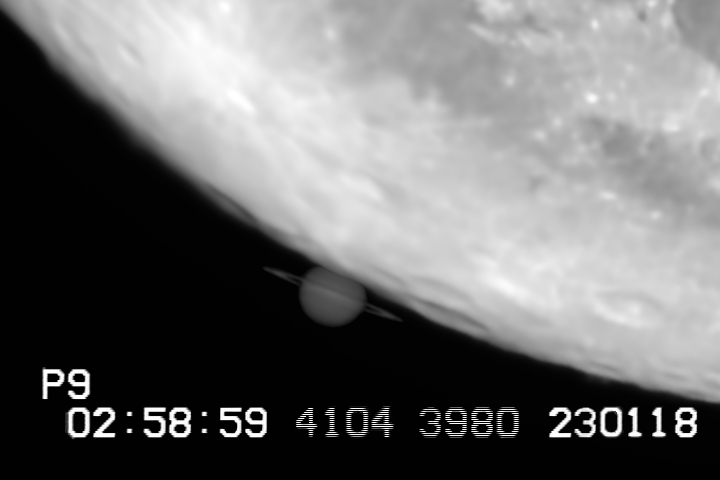
I actually did guiding in the last Saturn Occultation. Not because I needed for capture small videos, but it was the way that I found to keep the planet as center as possible during the night and the event, since I was at 6400mm in a SCT using a tiny CCD sensor from the old school. Any brease at the focal lenght would take the planet out of the way.
I guided using a mid guide scope on the planet itself, which did a perfect job. In my situation, a few minutes before the first contact between the planet and the Moon, I switched to Titan who was still visible, and then ended a few minutes after the complete occultation. Then 45min later I did the same thing when the planet came out from the other side of the Moon, starting with Titan, the going to the planet. I only used PHD2 to do this.

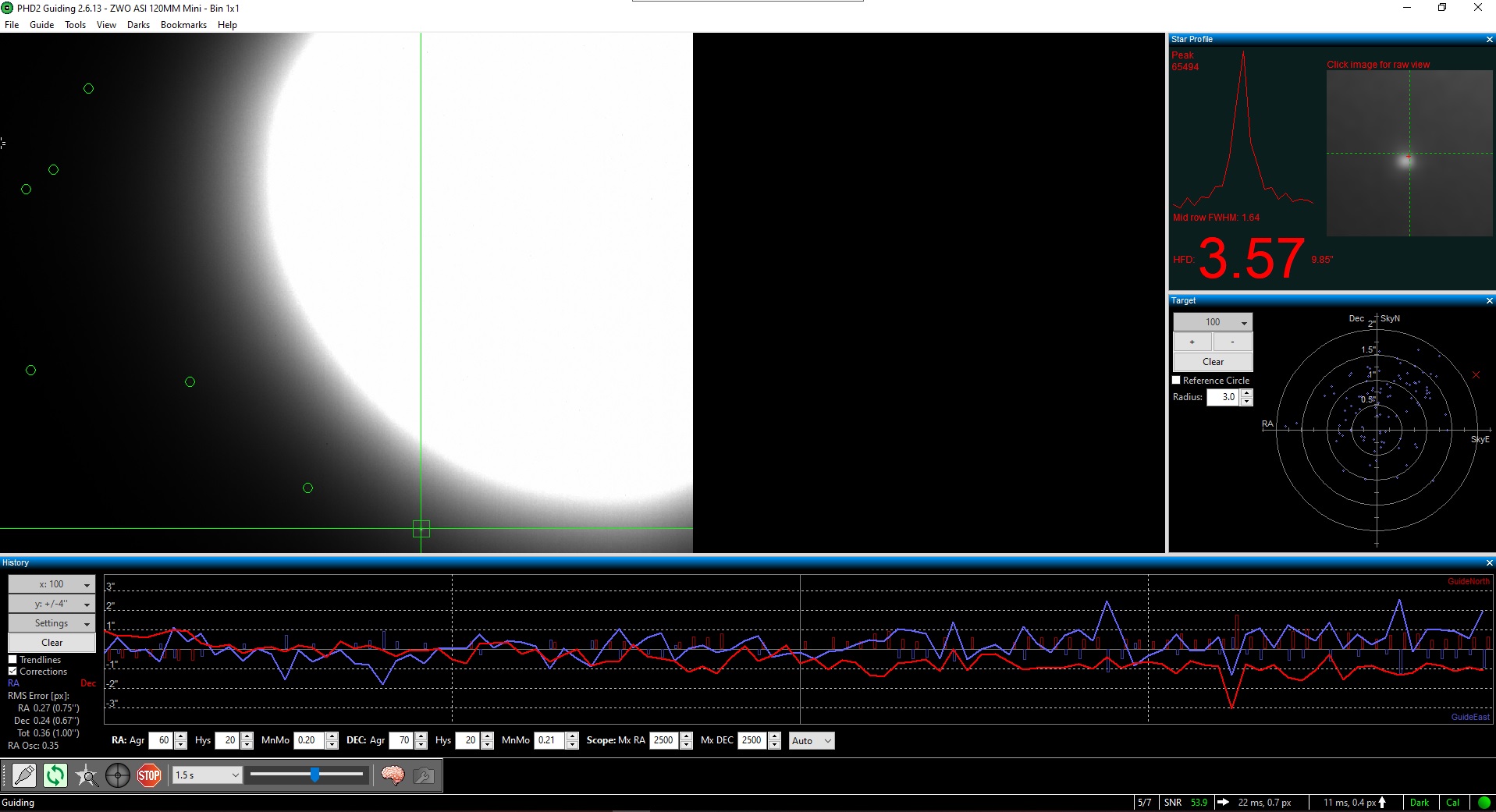
Here's a peek of the guiding (I'm at 1" of RMS, because I wasn't with a good polar alignment at the time and I was guiding with too much brightness because of the Moon, but usually my mount goes around 0.50" in this situations.


This was my final result on the main camera:


Regards,

Cesar
Helpful Insightful Respectful Engaging
Tony Carro avatar
That’s a great shot, amazing capture!
Observatório Astrográfico do Boqueirão avatar
Tony Carro:
That’s a great shot, amazing capture!

Thank you Tony
It was hard to process, specially because the moon and the sensor that I was using, but at the end I think it was a good image. I would love to do it again

Regards,

Cesar
Tony Carro avatar
Makes me want to try and take a shot of Saturn with my 765mm Refractor never have before just DSO and just starting at that.
Observatório Astrográfico do Boqueirão avatar
Tony Carro:
Makes me want to try and take a shot of Saturn with my 765mm Refractor never have before just DSO and just starting at that.

You should do it!
Do you want to know something cool? I used a medium size guidescope to to the guiding and the C8 for imaging, but for do the perfect align with the two scopes, I used an eyepiece first. and when I saw the planet through the C8, everything falled in my head: it was like.. damm I didin't put an eyepiece in any of the scopes in almost 4 years. And I miss it! I miss doing some visual astronomy. 

Because of this, I preparing myself, even bought a few days ago some planetary glass filters to play this Autumm with visual astronomy and enjoying some views of the planets.

Regards,

Cesar
Tony Carro avatar
I have a couple of lenses that have not been used yet.  A Baader 31mm and a Baader zoom lens both 2 inch variety.  I have a 25 year old Nexstar 8 that I need to put right by the imaging scope.  Weather is real nice outside in my backyard.
Related discussions
Six lessons learned by a professional astronomer in his first six months as an amateur.
Having retired as a professional astronomer and moved to a rural (Bortle Class 3) site in New Zealand, I decided to take up the hobby of astrophotography six months ago. I started with a good knowledge of astronomy, CCD processing, but no kit apart f...
Professional astronomer shares astrophotography lessons relevant to improving imaging quality.
Dec 2, 2020
Autoguiding camera
I’m looking at getting an autoguiding camera and have been looking at either the ZWO ASI120MM with an Agena or William Optics 50mm guide scope or the Altair Skywave package that has the Altair GP130M and a 60mm guide scope. Does anyone have any exper...
Autoguiding with Planets — discusses autoguiding implementation with similar equipment considerations.
Feb 28, 2018
ZWO cameras for solar system imaging
Hi again, I know that ZWO has many cameras can be used for planetary, and there are 2 or 3 models can be used as popular for planets, but if we are planning to add the moon and the sun in the equation or question, are there benefits for another camer...
Discusses planetary imaging quality improvement techniques relevant to camera selection.
Aug 24, 2018
Adaptive Optics With Mid-Sized Refractor
I was wondering if anyone has experience with adaptive optics on refractors (or anything in the 300-500mm range) and can say or presume how much of a difference it makes in image quality over regular guiding. I'm mostly a backyard imager so I do ...
Adaptive optics discussion applicable to high magnification planetary imaging challenges.
Nov 4, 2018
Star elongation
Good evening. The past few nights I've been trying to image M13. However, I've noticed I'm getting a fairly uniform elongation on the stars. I think it's roughly aligned with the RA axis. This is the first time I've noticed the is...
Star elongation issues may relate to guiding problems at high magnification.
May 18, 2020