Hi Christine,
Suggest you get used to the camera doing normal photography first, read the manual and understand all the functions and get used to finding your way around the camera in the dark, essential for astrophotography. When you've done that, here is a guide to get you started on shooting stars .
I'll assume you are on a static tripod for now.
It is possible to get some very pleasing wide field astro images with your camera and I suggest trying the 18-55 initially, it will be much more forgiving.
here is an example from a friend of mine
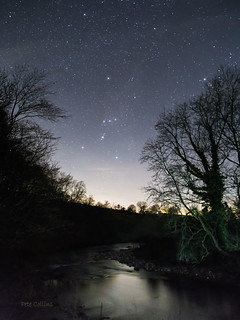 Orion & River Greta, Ingleton
 by
Pete Collins, on Flickr
Don't want to bog you down with too much but here is a good start just to get some sort of a result to wet your appetite.
CAMERA SETTINGS-
set the dial to manual, this will allow to select the exposure length, more on that shortly.
set the aperture to wide open right now, probably f4.5.
set the zoom to 18, most wide angle
set focus to manual for now
set iso to 800 ish
set quality to raw
set screen brightness to max
SETTING UP YOUR CAMERA-
set your camera high on it's tripod and shutter release cable and point it towards some bright stars, some foreground trees can add to your initial image.
Not sure if your model has a screen on a hinge? if not it can be quite hard to see the screen for focussing as it will be pointing at the ground to a degree.
so focussing, put your camera on live view and move your focus ring back from infinity and hopefully you will see some stars come into view, use digital zoom to fine tune your focus, stars should be as small as possible.
SETTING EXPOSURE-
there is a rule you can use to minimise star trailing, very simply, 600 divided by your focal length, result in seconds. So if you use 18mm initially that will result in a shutter speed of 33" (30" will probably be the max you can set your camera before going to bulb)
Light pollution will have an effect on your settings for sure, reduce the exposure if your images are washed out with an orange colour.
Suggest right now rather than going into anymore advance techniques, is to give that a bash and see how you get on. It will be a steep learning curve initially but hopefully you will be astounded by your results and go on to become more involved. Remember the images on AstroBin are with complex setups and people have taken years sometimes to achieve these results
Best of luck, look forward to hearing how you got on.
David


![[deleted]](/assets/images/default-avatar.jpeg?v=2)


