Takahashi FSQ106 N

9 replies559 views
Rick Evans avatar
I recently was able to buy an older classic refractor, the Takahashi FSQ106 N Petzval quadruplet with two fluorite (not FPL-53) front and rear lenses.  It normally is an f5 scope so focal length is about 530mm.  However, it comes including a flattener/barlow type extender (Extender-Q-1.6x) which I believe was intended for visual use and brings the f number to f8.  

My main question is, realizing that this extender operates at f8 which is fairly horrible for imaging due to increasing exposure time, is it still possible to image smaller DSOs using it (medium sized and smaller galaxies) or is it better to just not use this extender for astrophotography and simply attempt to crop the f5 image and not use the extender.

My other question, is I'm wondering how the fluorite lens images in comparison with the newer versions of this scope that use a high quality ED glass.

I would like to benefit for the experience of astrophotographers who have specific knowledge of this scope etc. 

Rick
Engaging
andrea tasselli avatar
First off the FS106N it's a hell of a scope at its native f/5 focal ratio, with a image circle of 88 mm given that, after all, it's a petzval design i.e., with integrated flattener. Now, I'll probaly would use at f/8 if the subject would fit for a number of reasons but to each his/her own. Secondly, flourite is the king of the optical crowns in terms of optical design, first introduced by Zeiss about a century ago into EP design. It is very expensive and therefore highly sought after if you can afford it. The fact that you want to compare it to ED glass (possiby a FP3 or similar variants) is quite startling. In fact is the other way around; how these ED glassess compare to flourite that one should worry about…
Helpful Insightful
Lynn K avatar
I have a Tak FSQ106ED.  I agree with the above post.  ED glass is an attempt to reproduce a cheaper version of Florite.  There may be some imagers that used the Florite and ED version, and may can give a comparison.  I can not.   My understanding is that the reason for Florite or ED is to better correct color aberation.  I see no color aberrations in my ED version. As far as Tak refiguering the optics, I don't know.

Whether to use the extender of not, I would think, depends on your pixel sampling.  If your sampling is good at 530mm, then it will probably crop with near equal resolution as 848mm.  And 848mm may be way over sampled.  But that all depends on you camera pixel size. I image with both a Starlight Xpress Sx814 (3.69mu pixel) and QHY268M (3.76 um pixel) at F3.64.  The detail under my seeing is as good as a AP130GTX at F4.8.  Seeing is the other big factor that will determine whether you will gain anything at 848mm. 

Lynn K.
Rick Evans avatar
andrea tasselli:
First off the FS106N it's a hell of a scope at its native f/5 focal ratio, with a image circle of 88 mm given that, after all, it's a petzval design i.e., with integrated flattener. Now, I'll probaly would use at f/8 if the subject would fit for a number of reasons but to each his/her own. Secondly, flourite is the king of the optical crowns in terms of optical design, first introduced by Zeiss about a century ago into EP design. It is very expensive and therefore highly sought after if you can afford it. The fact that you want to compare it to ED glass (possiby a FP3 or similar variants) is quite startling. IInexact is the other way around; how these ED glassess compare to flourite that one should worry about...

Well, my impression is that fluorite lenses are softer than ED glass and more subject to scratches etc.  I've also heard that they can discolor and even heard that they can absorb a certain amount of water which over time can change their optical properties a bit.  I have no way of knowing if any of that is significant or even true in an objective sense.  I've also heard that it is a more difficult material to figure optically than FPL-53 glass and I wondered if these classic refractors were figured as well as the newer versions using an ED glass.  There must be some reason Tak changed to the ED glass..... might just have been cost but I don't know.

Rick
Engaging
Kevin Morefield avatar
Congrats on getting a great scope!  Regarding the use of the extender for imaging, one thing to consider is the diffraction limit of the 106mm aperture.  At Red 650nm the diffraction limit is 1.54 arc-seconds, at Green 550nm 1.31 arc-seconds, and Blue 475nm 1.13 arc seconds.  With the popular 3.76 micron pixels, your image scale is 1.46 arc-seconds.  So moving to a longer focal length will not gain resolution in the red wavelengths but might gain some in green and blue.  However, with the 1.6x extender your Image scale would .96 arc-seconds which is below the diffraction limits of all visible light for 106mm aperture.  

My personal opionion is that, given the additional complexity of using the extender (re-balancing, new flats, possible degradation of the spot sizes, etc.), I wouldn't bother given the likely minimal improvement in resolution.  Of course, if you are using a camera with larger pixels, you are much more likely to see an improvement in resolution.  But that's only because the resolution at 530mm was degraded in the first place by the undersampling of the larger pixels.

Interested to hear other thoughts  on the impact of the diffraction limit here.

Kevin
Well written Helpful Insightful Engaging Supportive
andrea tasselli avatar
Rick Evans:
Well, my impression is that fluorite lenses are softer than ED glass and more subject to scratches etc. I've also heard that they can discolor and even heard that they can absorb a certain amount of water which over time can change their optical properties a bit. I have no way of knowing if any of that is significant or even true in an objective sense. I've also heard that it is a more difficult material to figure optically than FPL-53 glass and I wondered if these classic refractors were figured as well as the newer versions using an ED glass. There must be some reason Tak changed to the ED glass..... might just have been cost but I don't know.

Natural fluorite might display some of those issues but not as much the artificially grown one. It is a softer material to polish that's true but as end users who cares? The case for ED glass for lenses is that they can be figured and polished with automated process (e.g., high speed polishing) so the cost can be kept down. I personally used a Canon fluorite lens well over 30 years old and I found nothing wrong with it.
andrea tasselli avatar
Kevin Morefield:
Interested to hear other thoughts on the impact of the diffraction limit here.


In a word: nil
Wei-Hao Wang avatar
It's never about fluorite vs. ED.  The design choice can have much greater impacts than the glass material.

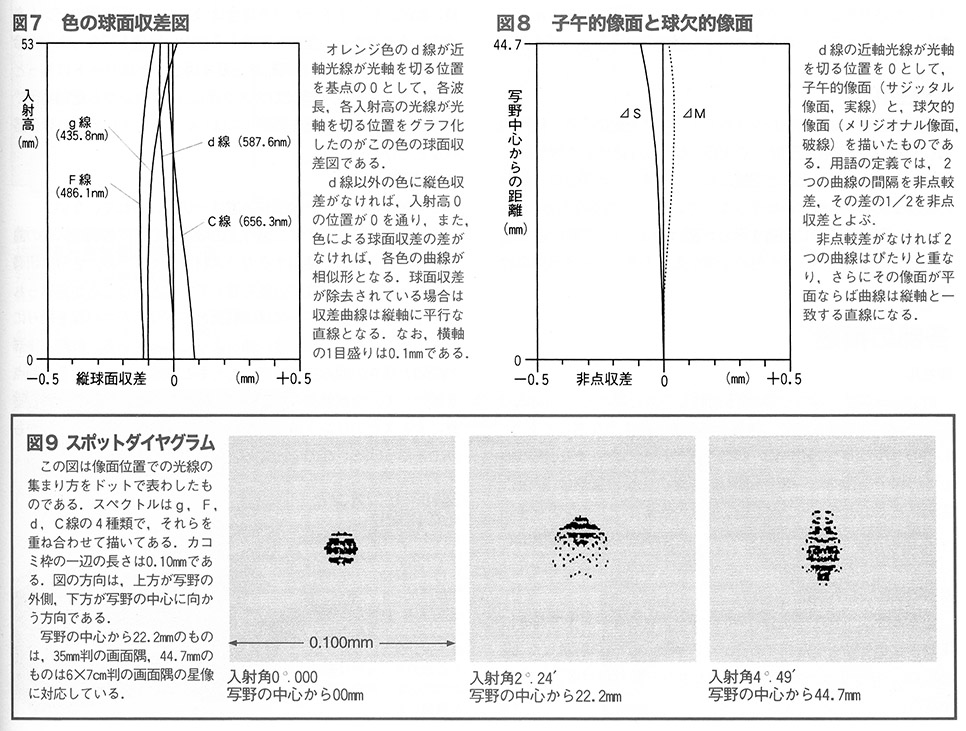
The fluorite FSQ106 was designed for film, especially 67 format film, which was very popular at that time in the Japanese market. From its spot diagram (adapted from the Japanese magazine, Tenmon Guide):
http://group.asiaa.sinica.edu.tw/whwang/old/spot_diagrams/FSQ106.jpg
you can clearly see that the design aimed for a uniform image quality across the 88mm image circle.  The central sharpness is still quite good, but not as good as FSQ106ED, whose spot diagram can be found here:
https://www.takahashijapan.com/ct-products/products/FSQ-106ED.html
The ED clearly was designed with digital sensors in mind and TAK knows that digital sensors will not be big for a very long while. So even though the ED still maintains an 88mm image circle, the optimization is for central sharpness rather than the edge of the image circle which is unnecessarily big in the digital era.

I have limited first-hand experience on both FSQ, so I can only comment based on the spot diagrams published by TAK itself.  I hope someone has real high-quality images taken side-by-side by both scopes using modern high-resolution digital sensors.  This should give us the final answer to the question.
Well written Helpful Insightful Engaging
Maciej avatar
I have been using Takahashi FSQ  106N for many years. This is probably the best device in its class. Takahashi’s use of ED glass was solely due to the production costs of artificial fluorite. Similar to other refractors, e. g. FS 128. they switch to ED glass.
I use the extender sometimes and since I have the STL-11 000 camera for this setup, I can safely say that the full frame coverage is completely satisfactory. The results you can find in my gallery.
CS
Maciej
andrea tasselli avatar
Maciej:
I have been using Takahashi FSQ  106N for many years. This is probably the best device in its class. Takahashi’s use of ED glass was solely due to the production costs of artificial fluorite. Similar to other refractors, e. g. FS 128. they switch to ED glass.
I use the extender sometimes and since I have the STL-11 000 camera for this setup, I can safely say that the full frame coverage is completely satisfactory. The results you can find in my gallery.
CS
Maciej

Q.E.D.
Related discussions
Large telescopes and seeing - what does make sense?
Hi out there, an often asked question brings up a thought I have for a long time and I'm not sure if I answered it to myself correctly. So I'd like to ask for some explanations to help me understand this better. There is always this recommend...
Discusses seeing limitations relevant to slower f-ratio imaging considerations.
Feb 4, 2024
Please help: comparing two fl, f ratios, pixel scale, etc
I need help understanding something. I often hear experienced imagers say they want long focal length scopes to do images of DSOs. They say it "increases resolution of extended objects". I am looking at adding a focal reducer to my CDK 14 Z...
Directly addresses f-ratio, focal length, and imaging trade-offs for DSOs.
Oct 15, 2023
Imaging smaller galaxies with a 8'' newtonian and a barlow
Dear fellow astrophotographs, I have much fund since more than one full year with my 8'' newtonian. I captured many nebula, some clusters and galaxies as well. Now that we are turning to galaxy season, and because I already have captured larg...
Covers barlow use and imaging with modified telescope configurations.
Jan 18, 2024