The best telescope for a focal length of 1200–1500 mm

10 replies222 views
Youngwoo Yoon avatar

Hello.

I’m a beginner-level amateur who has been enjoying astrophotography in Korea for four years.

I’m not sure if anyone here is familiar with the conditions for astrophotography in Korea, but whilst the country’s compact size and high level of development mean that the living and industrial infrastructure is excellent, conversely, it is by no means a good environment for enjoying this hobby 😂. What’s more, there aren’t many clear nights, weather forecasts change frequently, and the air is rather hazy, so the conditions are really quite challenging. Nevertheless, I believe that hobbyists in Korea are overcoming these conditions with great passion.

Due to the various conditions mentioned earlier, I’ve estimated that the longest focal length I can realistically operate here is around 1200–1500mm. At the moment, I’m using a William Optics UltraCat 76 on a crop sensor, and I’m awaiting a setup combining the E-180ed—which I’ll soon be operating as a remote observatory—with a full-frame sensor. Both are relatively wide-field setups. Therefore, I hope to operate a longer-focal-length setup in the near future, and, taking various adverse conditions into account, I am currently envisaging a focal length of around 1200–1500 mm as the longest feasible for operation in Korea.

Now, onto the main point.

When using a camera with a full-frame sensor, what do you consider to be the finest telescope for a focal length of 1200–1500mm?

It could be for any reason—be it price, mechanical build quality, excellent materials and optics, ease of maintenance, or anything else. Setting aside the financial aspect of it simply being expensive, I would like to hear your views as an experienced enthusiast who has enjoyed this hobby for a long time.

Thank you, and Clear sky~!

Well written Respectful
Daniel Cimbora avatar

Youngwoo Yoon · May 19, 2026, 11:59 PM

what do you consider to be the finest telescope for a focal length of 1200–1500mm?

Setting aside the financial aspect

Probably more than you want to bite off as a beginner though… :-)

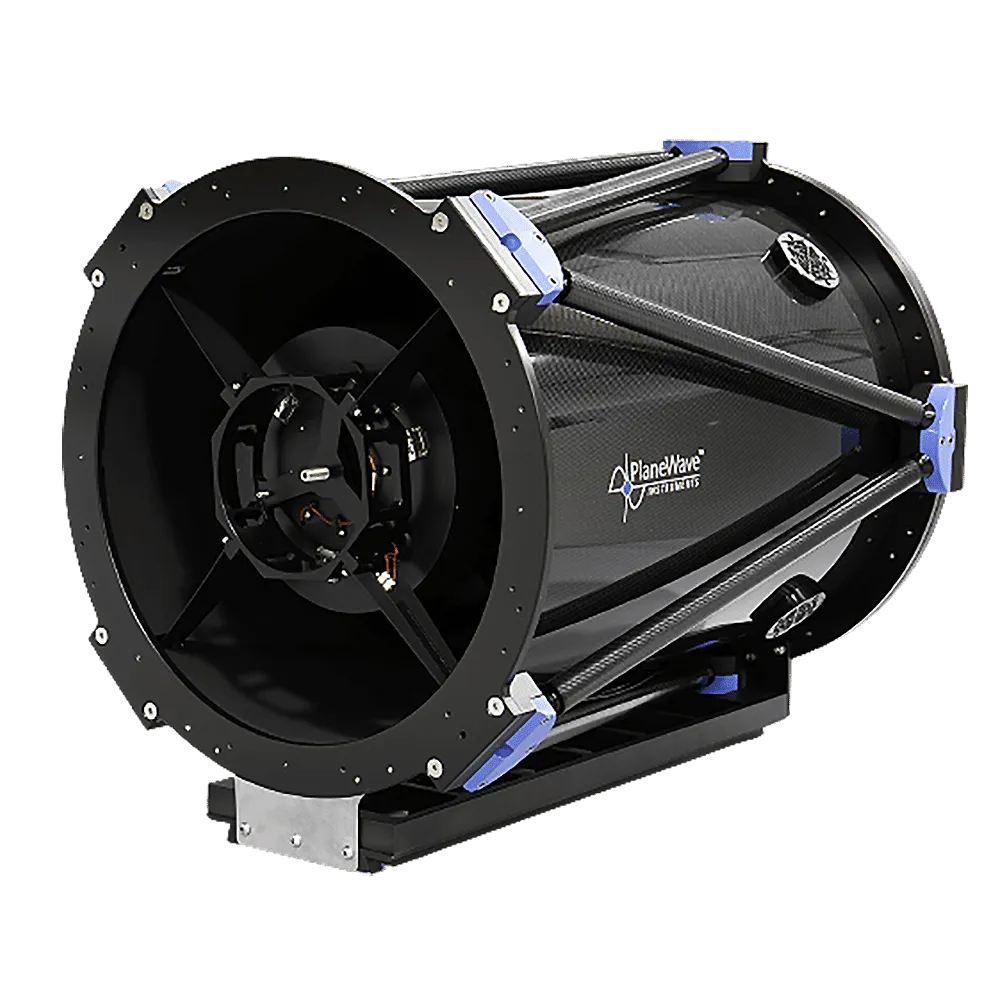
https://planewave.com/products/deltarho-500-ota/

On a more serious note, a high-quality 130-140mm refractor at ~1000mm FL (Astrophysics, Takahashi, TEC) can do a remarkable job with a full-frame 3.76u CMOS camera. Plenty of people are pulling out amazing detail with “only” 1000mm.

Well written Helpful Respectful Concise Engaging Supportive
Reg Pratt avatar

If the DR series is out budget my vote would be a high quality 10-12” F4 Newtonian. They’ll give you more aperture and speed than a refractor and at a lower cost than a high end refractor. Check out Lacerta, Teleskop Service ONTC, and maybe OOUK (doesn’t have a great past but supposedly are improved these days).

Well written Helpful Concise Engaging
Youngwoo Yoon avatar

Daniel Cimbora · May 20, 2026, 01:07 AM

Probably more than you want to bite off as a beginner though… :-)

We’re currently reviewing this product alongside the CDK, but whilst the high price tag is one thing, I can’t help feeling it’s more of a specialist research tool for astronomers ^^;;

Reg Pratt · May 20, 2026, 01:22 AM

my vote would be a high quality 10-12” F4 Newtonian.

I believe that modifying a suitable large-aperture Newtonian telescope with high-quality components is a very sensible choice.

Well written Engaging
Tony Gondola avatar

I’m not sure where you’re going here. You want more focal length I assume for the image scale it provides but yet want to stick will full frame which is going to make things difficult, not imposable but it certainly narrows your choices. What is your main imaging goal with the new instrument?

Concise Engaging
andrea tasselli avatar

Since you’re in South Korea probably sourcing closer to home makes sense and I’ll suggest you take a look at these:

https://www.aliexpress.com/item/1005010289725782.html

Youngwoo Yoon avatar

Tony Gondola · May 20, 2026, 03:51 AM

I’m not sure where you’re going here. You want more focal length I assume for the image scale it provides but yet want to stick will full frame which is going to make things difficult, not imposable but it certainly narrows your choices. What is your main imaging goal with the new instrument?

Hello Tony!

I realise I didn’t provide enough detail in my original message.

It would be more accurate to say that I’m looking for a longer focal length rather than a wider angle. My main aim is to capture the fine details of springtime galaxies and large nebulae.

The reason I’m sticking with full-frame isn’t anything spectacular; it’s simply that my current camera kit is fitted with a lot of high-end components, and I’d like to keep using them as they are. However, as you say, this does seem to narrow my options considerably. 🤔 After all, proper support for the full-frame format implies high-end, expensive optics. Assuming I don’t necessarily have to stick with full-frame, I’d be interested to hear your advice.

Thanks a lot!

Well written Respectful
Youngwoo Yoon avatar

andrea tasselli · May 20, 2026, 08:08 AM

Since you’re in South Korea probably sourcing closer to home makes sense and I’ll suggest you take a look at these:

https://www.aliexpress.com/item/1005010289725782.html

This is the first time I’ve seen this product, and it’s really caught my interest. It looks like a very well-made Newtonian telescope.

Thank you for sharing this information about such a great product.

Well written Respectful Supportive
Tony Gondola avatar

Youngwoo Yoon · May 20, 2026, 08:55 AM

Tony Gondola · May 20, 2026, 03:51 AM

I’m not sure where you’re going here. You want more focal length I assume for the image scale it provides but yet want to stick will full frame which is going to make things difficult, not imposable but it certainly narrows your choices. What is your main imaging goal with the new instrument?

Hello Tony!

I realise I didn’t provide enough detail in my original message.

It would be more accurate to say that I’m looking for a longer focal length rather than a wider angle. My main aim is to capture the fine details of springtime galaxies and large nebulae.

The reason I’m sticking with full-frame isn’t anything spectacular; it’s simply that my current camera kit is fitted with a lot of high-end components, and I’d like to keep using them as they are. However, as you say, this does seem to narrow my options considerably. 🤔 After all, proper support for the full-frame format implies high-end, expensive optics. Assuming I don’t necessarily have to stick with full-frame, I’d be interested to hear your advice.

Thanks a lot!

In that case I would give serious consideration to an RC. With all reflecting optics you can take advantage of the near IR which is very effective at taking L frames for Galaxies and other objects. I use one in Bortle-8 and it really cuts through the LP here. The RC also gives you a well corrected, flat field that covers an APS-C sensor without needing any additional optics. A 6” F/9 RC will give you a FL of 1370mm and an 8” F/8 will be at 1625 mm putting you in the range you’re looking for. You will have to learn the art of collimation with an RC but once it’s dialed in, it’s very stable. These things really will give a lot of performance for the money spent with plenty leftover for a new camera setup. Here’s a test image of M33 in IR I did with a 6” under B8 skies:

https://app.astrobin.com/i/2u80zg

Well written Helpful Respectful Engaging
Dan Watt avatar

10-12.5” f4 newt, premium mirror from somebody like Ostahowski or Mike Lockwood, 3” focuser + the 3” Big Paracorr would yield you an f4.6 sharpness monster that is relatively simple to deal with, thus optimizing the amount of time you’ll get to image.

Well written Helpful Concise Engaging Supportive
Rick Krejci avatar

Dan Watt · May 20, 2026, 03:14 PM

10-12.5” f4 newt, premium mirror from somebody like Ostahowski or Mike Lockwood, 3” focuser + the 3” Big Paracorr would yield you an f4.6 sharpness monster that is relatively simple to deal with, thus optimizing the amount of time you’ll get to image.

I’ll add that it will need a larger secondary in addition to the larger focuser/paracorr to cover FF.

The issue I had with something like a newt at that focal length will be very long, so will need protection from the wind along with a very sturdy mount.

Helpful Concise