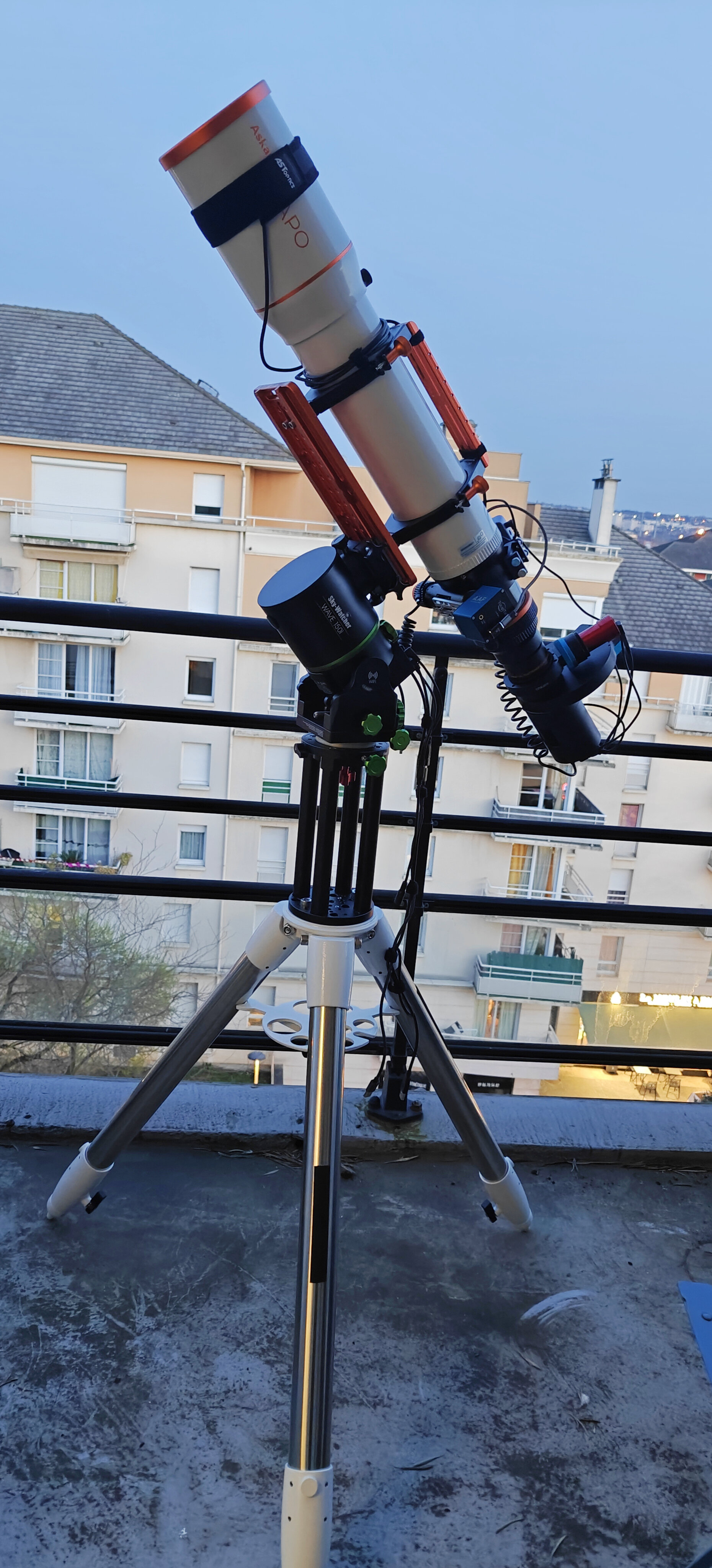
Trying to decide on a larger refractor for imaging galaxies.

23 replies630 views
Greg avatar

Hi all. A currently have a widefield refractor, a Carbonstar 150 newt and a Celestron C6. SCT. I’m looking for something easier to use than the C6 and more consistent for galaxies. I image with a 533mcpro and on a CGX mount. 50mm guide scope/220mini guide cam.

I should point out that I’m not talking about tiny galaxies under 10’ but looking at Telescopius I feel that galaxies larger than say 11’ should be within reach with a decent crop of the image.

I’m deciding between the ASKAR 120mm at 840mm f/l and the Astro-Tech AT 130 EDT at 910mm. I might even spring for the 130 EDX, but I’m not sure it’s necessary. I certainly welcome opinions on that too.

My biggest sticking point is that frankly, I don’t want to add a pier extension if at all possible. I’m hoping the CGX can handle the scope’s weight and dimensions without having to raise it or worry about it hitting tripod legs. Is that reasonable, or will any of these scopes be ok without a pier extension?

Thanks for your time.

Well written Respectful
Tony Gondola avatar

I would go with the longest focal length you can get from your choices.

Well written Respectful
Jeff Bennett avatar

Tele Vue NP127is will work great. I use mine for galaxies sometimes, the detail is incredible. Easy to use adapters, spacers, reducers etc. The quality if hard to beat. Check out Jerry Macon’s images for proof. Of course, if I could find one, Ive always wanted an AP 130 !

Concise Engaging Supportive
Jesse Priolo avatar

Greg, I think I responded to your thread on CN too, but you may run into an issue with a ~130mm scope hitting the tripod legs when imaging near the meridian. I haven’t used a CGX specifically, but I ran into this with my 130mm scopes when imaging with an EQ6-R.

I’ve since moved to iOptron mounts and use the tri-pier, which has eliminated collisions.

I’ll reiterate what I said over on CN too: the AT130EDT is inexpensive but well-made, and there are some terrific images taken with it that you can find just by searching “AT130EDT” in the search bar above.

Well written Helpful Respectful Concise Engaging Supportive
Greg avatar

Jesse Priolo · May 3, 2026, 01:19 PM

Greg, I think I responded to your thread on CN too, but you may run into an issue with a ~130mm scope hitting the tripod legs when imaging near the meridian. I haven’t used a CGX specifically, but I ran into this with my 130mm scopes when imaging with an EQ6-R.

I’ve since moved to iOptron mounts and use the tri-pier, which has eliminated collisions.

I’ll reiterate what I said over on CN too: the AT130EDT is inexpensive but well-made, and there are some terrific images taken with it that you can find just by searching “AT130EDT” in the search bar above.

Thanks Jesse. Sometimes it’s difficult to get a lot of feedback on CN so I posted here too. I have looked at the EDT images on Astrobin. Incredible.

Respectful
Rafael Amarins avatar

My 122mm triplet requires a pier extension on my AM5. I don’t know fore sure how tall is the cgx mounting plate clamp but you might need one. As for OTA I would go for a 130. Maybe you could stretch to an Askar 140 or 130PHQ. 120mm won’t make you happy if you’re looking for a good level of details on galaxies. Since someone just suggested a 7400USD refractor I’d take the liberty to suggest an Askar 151PHQ for much less than that and it should give ou >1000mm FL

Helpful Engaging
[deleted]

You mentioned you did not want a pier extension but that is the way to make your existing mount work for what you want to do.

I use a pier extension on a skywatcher az-eq6 and not only does it prevent collisions but it will reduce the need to extend the tripod legs all the way so the overall footprint on the ground is smaller and much easier for you to work around, and more stable resulting in marginally better performance.

The 0.63 reducer will make using your C6 much easier and gets you a little more reach than the refractors. I think you can pick these up used for less than $100 on ebay.

Well written Helpful Concise Engaging Supportive
AstroGadac avatar

I own the Askar 120APO. For larger galaxies it works fine (see for instance https://www.astrobin.com/b6qaon/C/, https://www.astrobin.com/4pkg4g/, https://www.astrobin.com/yio9fc/) but for smaller galaxies its more appropriate for groups/cluster of galaxies otherwise the reach is a bit too limited. However I dont think a 140APO would fare much better, especially since seeing will start limiting things at some point.

In any case for a long refractor like that a pier extension is mandatory. Since I use an harmonic mount whose dec saddles lies low from the RA axis, I had to find one that was 25cm long and I also raised the scope on its dovetail using 2cm riser blocks:

I have 0 risk of crash on the tripod legs now.

Well written Helpful Respectful Concise Engaging Supportive
Greg avatar

[deleted] · May 5, 2026, 12:34 PM

You mentioned you did not want a pier extension but that is the way to make your existing mount work for what you want to do.

I use a pier extension on a skywatcher az-eq6 and not only does it prevent collisions but it will reduce the need to extend the tripod legs all the way so the overall footprint on the ground is smaller and much easier for you to work around, and more stable resulting in marginally better performance.

The 0.63 reducer will make using your C6 much easier and gets you a little more reach than the refractors. I think you can pick these up used for less than $100 on ebay.

Thanks. I have the .63 reducer and I’ve used it for years. There are other issues plaguing me with the C6. (focus shift, back focus, vignetting, balance). As for the pier extension, one is not made for the CGX or any Celestron mount. I did call Astronomics about the Astro-Tech 130EDT, and I contacted Agena Astro about the ASKAR 120mm Apo. Both places told me I would not need a pier extension for these scopes for imaging, if one existed. I’ve got a lot to mull over before purchasing. I appreciate your input.

Well written Respectful Concise
Greg avatar

AstroGadac · May 5, 2026, 01:04 PM

I own the Askar 120APO. For larger galaxies it works fine (see for instance https://www.astrobin.com/b6qaon/C/, https://www.astrobin.com/4pkg4g/, https://www.astrobin.com/yio9fc/) but for smaller galaxies its more appropriate for groups/cluster of galaxies otherwise the reach is a bit too limited. However I dont think a 140APO would fare much better, especially since seeing will start limiting things at some point.

In any case for a long refractor like that a pier extension is mandatory. Since I use an harmonic mount whose dec saddles lies low from the RA axis, I had to find one that was 25cm long and I also raised the scope on its dovetail using 2cm riser blocks:

I have 0 risk of crash on the tripod legs now.

Thanks. Oddly, I called Agena Astro yesterday and the person I spoke to uses the ASKAR 120 for imaging without a pier extension. Unfortunately, one is not made for the CGX or any Celestron mount, I’ve been told. The cradle on my mount does sit significantly higher so maybe that will make a difference. One more question….when you say “smaller” galaxies, what size are you thinking of? I’m thinking anything under say 10’ in size is off limits with the 120, and that’s fine. I was looking more in the range of 10’ + Like M63, M64 and larger. With a decent crop could I still get solid images with that scope? Thanks for your input!

Well written Respectful
AstroGadac avatar

Greg · May 5, 2026, 01:53 PM

AstroGadac · May 5, 2026, 01:04 PM

I own the Askar 120APO. For larger galaxies it works fine (see for instance https://www.astrobin.com/b6qaon/C/, https://www.astrobin.com/4pkg4g/, https://www.astrobin.com/yio9fc/) but for smaller galaxies its more appropriate for groups/cluster of galaxies otherwise the reach is a bit too limited. However I dont think a 140APO would fare much better, especially since seeing will start limiting things at some point.

In any case for a long refractor like that a pier extension is mandatory. Since I use an harmonic mount whose dec saddles lies low from the RA axis, I had to find one that was 25cm long and I also raised the scope on its dovetail using 2cm riser blocks:

I have 0 risk of crash on the tripod legs now.

Thanks. Oddly, I called Agena Astro yesterday and the person I spoke to uses the ASKAR 120 for imaging without a pier extension. Unfortunately, one is not made for the CGX or any Celestron mount, I’ve been told. The cradle on my mount does sit significantly higher so maybe that will make a difference. One more question….when you say “smaller” galaxies, what size are you thinking of? I’m thinking anything under say 10’ in size is off limits with the 120, and that’s fine. I was looking more in the range of 10’ + Like M63, M64 and larger. With a decent crop could I still get solid images with that scope? Thanks for your input!

A conventional belt and drive mount will have its saddle much higher yes so it could alleviate the need for a pier extension. But I would still check using a low speed maneuver the first time if indeed it clears the tripod legs. You never know.

The galaxy it does well are the big one like M51/M63, probably M64 too so yeah that’s about 10’. Smaller would work too if the framing is interesting with other galaxies around perhaps.

Helpful Supportive
Willem Jan Drijfhout avatar

If possible you may want to hit at least 1000mm focal length, e.g. Askar 130/150 PHQ, or if budget allows Takahashi TOA-130 or similar.

None of these scopes ‘needs’ a pier extension, as long as you set your pointing limits accordingly. Personally I would add the extender, because why not, and it gives you a bit more room to play with. But with filter wheel rotated down, you will still hit the pier, als with extender.

Helpful Concise Engaging
Tony Gondola avatar

Greg · May 2, 2026, 08:38 PM

easier to use than the C6 and more consistent for galaxies

Looking back at your post it’s not clear to me why you want to stick with refractors for this. I’m also a bit puzzled over what the above line really means. In many ways that C6 is already right focal length range to make galaxies even smaller than 10’ interesting. Have you actually tried it?

Thinking along those same lines why not consider the MK127 Maksutove/Cass? That could be perfect for what you want to do at 1500mm. Another good option would be a 6” RC pulling you out to about 1380mm, fully color correct and no flatteners, reducers or pier extensions needed. Throw an EAF on it and you’re good to go.

Helpful
Phil Creed avatar

If you’re looking at 700-800mm you can go under 10’ and still get some good detail.

The issue is getting focal length while maintaining speed. You’ve got speed with the CS150 but the 570mm focal length with the recommended 0.95X CC is a bit small for galaxies. That being said, a Paracorr (1.15X) bumps that out to 690mm and slows it down to a still-fast f/4.6 nominal (~f/5.0 effective). That’s a 20% bump in focal length without the need for another OTA.

If you don’t mind collimation adventures, an 8” f/8 RC with a 0.67X reducer is ~1,070mm @ f/5.3.

An AT130EDT is a running up to the point where FK61/FPL-51 triplets can cause noticeable “blue bloat”, but it’s not bad. An AT130EDX wouldn’t have any of that but would be pricier. Still…910mm @ f/7.0 or 728mm @ f/5.6 when reduced, both appreciably more than your CS150+0.95X CC.

If you can swing it and NP127 would be awesome, even if only 660mm. It’d be a sharp 660mm. To give you an idea, here’s its little brother, the NP101, on M100 (~7’ x 6’ main disk) at 540mm:

https://app.astrobin.com/u/PhilCreed?i=gsvcb4

An NP127 can be reduced to 528mm at a screaming f/4.16, or you can get a used (discontinued) Tele Vue NPE-1118 1.5X extender, which takes it out to 990mm @ f/7.8. I know that doesn’t seem fast, BUT…it’s an unobstructed f/7.8. Going along with the “…and this is why I’ve got trust issues” theme, many “0.63X” SCT reducers don’t always reduce it to the stated spec and then there’s the effect of the central obstruction.

Clear Skies,
Phil

Well written Helpful Insightful Engaging
Greg avatar

AstroGadac · May 5, 2026, 02:01 PM

Greg · May 5, 2026, 01:53 PM

AstroGadac · May 5, 2026, 01:04 PM

I own the Askar 120APO. For larger galaxies it works fine (see for instance https://www.astrobin.com/b6qaon/C/, https://www.astrobin.com/4pkg4g/, https://www.astrobin.com/yio9fc/) but for smaller galaxies its more appropriate for groups/cluster of galaxies otherwise the reach is a bit too limited. However I dont think a 140APO would fare much better, especially since seeing will start limiting things at some point.

In any case for a long refractor like that a pier extension is mandatory. Since I use an harmonic mount whose dec saddles lies low from the RA axis, I had to find one that was 25cm long and I also raised the scope on its dovetail using 2cm riser blocks:

I have 0 risk of crash on the tripod legs now.

Thanks. Oddly, I called Agena Astro yesterday and the person I spoke to uses the ASKAR 120 for imaging without a pier extension. Unfortunately, one is not made for the CGX or any Celestron mount, I’ve been told. The cradle on my mount does sit significantly higher so maybe that will make a difference. One more question….when you say “smaller” galaxies, what size are you thinking of? I’m thinking anything under say 10’ in size is off limits with the 120, and that’s fine. I was looking more in the range of 10’ + Like M63, M64 and larger. With a decent crop could I still get solid images with that scope? Thanks for your input!

A conventional belt and drive mount will have its saddle much higher yes so it could alleviate the need for a pier extension. But I would still check using a low speed maneuver the first time if indeed it clears the tripod legs. You never know.

The galaxy it does well are the big one like M51/M63, probably M64 too so yeah that’s about 10’. Smaller would work too if the framing is interesting with other galaxies around perhaps.

Thanks. I really like the scope and despite it not having super high end glass, I’m not reading about much CA in the scope at all.

Tony Gondola avatar

Another approach is to look at changing your camera rather than the optics. As an example, take your 6” F/4 CarbonStar at 600mm native. Putting a 585 (2.9 micron) on that is equivalent to using the 533 at 774mm. Go even further with a 183 at 2.5 micron pixels and it would be equivalent to shooting the 533 at a focal length of 948mm, exactly where you want to be.

Well written Helpful Concise Engaging
Dark Matters Astrophotography avatar

I am going to give a response here without reading anything other than your original post. As someone that images a ton of galaxies on widely different imaging systems here is some advice I would give you.

First, do not be as concerned with the size of the visible galaxy on the chip as you may default to doing. For galaxy imaging you care a lot of about resolution and since you have stated you want to use a refractor system for this (good choice) you will not have a diffraction penalty. You do want to use a chip with better ADC than the 533 has. I would recommend the APS-C version of the Sony chipped camera of your choice for this reason.

Next, galaxy imaging is perfected by knowing the field you are working on as best as you can. I would advise people to use the NASA NED database, the WISE database, and the IRSA resources to help you better understand the field prior to imaging it. We at Dark Matters ingest all of this data for our AI we use to program scope operations across our fleet and this data has been priceless for us.

Lastly, don’t get discouraged. This talk of cameras, databases, spectral graphs, etc is very good data, but the most important piece of gear you can ever own in this hobby is the motivation to do it.

I will close, with a scope suggestion though. Celestron Edge C9.25. :) Not what you thought, eh?

For a refractor though, I will offer this: Takahashi TOA150. Lifetime refractor. King of the hill, best corrector, best correction itself. The TOA130 is equally as good.

So in closing - TOA130.

Alex Nicholas avatar

I had the 120APO and loved it, and miss it since I sold it… i would say almost any 120+ mm refractor is going to need a pier extension… the 120apo all rigged up for imaging is LONG. Like 1.4m from dew shield to the end of the camera and cables.

Helpful Concise Engaging Supportive
Willem Jan Drijfhout avatar

Tony Gondola · May 6, 2026 at 02:33 AM

Another approach is to look at changing your camera rather than the optics. As an example, take your 6” F/4 CarbonStar at 600mm native. Putting a 585 (2.9 micron) on that is equivalent to using the 533 at 774mm. Go even further with a 183 at 2.5 micron pixels and it would be equivalent to shooting the 533 at a focal length of 948mm, exactly where you want to be.

There is definitely merit in putting camera’s with <3.8 micron pixels behind a wide-field scope.

But the reasoning that by making the pixels smaller you see smaller targets, does not tell the whole story. If that would be the case, the best thing to do is just put your iPhone on your scope. The optical design plays a role as well. Horses for courses. So if the target is to go after small-ish galaxies, an optical design with a focal length of >1000mm and aperture as large as budget allows is definitely worth considering.

Helpful Respectful Concise Engaging
Greg avatar

Tony Gondola · May 6, 2026, 02:33 AM

Another approach is to look at changing your camera rather than the optics. As an example, take your 6” F/4 CarbonStar at 600mm native. Putting a 585 (2.9 micron) on that is equivalent to using the 533 at 774mm. Go even further with a 183 at 2.5 micron pixels and it would be equivalent to shooting the 533 at a focal length of 948mm, exactly where you want to be.

A very good point. I was actually looking at going the opposite direction, toward a 2600mc for use with my 75mm refractor to be able to capture M31, California neb. and other such very large objects. I hadn’t even considered a smaller sensor than the 533. I appreciate the advice. Not sure I can swing three cameras though. :)

Respectful
Stelios_Stergiou avatar

Take a look at the esprit edx series…(120 or 150 if you can aford) far better optics than the askar

Tony Gondola avatar

Willem Jan Drijfhout · May 6, 2026, 09:44 AM

Tony Gondola · May 6, 2026 at 02:33 AM

Another approach is to look at changing your camera rather than the optics. As an example, take your 6” F/4 CarbonStar at 600mm native. Putting a 585 (2.9 micron) on that is equivalent to using the 533 at 774mm. Go even further with a 183 at 2.5 micron pixels and it would be equivalent to shooting the 533 at a focal length of 948mm, exactly where you want to be.

There is definitely merit in putting camera’s with <3.8 micron pixels behind a wide-field scope.

But the reasoning that by making the pixels smaller you see smaller targets, does not tell the whole story. If that would be the case, the best thing to do is just put your iPhone on your scope. The optical design plays a role as well. Horses for courses. So if the target is to go after small-ish galaxies, an optical design with a focal length of >1000mm and aperture as large as budget allows is definitely worth considering.

Obviously but it does work and is certainly an option for the OP.

Tony Gondola avatar

Greg · May 6, 2026, 11:35 AM

Tony Gondola · May 6, 2026, 02:33 AM

Another approach is to look at changing your camera rather than the optics. As an example, take your 6” F/4 CarbonStar at 600mm native. Putting a 585 (2.9 micron) on that is equivalent to using the 533 at 774mm. Go even further with a 183 at 2.5 micron pixels and it would be equivalent to shooting the 533 at a focal length of 948mm, exactly where you want to be.

A very good point. I was actually looking at going the opposite direction, toward a 2600mc for use with my 75mm refractor to be able to capture M31, California neb. and other such very large objects. I hadn’t even considered a smaller sensor than the 533. I appreciate the advice. Not sure I can swing three cameras though. :)

You could actually end up saving money if it meant that you didn’t need to get another OTA.

Alex Nicholas avatar

Indeed - a different camera would almost certainly be cheaper than ~5” APO.

I have my IMX571 mono that gives me a MASSIVE almost 5° x 3° field of view on the HOPE D60, and a still very wide view at 3.2° x 2.1° with the Sharpstar 15028HNT, but I have an IMX676 camera on the way that gives me a 0.96° x 0.96° field of view at a near perfect 0.98”/px view with the Sharpstar 15028HNT, This field of view would require a ~1500mm focal length to achieve with the IMX571, and the resulting resolution would be quite oversampled, and FAR outside what my local seeing can support…

I’m really stoked to be getting my hands on this little camera, as I get all the benefit of having a long focal length scope, while having none of the frustration of a telescope greater than a meter long, undoubtedly considerably heavier, but also, I get the amazing speed of my F/2.8 ‘wide-field’ newtonian…

Using your 150mm f/4 would be considerably faster than a 120mm f/7 refractor, much less weight and more managable OTA etc..

Not to mention, storing a secondary camera is far easier than storing a second telescope…

Helpful Engaging Supportive