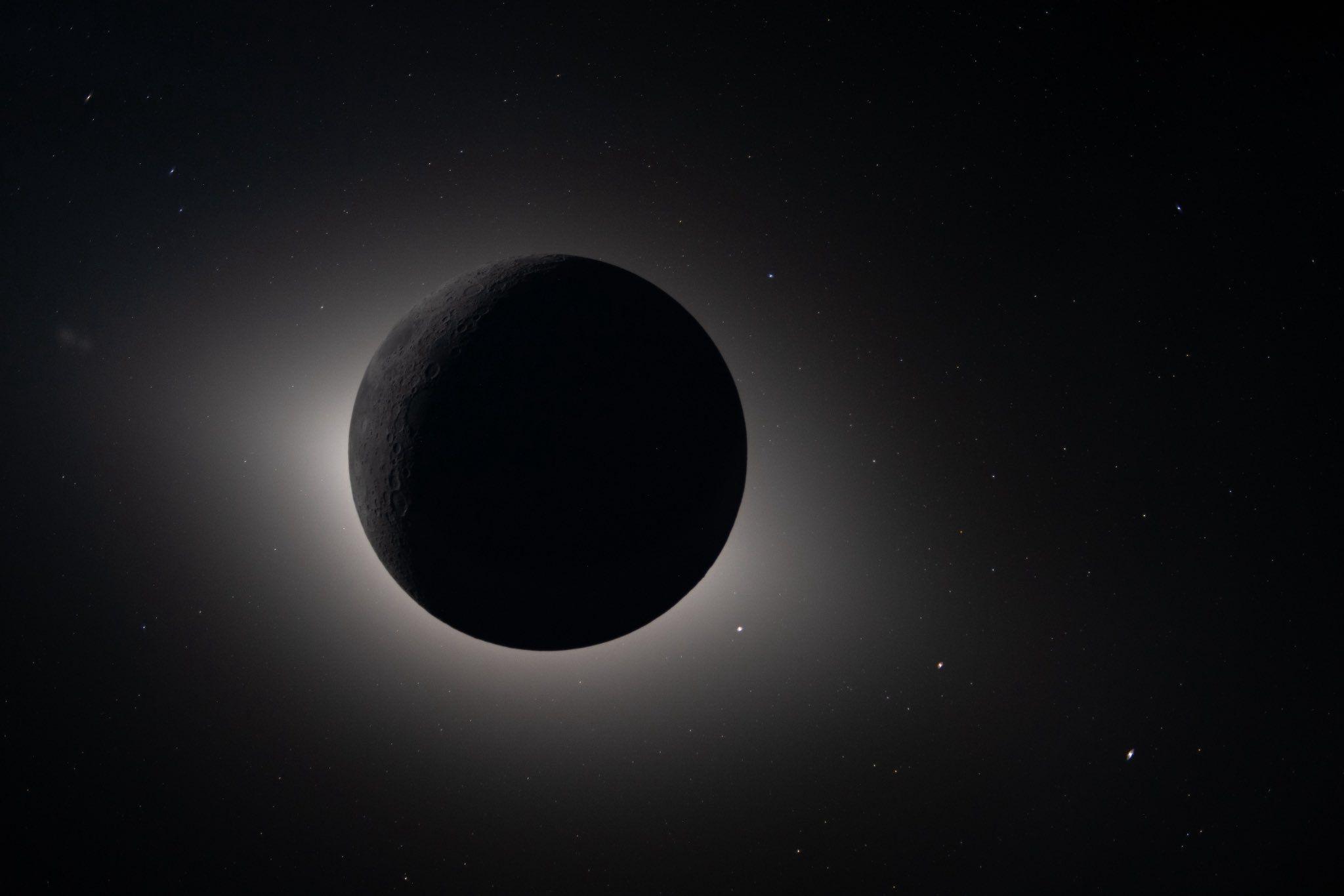
Ultra Low Definition Artemis II Photo's of the Moon

Richard JonesRick KrejciTony GondolaAlan BrunelleArun H
28 replies511 views
Richard Jones avatar

I looked with total disbelief at the Moon images released by NASA as the Artemis II spacecraft is just a few thousand miles from the Moon rather than a quarter of a million miles. The images are blurry with low contrast and no detail and are worse than the ones I get in my own backyard with a cheap 70mm refractor.

The reason for this is they are using what is essentially a Go-Pro Hero 4 to take their moon photos. Which as we all know is completely the wrong type of camera for that purpose. They are going into a rare Moon Solar Eclipse situation with virtually no optical imaging equipment up to the job.

The Mission Briefing touched on the subject and the NASA lady responsible for fielding that question did not appear to know what optical imaging equipment they had available. She also said it would take them at least six months to process the high definition images they did capture before public release. This is ridiculous. If NASA released the raw optical images to the public, I am sure the astrophotography experts here could release excellent images in a few days.

She mentioned that, because of the Solar Eclipse on the mission, the astronauts had been given a “few days” training in taking Eclipse photos with a hand held camera through a thick perspex window. I think we can deduce from that that the only Hi Definition cameras on the mission are the hand held Nikon D5 20 megapixel cameras which were added as an afterthought.

Extremely bad mission planning in my view.

Well Written
Rick Krejci avatar

They mentioned they had a Z9 in the sit reps

Richard Jones avatar

Rick Krejci · Apr 7, 2026, 11:50 AM

They mentioned they had a Z9 in the sit reps

Yes. That was added in at the last minute as a response from a request from the crew. It is a big improvement but still handheld shooting through an angled perspex window. So the crew knew that the optical imaging equipment was sub par even though the mission planner did not.

It is so obvious one has to ask : Why?

The mission and future funding are judged by the “wow” factor and primarily by superb optical images, like the Hasselblad ones from Apollo. Releasing HD images six month after the event looks like some kind of deliberate PR sabotage.

Well Written Concise Engaging
apennine104 avatar

The photos they are sending back look pretty amazing to me, and I am sure there are 1,000’s more as they transfer them back…

https://images.nasa.gov/ (sort by newest)

https://www.flickr.com/photos/nasa2explore/albums/72177720307234654/

📷 art002e009289~small.jpgart002e009289~small.jpg

Richard Jones avatar

apennine104 · Apr 7, 2026, 02:07 PM

The photos they are sending back look pretty amazing to me, and I am sure there are 1,000’s more as they transfer them back…

https://images.nasa.gov/

www.flickr.com/.../72177720307234654

📷 art002e009289~small.jpgart002e009289~small.jpg

The photos are amazing in terms of subject matter and composition, which is very good but if you zoom in then the blurring due to handheld photography become apparent. Good as a snap but not quite what you want for scientific research. If you compare this snap with a HiRise photo of Mars you would spot the differences immediately. Mainly lack of contrast which is due in part to in camera processing and the wrong type of chip for high definition. I’ve looked at a lot of Mars photos which are truly amazing in all aspects.

Tony Gondola avatar

I agree that NASA should have used much better cameras for the live feed but I have no idea what the bandwidth restrictions are between the high gain antenna on the spacecraft and the deep space network. That said, the inside the cabin views were certainly better than the outside GoPros so they could have done better.

Anyway, the DSLR photos taken by the crew are certainly good enough for the exercise. I don’t think there’s really much new here in terms of data. The real value seems to be exercising the system including the crew and getting images that while of limited scientific value, will generate a lot of public interest and excitement. The observation of 5 impact flashed in the course of 40 min. was certainly an interesting result.

Don’t forget, Apollo 8 changed our world view with a single handheld photo of the Earth rising over the lunar surface. Not really an image with high scientific value but high human value instead.

Well Written Engaging
Richard Jones avatar

I agree they did well with the DSLR cameras but these are ancient tech devices and don’t move the mission forward very much. Regarding the testing the equipment part of the mission, which was the main goal. They missed a really good opportunity to take a big step forward.

Rather than have 11 Go Pro cameras they should have tested a number of brand new cameras with different specialisations. High frame rate and high contrast filtered to observe fluid flow in the thruster streams. HD thermal imaging cameras to observe the temperature variations in thruster flow and nozzle heat. This is to identify potential types of failure during long missions. That missing information could save lives later. The go pro cameras were on a par with the Apollo tech in that respect.

A thermal camera to observe the heat distribution in the capsule to identify areas where thermal stress could become a problem in reentry or toilet waste ejection problem cause. New HD optical imaging cameras to identify new lunar structure or water.

In my view it was much less well thought out than in previous missions to Mars or the Moon with a far too narrow project scope.

Well Written Engaging
Richard Jones avatar

The image that I wanted to see the most was the Sun’s corona around the Moon.

The sun shining behind the blocked out moonA very nice picture that could have been of significant scientific interest if taken with proper scientific equipment. As it happens the stars are little streaks due to camera shake and the corona has virtually no detail, which is probably due to Canon camera internal smoothing routines. Pretty but useless.

Well Written
Arun H avatar

I generally agree with this.

I appreciate that the primary purpose of this trip is as a precursor to a future Moon landing. But that is only possible if the public continues to support the funding (which I do). A big part of this is and continues to be outreach. There are far better photographs being shared even on this site than what I have seen so far. The solar eclipse photograph is particularly disappointing. How hard would it have been to take a small modern mirrorless camera and take a few nice shots rather than some iPhone quality shots to share on Instagram? The photographs we saw from the Voyager missions, New Horizons missions, and various Mars missions were amazing.

Well Written
Kay Ogetay avatar

I understand why those images might feel underwhelming at first glance, especially if you’re comparing them to carefully processed astrophotography taken from Earth. But the conclusion that this reflects poor mission planning isn’t accurate, and it misses some important context about how missions like Artemis II are designed.

First, imaging is not the primary objective of Artemis II. This is a test flight mission, its core goals are to validate the Orion spacecraft systems with crew onboard: life support, navigation, communication, thermal control, and crew safety in deep space. Every system onboard is selected and prioritized based on mission-critical reliability, not maximum photographic performance.

NASA is not trying to replicate telescope-quality lunar imaging from Orion, because that’s already been done far better by robotic missions like Lunar Reconnaissance Orbiter.

Why not fly a “proper telescope”? Why use GoPro-type systems?

Because every gram and every cubic centimeter on a crewed spacecraft is tightly budgeted. Adding a high-end optical system is not just a matter of bringing a better camera, it would require structural mounting and stabilization, dedicated thermal control (which is already a challenging constraint), additional power allocation, increased data bandwidth, and perhaps most critically valuable crew time for operation.

In contrast, GoPro-type systems are rugged, lightweight, low-power, and highly reliable. They are well-suited for capturing contextual imagery without adding operational complexity. It’s also important to consider the radiation environment these systems must endure; ensuring that more complex optical instruments can operate reliably under such conditions is a non-trivial engineering challenge in itself.

When all of these factors are considered together, the trade-offs do not happen in isolation. They directly compete with life support, safety systems, and other mission-critical instrumentation. Given these constraints, choosing systems that are already space-proven, robust, and sufficient for their intended purpose is not a compromise, but a deliberate and practical engineering decision.

Well Written Helpful Insightful Respectful Engaging
Rick Krejci avatar

Richard Jones · Apr 7, 2026, 03:00 PM

I agree they did well with the DSLR cameras but these are ancient tech devices and don’t move the mission forward very much. Regarding the testing the equipment part of the mission, which was the main goal. They missed a really good opportunity to take a big step forward.

Rather than have 11 Go Pro cameras they should have tested a number of brand new cameras with different specialisations. High frame rate and high contrast filtered to observe fluid flow in the thruster streams. HD thermal imaging cameras to observe the temperature variations in thruster flow and nozzle heat. This is to identify potential types of failure during long missions. That missing information could save lives later. The go pro cameras were on a par with the Apollo tech in that respect.

A thermal camera to observe the heat distribution in the capsule to identify areas where thermal stress could become a problem in reentry or toilet waste ejection problem cause. New HD optical imaging cameras to identify new lunar structure or water.

In my view it was much less well thought out than in previous missions to Mars or the Moon with a far too narrow project scope.

I was a bit disappointed in the live feed, which seemed to be the low bandwidth RF comms rather than the 4k laser feed.

But as far as science, they have been mapping the lunar surface with many sensors in lunar orbital satellites for a while now. I believe the main purpose of the DSLRs is to correlate an image from the camera with the human visual observations, notations and comments which can be more serendipitous. Plus for pretty PR pictures.

I assume the D5 was included exactly because it wasn’t mirrorless, so the astronauts could use human vision through a long lens rather than watching the video feed viewfinder of the Z9, which would miss the advantages and subtlety of human vision.

Well Written Helpful Insightful Respectful Concise Engaging
Rick Krejci avatar

Richard Jones · Apr 7, 2026, 03:06 PM

The image that I wanted to see the most was the Sun’s corona around the Moon.

The sun shining behind the blocked out moonA very nice picture that could have been of significant scientific interest if taken with proper scientific equipment. As it happens the stars are little streaks due to camera shake and the corona has virtually no detail, which is probably due to Canon camera internal smoothing routines. Pretty but useless.

The streaks are not consistent , so less from camera shake than optical aberrations. Probably due to shooting a 35 f2 lens wide open. And even at ISO1600 was a full 2 second shot with exposure compensation +2. So not a lot of light to work with.

And it is not from a Canon, it’s from the Nikon Z9.

It’s not heavily processed (yet) like many of the extremely processed looking spectacular corona shots one sees after an eclipse.

Helpful Respectful Engaging
Arun H avatar

Kay Ogetay · Apr 7, 2026, 04:15 PM

Because every gram and every cubic centimeter on a crewed spacecraft is tightly budgeted. Adding a high-end optical system is not just a matter of bringing a better camera, it would require structural mounting and stabilization, dedicated thermal control (which is already a challenging constraint), additional power allocation, increased data bandwidth, and perhaps most critically valuable crew time for operation.

Understand all this. But, as I said, outreach is a big part of this and needs to be given higher priority. If we are going to be sending astronauts on a journey of hundreds of thousands of miles, I feel like this should be given more consideration. I am an engineer myself - but I also understand the value of selling the need to do engineering to get the money to do it. As part of this, I do show and tells and tours of my lab to my business stakeholders and visitors; I could take the approach that it steals time that could be used towards science, but the reality is that this “selling” is an important component of showcasing the value we provide, complementing the direct impact of our work. Very few people pay attention to the robotic missions; a manned lunar flight is a much bigger deal and a bigger opportunity for NASA to showcase itself.

Well Written Engaging
Alan Brunelle avatar

There have been very few released full resolution images at this point.

I saw a video that stated the list of cameras on board. More than what is stated by those here who are dissappointed so far. So I would be patient. If you followed the dialog, there were references to these cameras, some fitted with different filters and specifically set up to certain exposures to highlight the target with best exposures, etc. The best images, in full resolution, will likely be offered after they return. No reason to muck up the bandwidth with imaging data.

There was a fairly detailed schedule and task list of how the observations were carried out. However, I do suspect that this was a later planned effort. If imaging was a primary objective, the cameras would have been mounted outside the cabin. As @Kay Ogetay stated well, there have been any number of robotic explorers that have already detailed surface features beyond what any remote sensing could have been done on this more distant flyby. So if you need more detail, go there.

Given the limitations of taking pictures through a window with an SLR, I think the goal was not to try to exceed the imaging from missions that took data from just a hundred miles, or less, from the surface with dedicated optics, radar, etc. So then, what is left to do? Not sure, other than PR, but I suspect that putting eyes on these areas offers unique perspective that the surveyors did not.

One thing I do not understand were the many statements that these astronauts would lay eyes on areas on the far side of the moon that had never been seen by human eyes. I assume that means in a live situation. But every Apollo moon shot included at least considerable orbiting of the moon, including the backside. My only thought is that not all of the lunar surface was visible during those orbits because the command module was too close to the moon’s surface to see the full disk, north to south. The much larger distances from the moon in this case allowed for more complete visual coverage? Is that what they mean? Have not seen this explained very well, even by the likes of Scott Manley!

Hvboy738 avatar

The mission wasnt supposed to take high resolution photos of the lunar surface, it was supposed to test the onboard equipment, specifically the life support systems and the re-entry procedure. We have the LRO for high resolution lunar imaging with a resolution of 40cm per pixel

Helpful Concise
Richard Jones avatar

Kay Ogetay · Apr 7, 2026, 04:15 PM

NASA is not trying to replicate telescope-quality lunar imaging from Orion, because that’s already been done far better by robotic missions like Lunar Reconnaissance Orbiter.

Why not fly a “proper telescope”? Why use GoPro-type systems?

Because every gram and every cubic centimeter on a crewed spacecraft is tightly budgeted. Adding a high-end optical system is not just a matter of bringing a better camera, it would require structural mounting and stabilization, dedicated thermal control (which is already a challenging constraint), additional power allocation, increased data bandwidth, and perhaps most critically valuable crew time for operation.

In contrast, GoPro-type systems are rugged, lightweight, low-power, and highly reliable. They are well-suited for capturing contextual imagery without adding operational complexity. It’s also important to consider the radiation environment these systems must endure; ensuring that more complex optical instruments can operate reliably under such conditions is a non-trivial engineering challenge in itself.

The mission was partly to test the engineering quality of the chosen components when used in a real life situation. I would say that it successfully determined that the toilet needs reengineering, the cabin insulation needs to be improved and that the go pro style cameras are inadequate to do a first class job. The omission of a thermal camera which could have replaced one of the 11 go pro cameras was a mistake. An HD thermal camera would have been really useful in evaluating all sorts of the problems actually encountered. It could also detect cabin atmosphere leaks due to micrometeoroid impacts and that could easily save lives in an emergency. A modular approach to external sensors could well be better, with a robust shielded housing an up to date and easily upgradeable sensor. Future use is important “Onward and Upward”. Using later technology instead of vintage technology would reduce the weight.

Well Written Helpful Insightful Respectful Engaging
Arun H avatar

Hvboy738 · Apr 7, 2026, 06:19 PM

The mission wasnt supposed to take high resolution photos of the lunar surface, it was supposed to test the onboard equipment, specifically the life support systems and the re-entry procedure. We have the LRO for high resolution lunar imaging with a resolution of 40cm per pixel

That isn’t the point. Yes, there exist far more high res photos of the moon than Artemis can provide. The idea is to publicize the value of NASA when you have people’s attention. That’s how you generate interest and funding and inspire people. I would love to live in a world where decisions on funding are based purely on scientific value, but that’s not the world we live in.

Well Written Concise Engaging
Quinn Groessl avatar

When I try to take photos of the moon through a window it gets a bit blurry too.

Tony Gondola avatar

Alan Brunelle · Apr 7, 2026, 05:58 PM

There have been very few released full resolution images at this point.

I saw a video that stated the list of cameras on board. More than what is stated by those here who are dissappointed so far. So I would be patient. If you followed the dialog, there were references to these cameras, some fitted with different filters and specifically set up to certain exposures to highlight the target with best exposures, etc. The best images, in full resolution, will likely be offered after they return. No reason to muck up the bandwidth with imaging data.

There was a fairly detailed schedule and task list of how the observations were carried out. However, I do suspect that this was a later planned effort. If imaging was a primary objective, the cameras would have been mounted outside the cabin. As @Kay Ogetay stated well, there have been any number of robotic explorers that have already detailed surface features beyond what any remote sensing could have been done on this more distant flyby. So if you need more detail, go there.

Given the limitations of taking pictures through a window with an SLR, I think the goal was not to try to exceed the imaging from missions that took data from just a hundred miles, or less, from the surface with dedicated optics, radar, etc. So then, what is left to do? Not sure, other than PR, but I suspect that putting eyes on these areas offers unique perspective that the surveyors did not.

One thing I do not understand were the many statements that these astronauts would lay eyes on areas on the far side of the moon that had never been seen by human eyes. I assume that means in a live situation. But every Apollo moon shot included at least considerable orbiting of the moon, including the backside. My only thought is that not all of the lunar surface was visible during those orbits because the command module was too close to the moon’s surface to see the full disk, north to south. The much larger distances from the moon in this case allowed for more complete visual coverage? Is that what they mean? Have not seen this explained very well, even by the likes of Scott Manley!

That’s exactly the reason. At 60 miles up, what you can see cross range is limited. Even more than it would be here on Earth. I think the limit was about 350 miles.

Well Written Concise
Tony Gondola avatar

Quinn Groessl · Apr 7, 2026, 06:48 PM

When I try to take photos of the moon through a window it gets a bit blurry too.

It’s worth pointing out that the windows in the spacecraft are not made of common plate glass. Of course there are 3 panels but still. They are carefully manufactured, heat treated and polished flat. I would venture that there’s less distortion than you might imagine. Especially if the camera is kept orthogonal to the surface.

Well Written Engaging
Alan Brunelle avatar

The mission was partly to test the engineering quality of the chosen components when used in a real life situation. I would say that it successfully determined that the toilet needs reengineering, the cabin insulation needs to be improved and that the go pro style cameras are inadequate to do a first class job. The omission of a thermal camera which could have replaced one of the 11 go pro cameras was a mistake. An HD thermal camera would have been really useful in evaluating all sorts of the problems actually encountered. It could also detect cabin atmosphere leaks due to micrometeoroid impacts and that could easily save lives in an emergency. A modular approach to external sensors could well be better, with a robust shielded housing an up to date and easily upgradeable sensor. Future use is important “Onward and Upward”. Using later technology instead of vintage technology would reduce the weight.

At this point, I think you have established that the team at NASA has no clue as to what they are doing. And no experience doing what they are doing, or how to devote the resources allowed. I am sure they did not vet any of the cameras that they took, nor understood what their capabilities would be. As on any such explorations, with new hardware, normally no failures ever occur nor does the engineering team ever learn anything because everything works to perfection. Clearly, the biggest failure with the cameras was not realizing that a number of astrophotographers were going to critique the hell out of the images the made, mostly before even 1% of them are ever posted.

John Tucker avatar

Well, maybe the purpose of this mission wasn’t to generate additional high resolution photos of something that we have tens of thousands of high resolution images of already?

The closest approach of the Artemis module to the moon’s surface is 4067 miles. The Lunar Reconnaissance Orbiter has been orbiting the moon at an altitude of approximately 31 miles since 2009.

📷 image.pngimage.png

Well Written Respectful Concise Engaging
Alan Brunelle avatar

I get a kick out of the AI-generated Table of Contents description of my last post: “Alan Brunelle criticizes NASA for lacking expertise and failing to properly vet cameras before exploration missions.” My guess is the model requires more training in sarcasm?

Well Written Engaging
Dunk avatar

Clearly NASA doesn’t want anyone to find out about the secret alien/nazi base on the dark side of the moon… ;-)

Austin Hillyard avatar

She also said it would take them at least six months to process the high definition images they did capture before public release.

You misunderstood what she said. She said they would be releasing them as quickly as possible and expect to be done releasing all of them within 6 months. She was saying it will take AT MOST six months.

Well Written Concise
Related discussions
Want to image NASA's Orion Spacecraft During Artemis II?
Artemis II could launch as early as 1-April; sending humans back around the moon for the first time since Apollo. During this mission the Orion spacecraft will perform an extra orbit around earth to allow time for systems checkouts as well as a docki...
Directly relevant to author's Artemis II spacecraft imaging concerns and mission details.
16 days ago