Just wondering if anyone has an array of cameras and scopes that they use for image capture rather than relying on one. It would be hellishly expensive, but would maximise the capture time. Just curious.
Does anyone have an array of telescopes/cameras?

Engaging

Hi Andy!
Yes, lots of peolpe here use a dual-setup (like me from time to time) with exact this intension
There is also a special group in the forum https://www.astrobin.com/forum/c/group-forums/dual-rig/
You may ask any questions there or check for the used equipement and other details like I do in my publications.

A special Cocoon Nebula
Best regards
Mike
Yes, lots of peolpe here use a dual-setup (like me from time to time) with exact this intension
There is also a special group in the forum https://www.astrobin.com/forum/c/group-forums/dual-rig/
You may ask any questions there or check for the used equipement and other details like I do in my publications.
A special Cocoon Nebula
Best regards
Mike

A lot of people run 2 rigs or have multiple ways of capturing data. Obviously it's the "best" way to maximise your imaging.
There are enough people that really do invest into setting up full rigs. Or creating the same rig twice.
I run 2 rigs too. But with a bit of a different mindset; my second rig is basically "left overs" from my main rig.
You know.. you upgrade bit and bobs on your main setup.. a guide camera, a guide scope, a filter, a camera, a mount, etc..
and all of a sudden you're looking at a stack of parts that can turn into a full running rig with minimal further investment.
And I might even be running 3 rigs at some point if I ever have enough spare parts laying around to do that.
I prefer growing into multiple rigs in that way, over a long period of time. But, each to their own.
Either way, It's a great way to get a lot of data. If you have 2 very similar rigs, you can double your capturing on 1 target.. turning an 8 hour imagining night into 16 hours worth of data or more is quite the game changer when good nights can be rare. Or if you have varying rigs, with different focal lengths and such, you can focus on different types of targets on the same night.
There are enough people that really do invest into setting up full rigs. Or creating the same rig twice.
I run 2 rigs too. But with a bit of a different mindset; my second rig is basically "left overs" from my main rig.
You know.. you upgrade bit and bobs on your main setup.. a guide camera, a guide scope, a filter, a camera, a mount, etc..
and all of a sudden you're looking at a stack of parts that can turn into a full running rig with minimal further investment.
And I might even be running 3 rigs at some point if I ever have enough spare parts laying around to do that.
I prefer growing into multiple rigs in that way, over a long period of time. But, each to their own.
Either way, It's a great way to get a lot of data. If you have 2 very similar rigs, you can double your capturing on 1 target.. turning an 8 hour imagining night into 16 hours worth of data or more is quite the game changer when good nights can be rare. Or if you have varying rigs, with different focal lengths and such, you can focus on different types of targets on the same night.
Helpful Engaging Supportive

I run 2 rigs most of the times and plan to run 4 in due time, a 3rd hopefully quite soon and the 4th later on. Too many things to do…
andrea tasselli:
I run 2 rigs most of the times and plan to run 4 in due time, a 3rd hopefully quite soon and the 4th later on.
and what do your individual rigs look like? Mounts, scopes etc. ?
Engaging
One looks like this:

The second looks like this:

And the third like this:

The fourth will be a GEM mounted 6" f/4 newtonian. A new camera will be coming in few days, crossing fingers.
The second looks like this:
And the third like this:
The fourth will be a GEM mounted 6" f/4 newtonian. A new camera will be coming in few days, crossing fingers.
Nice to see that your back garden looks almost as small as mine 

I think your question refers to someone purchasing two separate set-ups at near the same time for different imaging goals. I did not do that, but as mentioned, its very common for imagers to accumulate multiple scopes, mounts, cameras etc over yeaas of imaging. Some sell all old equipment as they by new, others, like me, tend to hold onto the older equipment and put it to use for more specific imaging task. Such as long focal length for galaxies and planetary, OR short focal length for wide field. Probably the most common double set up is heavier permanent or back yard, AND portable light set up for darker skies.
When I started out, I only had one CCD camera at a time. As I upgraded to better cameras I kelp the the older Starlight Express H9 for it's larger pixels to used on a C9.25 for galaxies. I had also bought smaller refractors for guide scopes, which I ended up imaging with for wide field. I experimented with a lot of different combinations over the years. Often limited funds made the choice more than the best equipment choice.
When I go to my dark site, I try to get as much data as I can in a limited amount of time. Over the years I have accumulated 5 mounts cable of imaging. I will run one with a 130mm refractor at F4.8, another with a 106mm refractor at F3.6. The targets are chosen to accommodate the field of view of each. If it is early spring when mostly galaxies are up, I will use a C9.25 for higher magnification. I had a used T3 DSLR modified for wide field with small refractor. The DSLR worked OK, but I picked up a used Starlight Xpress SXVR-M25C (APS-C) for a fraction of the new price.
Objects often need different fields of view, one scope can't do all that. I personally don't have a tandum dual set up. I change out set ups.
I also have scopes I use for visual. I have accumulated 12 scopes and a total of 5 working CCD, one DSLR and a recently purchased CMOS camera. That may be a little extream, but not that much for 20 years of involvement in amature astronomy. A lot of the stuff was purchased used and years old, but still as funktionable as ever. Electronics tends to become out dated fairly quickly but still works, especially older Starlight Xpress CCD cameras. I just purchased a new QHY268M as I think CMOS is now at CCD level.
Lynn K.
When I started out, I only had one CCD camera at a time. As I upgraded to better cameras I kelp the the older Starlight Express H9 for it's larger pixels to used on a C9.25 for galaxies. I had also bought smaller refractors for guide scopes, which I ended up imaging with for wide field. I experimented with a lot of different combinations over the years. Often limited funds made the choice more than the best equipment choice.
When I go to my dark site, I try to get as much data as I can in a limited amount of time. Over the years I have accumulated 5 mounts cable of imaging. I will run one with a 130mm refractor at F4.8, another with a 106mm refractor at F3.6. The targets are chosen to accommodate the field of view of each. If it is early spring when mostly galaxies are up, I will use a C9.25 for higher magnification. I had a used T3 DSLR modified for wide field with small refractor. The DSLR worked OK, but I picked up a used Starlight Xpress SXVR-M25C (APS-C) for a fraction of the new price.
Objects often need different fields of view, one scope can't do all that. I personally don't have a tandum dual set up. I change out set ups.
I also have scopes I use for visual. I have accumulated 12 scopes and a total of 5 working CCD, one DSLR and a recently purchased CMOS camera. That may be a little extream, but not that much for 20 years of involvement in amature astronomy. A lot of the stuff was purchased used and years old, but still as funktionable as ever. Electronics tends to become out dated fairly quickly but still works, especially older Starlight Xpress CCD cameras. I just purchased a new QHY268M as I think CMOS is now at CCD level.
Lynn K.
Helpful

Hello Everyone,
I am somewhat on the extreme. I run 3 to 4 separate rigs whenever I can. I travel 50 weeks a year and home only on weekends and vacation. So when clear skies and I come together at home I have to max out the opportunity... I use a very pragmatic approach. All mountings have a separate NUC connected via 5G wifi {when saving images on the NUC} or via Gigabit Enet when saving to my network Desktop with large SSD storage. Any laptop or computer on the home network can control any scope via windows Remote Desktop.
I can setup everything within an hour with an additional 30 min to PoleMaster up the mountings at dark. Scopes are setup in my front yard 80feet from the house. Then its remote desktop into each NUC and launch the evenings "Run" on that particular rig.

I was doing some lunar work on the Mak 150 later that evening. Typically a WO FLT132 rides on the CGX and a Sirius will have a 61EDPH or the Mak.
Pictured here are an Orion Atlas with a WO 81GT-IV, a CGX with an Orion 150 Mak, and a CGX-L with an Orion 10RC and Skywatcher 72ED Guide Scope. Tool boxes hold cables and such when going in and out of the house. They also have a 3D printer 30Amp 12VDC power supply which powers each mount, scope and cameras. A Dog Pen with the chain-link removed and polytarps are an effective temporary Roll of Roof without the Roof. :-) BTW I am 56 and have been in the hobby since the 4th grade, way too long, too much gear... but I am feathering the nest getting ready for retirement and realized it would be hard to afford all of the then...
Cheers and CS
Tim
I am somewhat on the extreme. I run 3 to 4 separate rigs whenever I can. I travel 50 weeks a year and home only on weekends and vacation. So when clear skies and I come together at home I have to max out the opportunity... I use a very pragmatic approach. All mountings have a separate NUC connected via 5G wifi {when saving images on the NUC} or via Gigabit Enet when saving to my network Desktop with large SSD storage. Any laptop or computer on the home network can control any scope via windows Remote Desktop.
I can setup everything within an hour with an additional 30 min to PoleMaster up the mountings at dark. Scopes are setup in my front yard 80feet from the house. Then its remote desktop into each NUC and launch the evenings "Run" on that particular rig.
I was doing some lunar work on the Mak 150 later that evening. Typically a WO FLT132 rides on the CGX and a Sirius will have a 61EDPH or the Mak.
Pictured here are an Orion Atlas with a WO 81GT-IV, a CGX with an Orion 150 Mak, and a CGX-L with an Orion 10RC and Skywatcher 72ED Guide Scope. Tool boxes hold cables and such when going in and out of the house. They also have a 3D printer 30Amp 12VDC power supply which powers each mount, scope and cameras. A Dog Pen with the chain-link removed and polytarps are an effective temporary Roll of Roof without the Roof. :-) BTW I am 56 and have been in the hobby since the 4th grade, way too long, too much gear... but I am feathering the nest getting ready for retirement and realized it would be hard to afford all of the then...
Cheers and CS
Tim
Helpful Engaging

Tim,
you are an inspiration I showed my family your picture so they will get off my back about having two rigs set up at once. Awesome stuff!
john
you are an inspiration I showed my family your picture so they will get off my back about having two rigs set up at once. Awesome stuff!
john
Supportive
I just moved to Detroit and was so disappointed with the lack of clear skies I purchased a second mount and camera. I run two rigs each night the WO FLT 132 for luminance and the Z61 for RGB S and O. When you get one clear night every 10 days it makes a big difference.
I did try dual mounting the two on my GGME but I took one look after assembling it had a panic attack and took it down!!!

I did try dual mounting the two on my GGME but I took one look after assembling it had a panic attack and took it down!!!
John, I have two 1600mmPro's and a 533 and a 071 as primary imaging cameras. I tend to pick a target for each scope/mount and hope I get enough on an opportunity to capture enough data on a target during a particular season. If I do, I have a second target for the mount/scope to work on before next season. The addition of a NUC to each mounting was a game changer. Those attach to the tripod legs with the colored DT clamps my friend designed for me. I was connecting to the house with a 50'USB3.0 extension cable to a laptop inside. Moving to a network gave me more distance from the house and is scalable...


Not mine but an interesting project
https://www.dragonflytelescope.org/
https://www.dragonflytelescope.org/

I run 2 rigs, one with an Esprit 100ed and the other with a Redcat 51…
This gives me a rig for closer, detailed, Astro and a second for wide field Astro…
it also means I get double imaging time when we get clear skies, this for me is the biggest advantage as I have more data to play with when the weather is rubbish… Clear Skies‼️

This gives me a rig for closer, detailed, Astro and a second for wide field Astro…
it also means I get double imaging time when we get clear skies, this for me is the biggest advantage as I have more data to play with when the weather is rubbish… Clear Skies‼️
not mine but something like this would be very cool
Quad scope setup, using 2x Z103 and 2x GT102

Quad scope setup, using 2x Z103 and 2x GT102

In the northeast where clear nights are rare in the long winter, and moonless clear nights even rarer, having two rigs is a game changer. However, owning two rigs definitely is not cheap, heck, one rig isn't cheap. To me these were investments that I gradually made over time, and if for some reason I need to offload them I can still get a decent resale price (which is a big reason to not skimp on quality).
I think it's a good idea to get a primary mount that supports OTAs at a longer focal length, and then get a smaller mount for shorter focal lengths. I currently run these two rigs that I keep assembled almost permanently, and I can switch cameras between them:
Rig 1
Rig 2
Cameras
The downside to operating two rigs is doubling the setup time and the stress that comes with it. Keeping as many components as possible assembled on the rig is key to efficiency. That way you just carry the pre-assembled rigs outside to its usual spot, eyeball the bubble level on the mount, and connect the power cords. And yes, it's also important to get a setup you can carry around assembled! If you're using a newtonian over larger than 6", it's probably not possible.
Hope this helps!
I think it's a good idea to get a primary mount that supports OTAs at a longer focal length, and then get a smaller mount for shorter focal lengths. I currently run these two rigs that I keep assembled almost permanently, and I can switch cameras between them:
Rig 1
- William Optics Z103
- Skywatcher EQ6-R Pro
Rig 2
- William Optics Recat51, or Samyang 135mm (conveniently fits in the Redcat ring system)
- Skywatcher HEQ5
Cameras
- ASI ZWO 294mm pro (mono, can image on almost any clear night, and use Ha or SII with 50%+ illuminated moon)
- ASI ZWO 533mc pro (color, for "quicker" captures of broadband targets)
- A DSLR works too! My first astro-camera was a modified Canon T5i that I still use depending on the field of view I need.
The downside to operating two rigs is doubling the setup time and the stress that comes with it. Keeping as many components as possible assembled on the rig is key to efficiency. That way you just carry the pre-assembled rigs outside to its usual spot, eyeball the bubble level on the mount, and connect the power cords. And yes, it's also important to get a setup you can carry around assembled! If you're using a newtonian over larger than 6", it's probably not possible.
Hope this helps!
Helpful Engaging Supportive

I have a long FL system at Sierra Remote and a short FL system I use in the backyard + out at local dark sites. Unfortunately, the weather in the Sierras is not great for long FL imaging in winter and the Portland weather is worse. So I get gobs of great data in the summer and sit idle in the Winter.
I'm working on a dual scope rig for Chile that I hope will solve this problem. I will only image with one scope per night but will have a "Max Resolution" long FL scope paired with a fast medium FL scope that has 6X the FOV. Hoping that this will even out my data flow…
I'm working on a dual scope rig for Chile that I hope will solve this problem. I will only image with one scope per night but will have a "Max Resolution" long FL scope paired with a fast medium FL scope that has 6X the FOV. Hoping that this will even out my data flow…
Well written Insightful Respectful Concise Engaging

Once you get used to running dual there's no going back. It is expensive but well worth it IMO. I'll actually be doing a presentation on The Astro Imaging Channel about this topic next month.


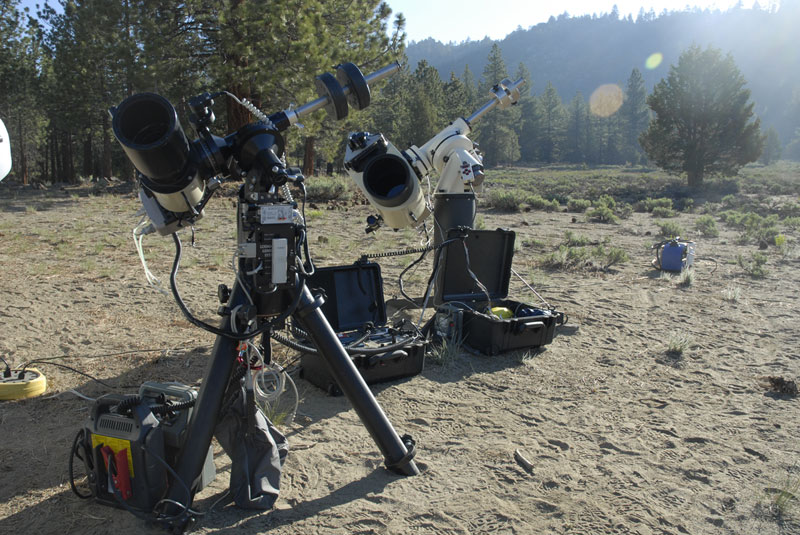
Ok so it’s been about a year and finally I decided to stop McGivering and buy the real gear. So I added a few helpful ADM accessories to my tandem rig and here we are 90 mins before first light - I’ll let you know how it goes.
Happy Thanksgiving!

Happy Thanksgiving!

I have two mounts, three telescopes, two cameras for DSOs and a plethora of planetary scopes. I also habw a couple of dobsonian reflectors for visual.


Dual astrograph from the Film Days circa 1972

Two Astrographs shared mount

Two Astrographs Separate Mounts
3-astrographs shared mount

Two Astrographs shared mount
Two Astrographs Separate Mounts
3-astrographs shared mount

Does anybody has a best practice to share on how to "perfectly" align the spider vanes of two newt ?

RedCat 51 V2
Askar FRA500
Explore Scientific 127 FCD-100
EdgeHD 8”
MAK 180 (for visual)
ZWO asi2600mm
ZWO asi2600mc
ZWO asi294mm
Astrodon LRGBHSO filters
Antlia LRGBHSO pro filters
Heq5 pro mount
Ioptron GEM45G mount
3 ASIAIR pros
Primalucelab Eagle 4S
plus an infinite amount of accessories.
I had to join AA (Astrophotography Anonymous).
Askar FRA500
Explore Scientific 127 FCD-100
EdgeHD 8”
MAK 180 (for visual)
ZWO asi2600mm
ZWO asi2600mc
ZWO asi294mm
Astrodon LRGBHSO filters
Antlia LRGBHSO pro filters
Heq5 pro mount
Ioptron GEM45G mount
3 ASIAIR pros
Primalucelab Eagle 4S
plus an infinite amount of accessories.
I had to join AA (Astrophotography Anonymous).

Up to 4 at a time. 
ASI2600MC Duo compatibility with OTAs
I am wondering if anyone has experience of the 2600MC Duo (the one with the built-in guide sensor). Looking at the ZWO website it shows a 44mm diameter circle to fully enclose the guide sensor. It would probably still work fine with a smaller image c...
Multiple camera setups for maximizing capture time with different optical tubes.
DIY Power using the EGO tool battery
Here is a partial posting from an image posting I posted recently regarding a grab and go imaging rig. The hope is to reach a wider number of potentially interested people. I did search the site and even CN to see if there was anything like this and ...
DIY grab and go imaging rig relevant to multi-camera array setup.
Capturing Galaxies for Noobs
Hi everyone! Im new to astrophotography, and Ive only done planetary imaging up to this point. You can find it all in my profile. However I have a dream. My dream is to capture a galaxy. Speaking of equipment, I use tabletop EQ mount with guiding mot...
Astrophotography imaging techniques applicable to multi-camera capture systems.