Proper backfocus with x0.63 reducer

7 replies380 views
Vitaly avatar
I’ve been struggling quite a bit with dialing in the correct backfocus for the f/6.3 setup using the reducer, aiming to get as close as possible to the theoretical focal length — 1280.16 mm (2032 mm × 0.63). The originally proposed distance of 105 mm was giving me bad star shapes at the outskirts of the images. Collimation was not the issue.

My setup uses an imaging train with an OSC camera + filter. If you're using filters too, don’t forget to factor in the glass thickness in your final measurements. For example, the Optolong L-Pro filter I’m using has a 2mm thickness, so I added 0.7 mm to the backfocus (2 mm ÷ 3).

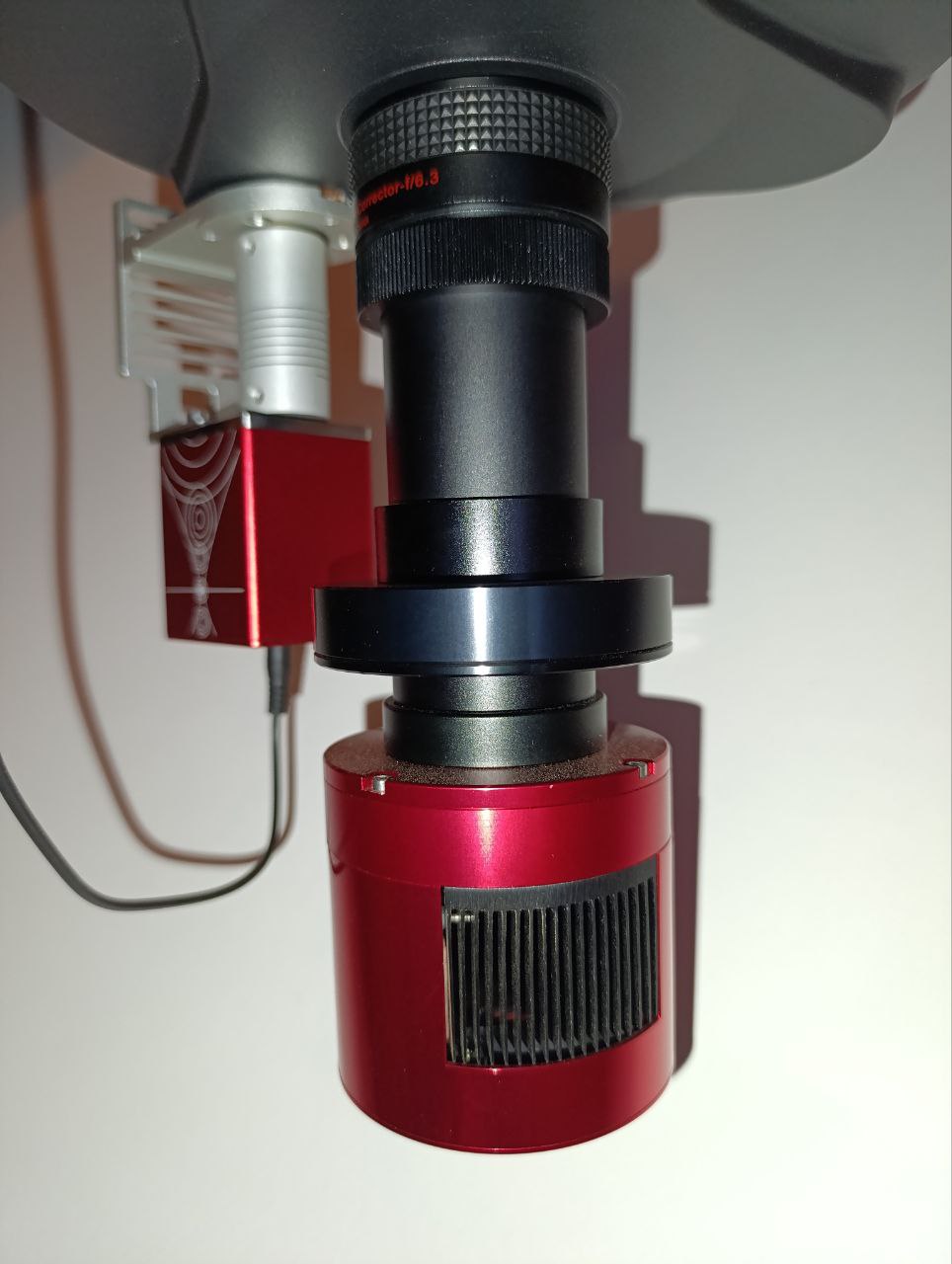
Here’s how I assemble my imaging train for DSO imaging — from scope to camera:
  • 50 mm – Celestron T-Adapter (screwed directly onto the reducer)
  • 16.5 mm – ZWO M48 to T2 adapter
  • 17 mm – Altair Filter Holder
  • 0.7 mm – added distance for filter glass thickness
  • 8 mm – T2 extension ring
  • 11 mm – T2 ring that came with the camera
  • 6.5 mm – camera flange to sensor distance
  • 1.5 mm – spacer ring

That totals 111.2 mm from the reducer glass to the camera sensor.
With this distance, I get a focal length that ranges between 1278 mm and 1283 mm, which is very close to theoretical.

Also, star shapes at the image edges have minimal "tails" with this setup, indicating I’m likely hitting the correct focal plane and achieving the flattest image possible with this reducer.

Hope this helps someone out there struggling with the same thing. Clear skies! ✨
Well Written Helpful Insightful Engaging
jewzaam avatar
Do you happen to have example images at the 105mm and 111.2mm backfocus you can share for comparison?  I have an old orange tube C8 (~1985 based on the SN) and I never could get good star shapes on the edges.  Mostly curious how bad yours might be in comparison.  I didn't spend much effort dialing in the backfocus as I assumed it was a problem with the scope being so old and not well matched for the 0.63x reducer. And that BlurXTerminator is black magic and fixed so much of the problems smile
Engaging
David Stokes avatar
Based on my 5yr experience using a Celestron 0.63 reducer/corrector with standard C8:
1.  sharp stars are achievable near center of FOV, but cropping may be needed to salvage images
2.  star shapes in corners can be improved by shifting focus to 1/3 to 1/2 FoV from center, and also by adjusting BF spacing, per Celestron guidance
3. star shapes can be significantly improved in post processing via BlurXterminator.

Bottom line:  the Celestron corrector is cheap but performs poorly compared to the Starizona FR.

For imaging, the Starizona SCT corrector IV delivers Significantly better star shapes in the corners of APSC sensor for std. C8 than Celestron unit.  I regret the many hours wasted trying to get the Celestron reducer to exceed it's potential.

Clear skies!
Dave Stokes
Helpful Insightful Concise
Gamaholjad avatar
105mm backfocus given by celestron is for 0.7x your using and different reducer. 0.63. So that rules 105 out, if it was me I'd tinker until you get good stars make a note. Good luck such a fun telescope I love mine.
Jesco avatar
105mm backfocus given by celestron is for 0.7x your using and different reducer. 0.63. So that rules 105 out, if it was me I'd tinker until you get good stars make a note. Good luck such a fun telescope I love mine.

The 0.63x reducer also has 105mm backfocus as stated by Celestron. In theory.

in reality, it’s usually a bit more than that. I always used around 110mm.

my recommendation would be to disregard final focal length and only look at star shapes. Pick the backfocus that gives you the nicest stars. It doesn’t really matter if you’re at 1280mm or 1350mm focal length, in the end.

The reducer cannot correct the full field for an APS-C sized sensor. An ASI533, yes, but any larger and I recommend some mild cropping.

its still a good bargain for the price. Especially considering that its original meant for visual.
Helpful Insightful Concise
Vitaly avatar
Do you happen to have example images at the 105mm and 111.2mm backfocus you can share for comparison?  I have an old orange tube C8 (~1985 based on the SN) and I never could get good star shapes on the edges.  Mostly curious how bad yours might be in comparison.  I didn't spend much effort dialing in the backfocus as I assumed it was a problem with the scope being so old and not well matched for the 0.63x reducer. And that BlurXTerminator is black magic and fixed so much of the problems

Sorry I don't have a comparison ready. I will make one next time I have an opportunity. Clear skies!
Well Written Respectful
Himanshu Pandey avatar
Unfortunately distorted stars at the edges are normal when using a reducer on the Celestron SCT telescopes if you are using APS-C or larger sensors.   I have an edge 8" model and when I operate it at F7 I see elongated stars along the edges, and some vignetting in the corners.   

Cropping the images is necessary but I would likely do it anyway to frame the object I wanted.  The elongated stars can cause trouble with autofocus runs and so if you use NINA or something that gives you the same capability you can reduce the crop ratio used for the star detection algorithms to help feed them better data.
Well Written Helpful Insightful Concise
maxchess avatar
I have to agree with David Stokes when he says
“performs poorly compared to the Starizona FR.

For imaging, the Starizona SCT corrector IV delivers Significantly better star shapes in the corners of APSC sensor for std. C8 than Celestron unit.  I regret the many hours wasted trying to get the Celestron reducer to exceed it's potential.”

the Starizona FR is in a different class, stars are sharper and there is more detail in nebulosity.
Related discussions
Esprit 100 & Starizona 0.65 Reducer
Hi, I got a Starizona 0.65 Reducer for my 100 ED. The nominal backfocus distance should be 58 mm. I tested a lot, but I got always elongated stars in the corners, which indicates, the camera (APS-C-IMX571) is too close. I am now at 59.5 mm and still ...
Backfocus tuning problem with reducer on ED scope, highly relevant.
Sep 6, 2023
2600m pro - Backfocus to Skywatcher Esprit 100?
Today I got my 2600mm pro with a 36mm filterwheel. Im not really sure if I have installed it correctly to fit my telescope… I removed the tiltplate and screwed the camera directly to the filterwheel and then used the 16.5mm spacer to screw it o...
Proper backfocus with x0.63 reducer — Directly addresses achieving correct back focus distance with optical components.
Aug 8, 2023
EdgeHD 8's Focal Length 1494 MM, not 1422, dark vignetting in the corners of image
So my ASIAIR Plus is reporting my Celestron EdgeHD 8's Focal Length as 1494 MM, not 1422 mm. I know a little variation is normal, but 1494 mm seems WAY off of 1422, isn't it? I'm also getting vignetting of dark in the corners of image. Th...
Covers backfocus calibration with reducers, directly relevant to setup problem.
Oct 7, 2023
M48 mount replacement
I know the one FLO sell is meant for Canon lenses, however someone has replied on their website that this also works with other brands. Has anyone tried it with a Nikon lens? I'm looking at it but can't find any obvious reasons why it shouldn...
Discusses backfocus distance concerns relevant to adapter compatibility issues.
Oct 1, 2023
Askar FMA180 Pro focusing issues and coma problems
Hello everyone, I am currently building a wide-angle setup, but I am facing serious issues with my Askar FMA180 Pro. Firstly, there is a problem with focusing: I am unable to reach focus at the manufacturer’s specified 55 mm backfocus distance. Inste...
Discusses optical issues with reducer setup; backfocus and collimation relevant.
Feb 21, 2026