Grid Pattern on Masters after Stacking with WBPP

20 replies437 views
Nana Dadzie Ghansah avatar
I have used the Moravian C3-61000 pro for 3 captures so far. If I stack the subs with calibration frames (darks, flats, and darkflats) in PI using WBPP, I get a grid-like pattern on the Ha and Sii masters. The Oiii is fine. If I stack without any calibration frames, the masters are fine.

I did a search and tried some of the remedies I found in the PI forums.
I have tried stacking without calibrating with just darks without flats and just flats without darks. The results are no better. 
Under "Lights" in WBPP, I have unchecked "Linear Defects Correction" and tried different modes for "Pixel Interpolation" under "Image Integration". No help there either.
I have even reshot the darks, flats, and darkflats.

The telescope is an AGO-IDK 10"  and the fliters are 3 nm Chromas.
I used the same filters in a ZWO 6200 before and had no such problems with the masters.

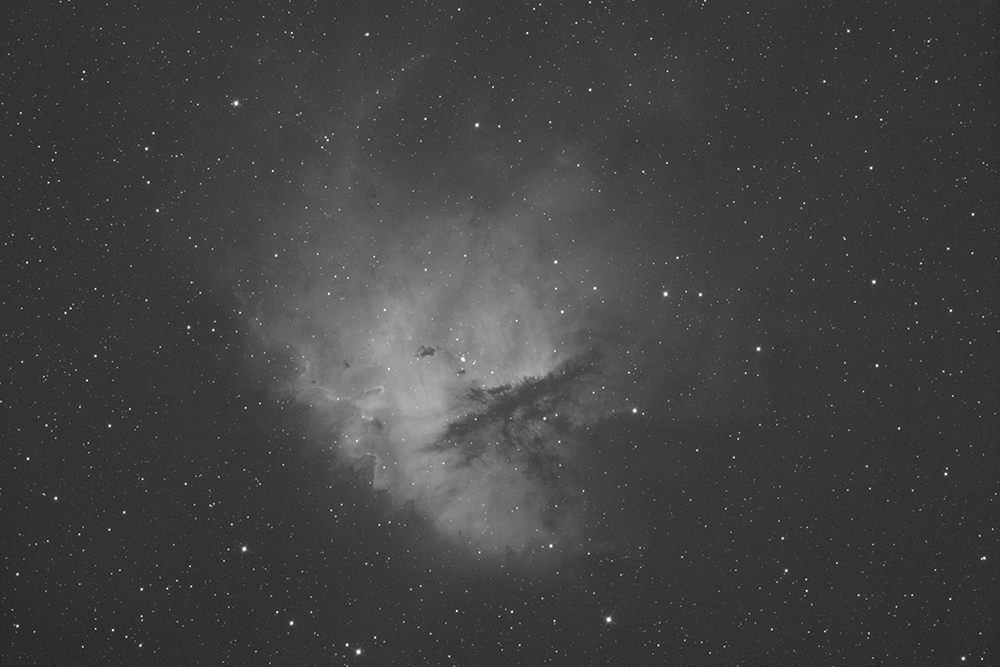
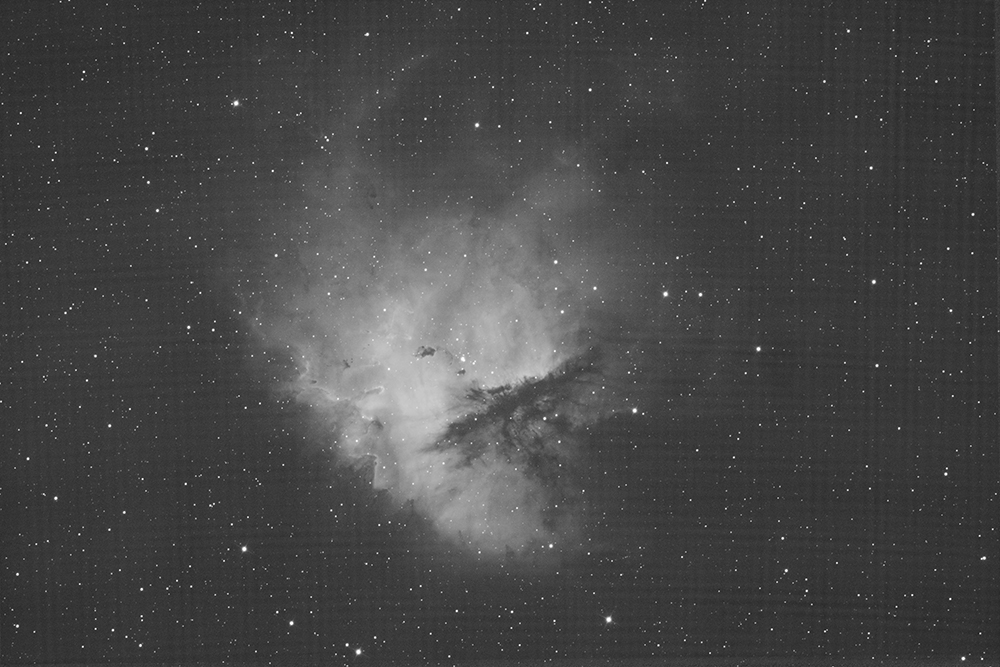
I have added  jpegs of the Ha masters of the Pacman. The one showing the grid was done with caibration frames. The without was done with no calibration frames.
Thanks in anticipation.
Helpful Engaging
Willem Jan Drijfhout avatar
That looks like a very strange pattern. If it's ok without calibration, and with calibration at least one of the filters is fine, it looks like something introduced during processing more than a hardware issue of sorts.
Are you applying an output pedestal? Without it I found that subtracting the darks resulted in quite some 0-values. Never looked at a pattern though. But I now always process with adding a manual pedestal of 200 ADU for the narrowband images.
Alternatively, is this something that could originate from your flats? Have your tried just dark subtraction? How do your flats look like when stretched really far? Exposure of the flats is probably many seconds? Sometimes cameras can behave strangely on flats taken at pretty short exposures (<=1s). But for your narrowband that is probably not true.

Hope you find the source of the issue quickly, as the C3-61000 is a wonderful camera to use.
Helpful
andrea tasselli avatar
Possibly do not use darkflats and do not use WBPP for your calibration. Look at the darkflats and darks master for any similar patterns. Which I'm not sure you get with WBPP.
Nana Dadzie Ghansah avatar
Willem Jan Drijfhout:
That looks like a very strange pattern. If it's ok without calibration, and with calibration at least one of the filters is fine, it looks like something introduced during processing more than a hardware issue of sorts.
Are you applying an output pedestal? Without it I found that subtracting the darks resulted in quite some 0-values. Never looked at a pattern though. But I now always process with adding a manual pedestal of 200 ADU for the narrowband images.
Alternatively, is this something that could originate from your flats? Have your tried just dark subtraction? How do your flats look like when stretched really far? Exposure of the flats is probably many seconds? Sometimes cameras can behave strangely on flats taken at pretty short exposures (<=1s). But for your narrowband that is probably not true.

Hope you find the source of the issue quickly, as the C3-61000 is a wonderful camera to use.

Thanks for the response. It is definitely not a hardware issue because without using the calibrations frames, the final image is fine. I have tried stacking without flats and I still got the grid. I haven't troed adding a manual pedestal yet. Will try that.
Brian Puhl avatar
Bad bias frames likely.  Or in your case dark flats.    Have you verified your gain is correct between the lights and calibration frames?    Modern CMOS doesn't need really need darks however.

My suggestion to you is to shoot bias frames, at least 0.3 seconds long.     Calibrate those with your flats and be done.   Chances are it will fix.   Any hot pixels that are present due to the lack of darks will easily get rejected out after a couple dithers.

If not, try turning off any extended fullwell mode you may have on.   I've had issues calibrating after turning it on before.  I don't remember what it's specifically called on the Moravian cameras.
Helpful
GalacticRAVE avatar
Such feature can be caused by the interpolation of image registration. I that’s the case, you could play with the interpolation algorithm in star align or alternatively drizzle with 1x. CS Matthias
Nana Dadzie Ghansah avatar
Brian Puhl:
Bad bias frames likely.  Or in your case dark flats.    Have you verified your gain is correct between the lights and calibration frames?    Modern CMOS doesn't need really need darks however.

My suggestion to you is to shoot bias frames, at least 0.3 seconds long.     Calibrate those with your flats and be done.   Chances are it will fix.   Any hot pixels that are present due to the lack of darks will easily get rejected out after a couple dithers.

If not, try turning off any extended fullwell mode you may have on.   I've had issues calibrating after turning it on before.  I don't remember what it's specifically called on the Moravian cameras.

That was my initial thought too but when I calibrate with just dark frames, I get that too.
Tony Gondola avatar
Not sure this is possible but it almost looks like a weave pattern in a t-shirt of cloth. Do you see the pattern in your flats?
Nana Dadzie Ghansah avatar
Tony Gondola:
Not sure this is possible but it almost looks like a weave pattern in a t-shirt of cloth. Do you see the pattern in your flats?

I used a flat panel, and the pattern is not visible in the flats.
Well Written
Jerry Yesavage avatar
Hummmm, I have the ASI-6200 and if you push the stretch you get something like this but with a bigger grid.
Tony Gondola avatar
What's weird to me is that the grid pattern is curved. I'm not sure how I could do that if I wanted to.
Well Written Engaging
Ken Kattner avatar
This is a long shot but be sure your Moravian firmware is up to date. I had some funny bias frames from my C3 before I updated.
Nana Dadzie Ghansah avatar
Ken Kattner:
This is a long shot but be sure your Moravian firmware is up to date. I had some funny bias frames from my C3 before I updated.

Will do!
Tom Boyd avatar
While I know this shouldn't be relevant, that pattern looks a lot like what I see when I stretch my raw, non-deBayered, subs from my OSC camera.
Well Written Insightful Respectful Concise
Brian Puhl avatar
Brian Puhl:
Bad bias frames likely.  Or in your case dark flats.    Have you verified your gain is correct between the lights and calibration frames?    Modern CMOS doesn't need really need darks however.

My suggestion to you is to shoot bias frames, at least 0.3 seconds long.     Calibrate those with your flats and be done.   Chances are it will fix.   Any hot pixels that are present due to the lack of darks will easily get rejected out after a couple dithers.

If not, try turning off any extended fullwell mode you may have on.   I've had issues calibrating after turning it on before.  I don't remember what it's specifically called on the Moravian cameras.

That was my initial thought too but when I calibrate with just dark frames, I get that too.


Run the statistics process in pixinsight and make sure you don't have any zero values.   I suspect you do though.    Other possibility could be a difference in gain. 

I didn't see this issue in my QHY camera until I tried running 2CMS and it was almost exactly like what you see.  I never could get it to calibrate so I just went without 2CMS
Concise
Jan Erik Vallestad avatar
I've seen this once as well and the culprit was the flat frames. I had just got a new set of filters and while in a hurry I decided to take shorter exposures which gave me the grid pattern. At first I thought it might be something wrong but re-taking them at my usual exposure length fixed it for me.
Helpful
Vidur Parkash avatar
This is an issue with your pedestal setting in WBPP
Nana Dadzie Ghansah avatar
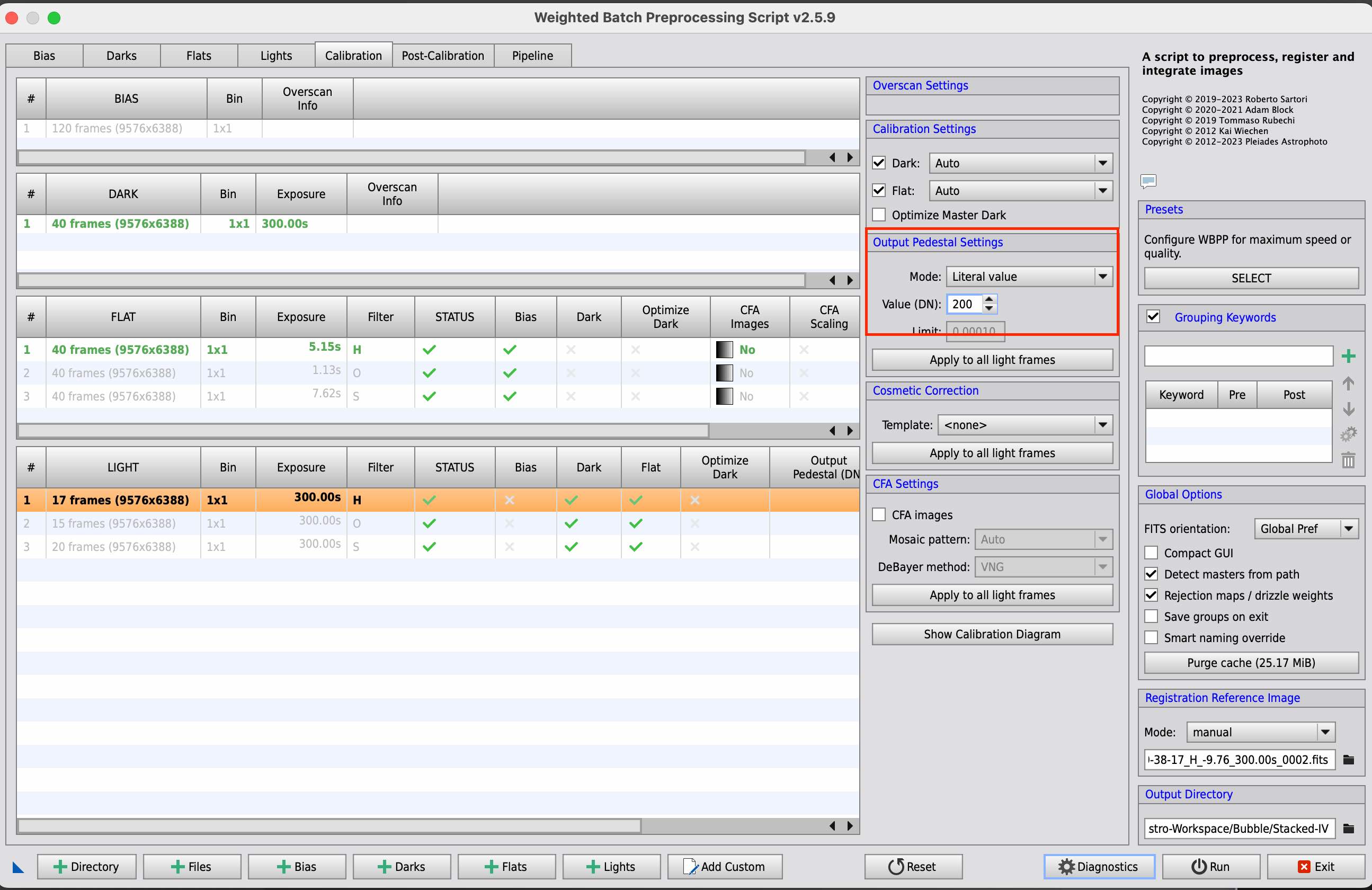
The only thing I had not tried was manually adding in a higher value in the "Output Pedestal Setting".  ON CN, a member suggested I do that  and so I did and it worked. I added 200 ADU as shown in the attached image. I did it for all three filters.

This was his suggestion:

"Very dark skies? it's possible you just need a pedestal. WBPP tries to automatically calculate one but it might be too low. maybe try setting it to 100ADU manually and see what happens. The cause is that the background levels are so dark, the background of your light frame is basically a dark frame. because of that it's very likely that you get negative valued pixels after dark subtraction. these negative values are clamped to 0. so now you have a bunch of zero valued pixels in your subs, and when they are registered and integrated together, you get a moire pattern."

I don't have dark skies. I image under Bortle 6-7 skies so I was reticent to try it but it worked.
Thanks for all the suggestions.

Helpful
Nana Dadzie Ghansah avatar
Vidur Parkash:
This is an issue with your pedestal setting in WBPP

Yes, it was!
Willem Jan Drijfhout avatar
Glad it worked! As for the required value, after testing I found that at 200 there are no zero values left. 100 takes out most already, but 200 is indeed the safer bet.
Well Written
Nana Dadzie Ghansah avatar
Willem Jan Drijfhout:
Glad it worked! As for the required value, after testing I found that at 200 there are no zero values left. 100 takes out most already, but 200 is indeed the safer bet.

I tried it again this morning with 100. Worked too.
Related discussions
WBPP Stacking Failed
Hi guys. I have been using Deepskystacker to stack my images,but I used PixInsight last night to stack my images. I had my 3 nights put in different groups with their specific darks,bias and dark flats. I used the image grouping 'NIGHT' which...
Similar stacking issues with calibration frames in PixInsight WBPP.
Jun 9, 2023
WBPP Script seems to have gone off the rails
An interesting problem recently developed during my latest post-processing of the Medusa nebula. My standard process for processing images is to use the WBPP script in PixInsight, as it has really been improved over the years and automates the post-p...
Grid pattern issues with WBPP stacking and calibration frames directly relevant.
Apr 4, 2023
Issues with Flats DSS and APP
I have two sets Oxygen III data for the Squid Nebula. One is 8 hours of data and the one below is 12 hours. The data with 8 hours calibrates well. I only have been taking flats and darks. I have tried calibrating and stacking the data below in both A...
Grid patterns after stacking suggest calibration frame issues similar to yours.
Jan 15, 2023
PixInsight WBPP - dust motes/donut still not cleaned with flats
Hello, I am still seeing dust motes/donut shaped spots even after calibrating with flats. I tried few exposures with flats but no improvement. I use dark, bias and flat calibration frames and default wbpp settings. from the attached screenshot, you c...
Grid pattern similar to dust mote artifacts; flats calibration troubleshooting relevant.
Sep 30, 2025
Flats adding to images instead of subtracting in PixInsight WBPP
Astro Friends, I have been imaging for about 5 years and have been successful using refractors and mono imaging. I have branched out this year and now have an SCT and mono setup. I am seeking help with my flats which seem to add themselves to my imag...
Flat frame calibration issues in WBPP directly related to author's problem.
Jan 2, 2026